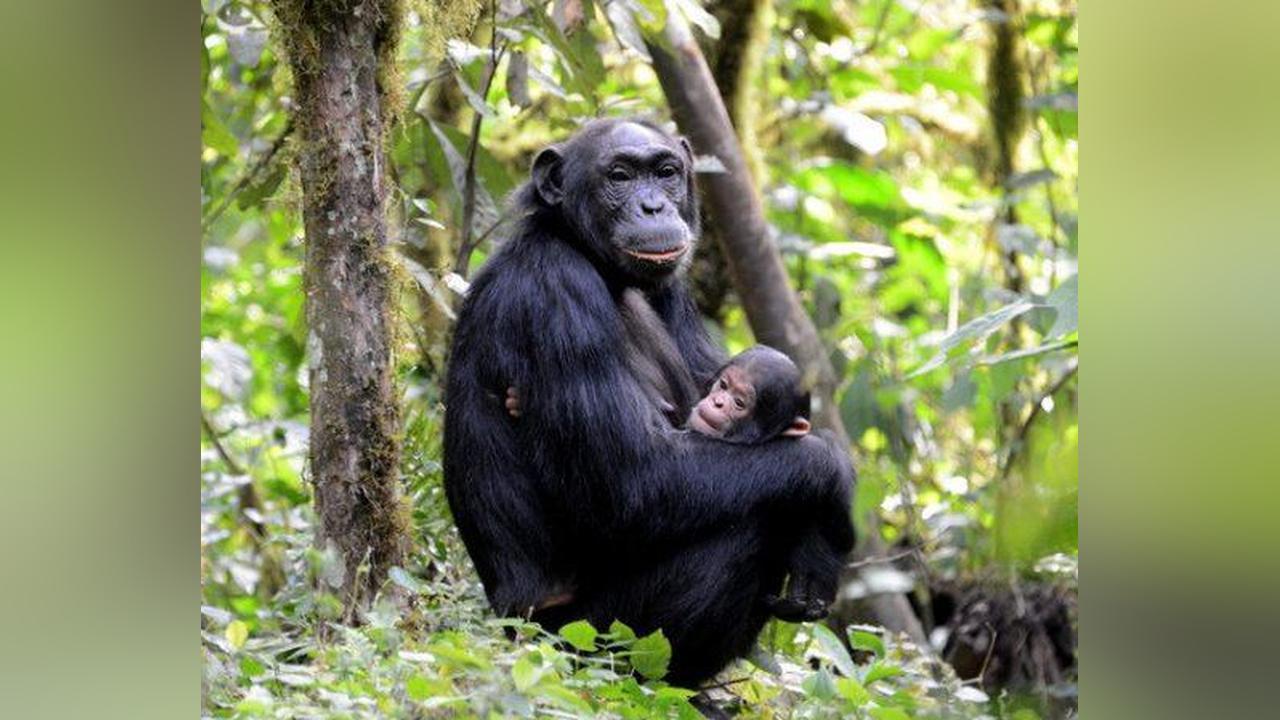
Africa-Press – Uganda. A groundbreaking chimpanzee census has confirmed the presence of at least 426 chimpanzees in Bwindi Impenetrable National Park, marking the first scientifically validated population count of the species in the Unesco World Heritage Site long known primarily for its mountain gorillas.
The findings, unveiled at the official launch of the Bwindi chimpanzee census report, are being hailed as a major milestone in Uganda’s conservation history.
Conservation leaders say the results expand the park’s global significance beyond gorilla tourism and reinforce the need for ecosystem-wide protection.
The study was led by the Jane Goodall Institute in partnership with the Uganda Wildlife Authority (UWA), alongside government officials, conservation researchers and international partners.
For decades, scientists suspected chimpanzees lived in Bwindi, but their numbers remained speculative.
Dr James Byamukama of the Jane Goodall Institute Uganda said the census was initiated to close a long-standing knowledge gap.
“This census was demand-driven. For years, we only had estimates, but no scientifically validated data,” he said.
“The findings now establish a clear baseline that will guide future conservation planning and monitoring.”
The study aligns with Uganda’s national chimpanzee conservation strategy and provides critical data needed to manage threats such as disease transmission, habitat pressure and climate change impacts.
Conducting a wildlife census in Bwindi — one of Africa’s most biologically dense and rugged forests — presented major logistical challenges.
Researchers used standardized line transect methods, dividing the park into multiple survey lines across steep and heavily forested terrain. Instead of counting chimpanzees directly, scientists relied on nest counts, a globally accepted method in primate research.
Lead researcher Michael Jurua explained that, on average, one chimpanzee builds one nest per night. By factoring in nest production and decay rates, researchers can scientifically model population density.
“We applied conservative analytical models to avoid overestimating the population,” he said.
The results indicate a population density of approximately 1.33 chimpanzees per square kilometre, with the highest concentrations recorded in the northern sections of the park, an area researchers often refer to as the “neck of Bwindi.”
One of the most significant discoveries was evidence of habitat overlap between chimpanzees and mountain gorillas — two of the world’s most iconic great apes.
Field teams documented multiple instances where chimpanzee and gorilla nesting areas were found in close proximity, sometimes within the same locality.
The finding suggests Bwindi may be one of the few ecosystems globally where multiple great ape species coexist within a single protected landscape.
Scientists say the overlap opens new avenues for ecological research, including studies on interspecies coexistence, disease dynamics and climate resilience in tropical forests.
UWA Executive Director James Musinguzi described the census as a turning point for conservation planning.
“For the first time, clear and scientifically robust evidence has been provided about the presence and distribution of chimpanzees in Bwindi,” he said.
“This data strengthens our ability to plan, protect and manage the park using evidence-based approaches.”
Musinguzi noted that surveys detected minimal signs of human disturbance across large sections of the forest, an encouraging indicator of effective long-term protection.
“The limited detection of human activity across transects suggests that large sections of the park remain intact and capable of supporting viable chimpanzee populations,” he said.
For years, Bwindi has been globally marketed primarily as a gorilla tracking destination. Conservation leaders now believe the new findings could support tourism diversification.
“This opens opportunities for tourism diversification, particularly in northern Bwindi,” Musinguzi said. “It also creates space for sustainable tourism models that can directly benefit surrounding communities.”
Potential diversification options include regulated chimpanzee tracking experiences, expanded research tourism and conservation-based travel products, which could help spread tourism benefits more evenly across the region and reduce over-reliance on gorilla tourism.
Speakers at the launch emphasized that conservation success in Bwindi is closely tied to community engagement.
Musinguzi stressed that future strategies must place people living near the park at the centre of conservation planning.
“The work we do in conserving wildlife puts communities at the center,” he said. “This is an opportunity to empower local populations through sustainable tourism and conservation-linked livelihoods.”
Community-focused initiatives are expected to include alternative income programmes, conservation education and strengthened benefit-sharing mechanisms.
Minister of State for Tourism Martin Mugarra said the census strengthens Uganda’s conservation credentials on the global stage.
“The findings strengthen our understanding of Bwindi as a critical habitat for great apes,” he said. “They provide the evidence needed to guide sound conservation decisions and strengthen Uganda’s role in regional biodiversity protection.”
He added that government would continue supporting research partnerships and science-led conservation initiatives to safeguard Uganda’s natural heritage.
Beyond confirming chimpanzee numbers, conservationists say the census lays the foundation for long-term ecological monitoring.
The data will inform future park management plans, including structured chimpanzee monitoring cycles, strengthened disease prevention protocols between humans and primates, habitat protection strategies and climate-linked biodiversity commitments.
Researchers have recommended repeat censuses every five to seven years to track population trends and respond to emerging threats.
The findings represent a shift in how Bwindi is understood — not only as a sanctuary for mountain gorillas, but as a complex great ape ecosystem of global significance.
As global pressure intensifies to protect biodiversity hotspots, Bwindi’s newly documented chimpanzee population adds both urgency and opportunity to conservation efforts in one of Africa’s most iconic forests.
With science now offering a clearer picture of life beneath the forest canopy, conservationists say the priority is ensuring that chimpanzees, gorillas and the communities surrounding them continue to thrive together for generations to come.