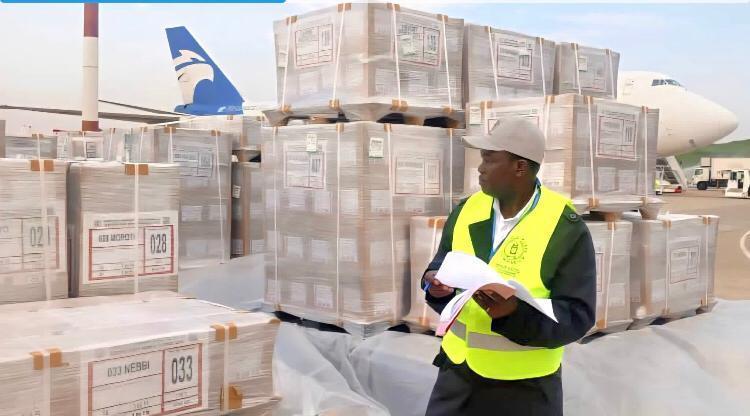
Africa-Press – Uganda. The Electoral Commission (EC) has received another major consignment of ballot papers at Entebbe International Airport, marking a critical milestone in Uganda’s preparations for the forthcoming general elections.
The latest delivery, which arrived on Sunday morning, comprises ballot papers for District and City Chairpersons as well as District Women Councillors.
The consignment is part of a phased importation process adopted by the Commission to ensure efficiency, transparency, and security in the handling of sensitive electoral materials.
With this latest shipment, the EC says the bulk of externally printed ballot papers required for the electoral process are now safely in the country, as the countdown to polling day gathers momentum.
This delivery follows two earlier consignments that arrived in late December 2025. The first, consisting of presidential ballot papers for more than 21.6 million registered voters, landed on December 24, Christmas Eve, and was formally received on December 25.
The reception exercise was conducted under tight supervision, led by EC Chairperson Justice Simon Mugenyi Byabakama, alongside senior commissioners, representatives of political parties, security officials, and election observers.
Later on the same day, December 25, a second batch containing ballot papers for Directly Elected Members of Parliament was delivered at Entebbe.
By December 29, the Commission had commenced the packing of presidential ballot papers at its warehouses, a process that again involved political party agents and other stakeholders, in line with the EC’s commitment to openness and accountability.
Speaking at Entebbe International Airport after receiving the latest consignment, EC spokesperson Julius Musinguzi said the Commission remains firmly on schedule to complete the receipt of all ballot papers printed outside the country.
“Today, January 4, 2026, the Commission received ballot papers for district and city chairpersons and district women councillors,” Musinguzi said.
“Ballot papers for district women councillors have arrived in full, while about 90 percent of those for district and city chairpersons have been delivered.”
Uganda currently has 146 districts and cities, each requiring ballot papers tailored to the specific number of registered voters in that administrative unit. According to the EC, this necessitates careful planning in printing, packaging, and distribution to ensure that every polling station receives the correct quantities.
“In total, we received 247 pallets—144 pallets for district and city chairpersons and 103 pallets for district women councillors,” Musinguzi explained. “These materials have been safely offloaded and will now be packed according to their respective destinations before dispatch.”
The phased approach to importing ballot papers, the Commission says, is designed to reduce logistical risks associated with transporting large volumes of sensitive materials at once, while also allowing for closer monitoring at each stage of the process. Each consignment is received, verified, and documented in the presence of key stakeholders to reinforce public confidence in the integrity of the electoral process.
Musinguzi reiterated that the Commission’s core legal mandate is to ensure that all election materials are delivered to polling stations in time for voting to begin as scheduled on polling day.
“Our duty under the law is to ensure that by polling day, all materials are at polling stations so that voting starts on time,” he said. “That process is ongoing, and we remain on schedule.”
Once packing is completed at EC warehouses, the ballot papers will be dispatched countrywide under secure arrangements, alongside other polling materials.
The Commission has repeatedly assured Ugandans that it is committed to conducting a credible, transparent, and timely electoral process, with logistics remaining one of its top priorities as election day approaches.
For More News And Analysis About Uganda Follow Africa-Press