Africa-Press – Uganda. Since March last year when the country confirmed its first Covid-19 case, scientists have emphasised the importance of testing in determining infections and designing measures to prevent its spread.
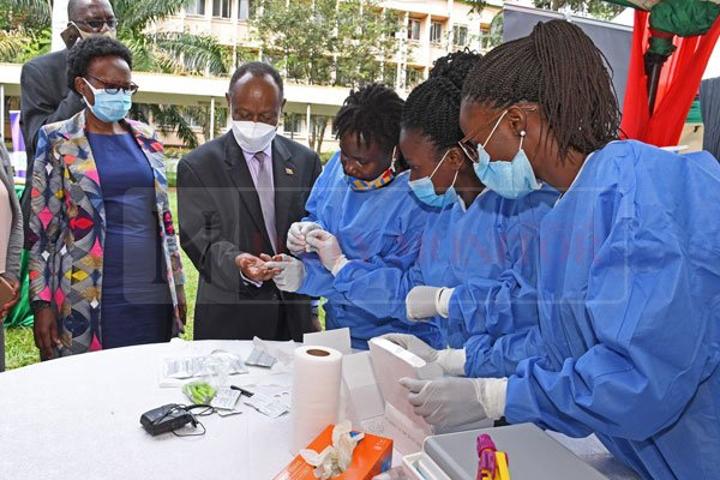
Dr Misaki Wayengera, the head of the ministerial scientific advisory committee on Covid-19, said government is planning to do mass testing to enable people know their status and take precaution.
Speaking to Daily Monitor yesterday, Dr Wayengera said mass testing is important but must be availed with other information such as how to self-isolate given that government does not have the capacity to isolate every positive case.
“We have to do it whether we can afford it or not. We have RDTs (Rapid Diagnostic Tests) that are a little bit cheaper so we will massively deploy,” Dr Wayengera said.
Although RDTs are said to be less sensitive than PCR (Polymerase Chain reaction), Dr Wayengera said: “Since we are a poor country, we have to go with what is affordable and available to us. Government has already committed to this.”
Costs
Currently, an RDT costs between $7 (Shs25,000) and $8 (Shs28,000). How, with government mass testing, the exercise will be free of charge.
Dr Monica Musenero, the Minister for Science, Technology and Innovation, also a senior presidential adviser on epidemics, said mass testing is quite challenging in terms of the logistics involved.
“It would actually be ideal. Theoretically, it works but practically difficult…Do you have the [required] test kits, human resource, isolation facilities,” Dr Musenero wondered.
She added that some countries have done mass testing which helps in bringing down cases after determining cases and isolating and treating. However other factors such as limited testing kits, among others might not make mass testing possible.
“They (China) did house-to-house taking the positive people to isolation then quarantine those homes where the positive cases are.
What that does is you know the virus circulation,”Dr Musenero added.
Currently, Uganda is experiencing wide community spread. More than 1.2million samples have been tested have been conducted since March 22 when Uganda confirmed its first case.
Of these, at least 73,401 are positive cases and 50,085 people recovered. Uganda has lost at least 714 people to the pandemic which has seen the country go into another lockdown.
Prof Pontiano Kaleebu the director Uganda Virus Research Institute (UVRI) said mass testing is very expensive.“It will help if you knew who was affected you isolate for management but it’s very expensive nobody can afford it. For example,
Imagine how much people are charged when they go to private laboratories for testing?” Prof Kaleebu.According to UVRI, though rapid tests are cheaper and fit for mass testing, they are not as sensitive as PCR tests and thus some cases can be easily missed.
Some experts say mass testing does not only help in knowing virus circulation, but also in understanding its mutation in the long run after sequencing, which can go a long way in contributing to understanding the epidemiological curve. Dr Susan Nabadda, the commissioner laboratory and diagnostic services at Ministry of Health, said the testing rates keep changing but at least government spends $50 on one person and this amount includes activities like sample collection, personal protective equipment.
Dr Mukuzi Muhereza, the general secretary Uganda Medical Association (UMA), said carrying out mass testing with wide community spread is expensive .
“Whether it helps yes, whether its feasible now, I don’t think so, I would say no. So other than being academic and knowing you have this per cent, I don’t think it adds anything,” Dr Muhereza said.However, Dr Muhereza added that its better at this stage to do purposive sampling rather than mass testing.
Background
The country has been registering at least 1,000 cases per day. The cases have increased as per Ministry of Health officials and cases might escalate further.
Some of the cases are in communities undetected, which has fuelled transmission. The country is under lockdown as one of the measures to curb further community transmission.
Experts disagree over mass testing