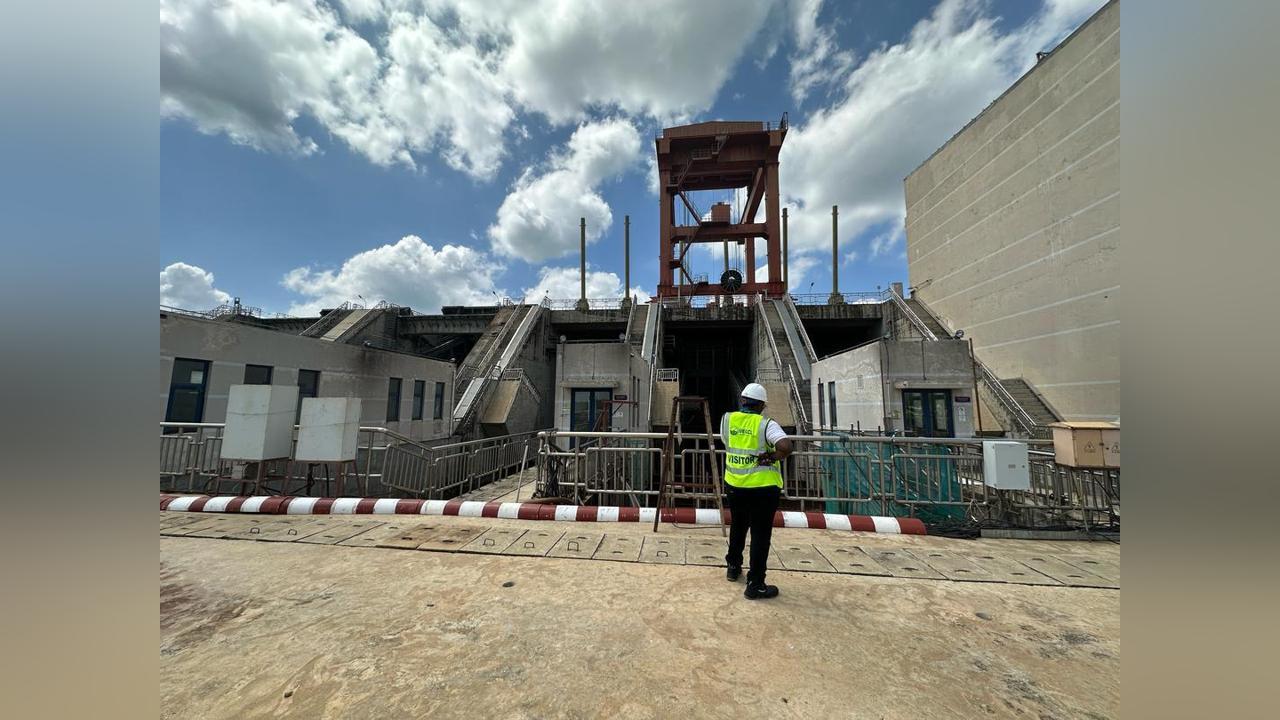
Africa-Press – Uganda. The Uganda Electricity Generation Company Limited (UEGCL) has raised serious concerns about the structural integrity of the Isimba Hydropower Plant, warning that unresolved defects could lead to catastrophic dam failure and endanger thousands of lives downstream.
During a site inspection on Friday, UEGCL Chief Executive Officer Eng. Harrison Mutikanga revealed that inspections conducted in September and December 2024 identified severe erosion of the dam’s spillway concrete and cracks in the joint seals.
“These issues pose a significant risk to the dam’s integrity,” said Mutikanga.
“They could trigger what engineers call ‘hydraulic jacking’, where water pressure lifts and displaces concrete slabs, potentially compromising the dam’s foundation,”he said.
He added, “If that happens, backward erosion could extend to the dam’s base, culminating in failure. A dam failure would be disastrous for downstream communities and critical activities reliant on the river.”
Commissioned in 2019, the 183MW Isimba Hydropower Plant was a flagship project under Uganda’s energy expansion program.
However, the emergence of structural defects just five years after its launch has raised serious questions about construction quality and project supervision.
Emergency underwater repairs were previously conducted to address earlier faults, but Mutikanga warned these were temporary and have since failed.
“We have told the contractor clearly permanent repairs are needed. Long-term solutions may even require constructing a new spillway,” he stated.
When asked about the severity of the situation, Mutikanga was blunt: “Yes, it is a disaster in waiting. When it rains heavily, I cannot sleep.
A defective spillway cannot handle the design flood capacity.”
Mutikanga criticized the contractor’s slow response. Despite acknowledging the problems in their December 2024 report, the contractor has yet to implement effective repairs.
“They admit there’s a problem,” he said. “The issue is their slow pace and questionable methodology.”
Under the Engineering, Procurement, and Construction (EPC) contract, the contractor had a two-year defects liability period to fix post-completion faults, which was later extended by another two years. However, the defects remain unresolved.
“Defects in major infrastructure aren’t unusual,” Mutikanga noted. “What’s concerning is the inability to fix them within the contractual timeframe.”
When asked about financial safeguards, Mutikanga deferred to the Ministry of Energy, which holds the EPC contract and oversees performance guarantees.
“We are contract administrators. If needed, the contract allows for termination. All options are on the table,”he said.
Despite these technical setbacks, UEGCL maintains that the plant is currently performing well in terms of electricity generation and revenue.
“We are generating steady revenue and servicing our Exim Bank of China loan,” said Mutikanga.
“If the technical issues are resolved, this plant would be a solid asset.”
However, he cautioned that dam failure would not only risk lives but also halt power production, resulting in major economic losses.
Concerns have also been raised about the project’s owner’s engineer a consultant hired to supervise construction who reportedly left the country under unclear circumstances.
The firm, believed to be based in India, allegedly failed in its oversight role.
“Yes, the owner’s engineer left. That’s part of the project’s history,” said Mutikanga. “Our focus now is on resolving the defects.”
Herbert Kato, Senior Energy Officer at the Ministry of Energy and Mineral Development, disclosed that the government has withheld around $65 million in contractor guarantees due to unresolved structural issues.
He confirmed that while the plant continues to generate power, major defects especially at the spillway pose long-term risks.
“During the defects liability period, we noted several serious faults,” Kato said.
“We have not issued the final completion certificate because the plant isn’t yet fit for its intended purpose.”
Guarantees currently withheld include a $16 million retention guarantee, a $39 million performance guarantee, and additional advance payment guarantees.
Kato explained that these funds are meant to compel the contractor to fulfill its obligations.
“The government’s goal isn’t to withhold funds, but to ensure the dam reaches its design life and can withstand future emergencies.”
The plant was constructed under an EPC contract and expected to be delivered as a fully functional system.
However, cracks and erosion have raised concerns about the dam’s durability, especially during heavy rains that could stress its structure.
“The dam is functional, yes,” Kato said. “But for long-term resilience and emergency design performance, we have concerns.”
He added that partial shutdowns may be necessary for repairs, though a total shutdown is not expected.
“The plant has four generating units. We can isolate and work on individual units without stopping power generation.”
The government has recently intensified pressure on the contractor, working with UEGCL and a newly appointed owner’s engineer who replaced the previous supervisor.
“The new owner’s engineer has done commendable work,” said Kato. “It was on their advice that defective spillway works were rejected potentially averting a greater crisis.”
Inspections by government agencies, including the Inspector General of Government (IGG) and Members of Parliament, have further emphasized the urgency.
Experts warn that spillway failure could severely impact energy security and devastate communities downstream.
Kato reiterated the Ministry’s commitment to salvaging the project within existing legal frameworks. “We’re working with all stakeholders to compel the contractor to deliver as agreed.”
He emphasized that the government will enforce contract terms without additional taxpayer burdens.
Insurance policies for the dam also remain active, as final project acceptance has not yet occurred.
“The guarantees and insurance are still valid,” he said. “This approach allows us to hold the contractor accountable.”
The Isimba plant, located about 50 kilometers downstream of Lake Victoria in Kayunga District, was funded primarily by a $570 million loan from China’s Exim Bank. It plays a critical role in Uganda’s Vision 2040 strategy, aiming to expand electricity access for industrial and domestic use.
Although electricity generation continues uninterrupted, experts and engineers stress the need for urgent and lasting repairs to secure the dam’s future.
The warnings from UEGCL follow the remarks by IGG Beti Kamya, who raised similar concerns during an inspection.
Kamya remarked that the plant appeared older than its five-year lifespan, comparing its condition to infrastructure from the 1950s.
She pledged to release a detailed report within three weeks.
For More News And Analysis About Uganda Follow Africa-Press