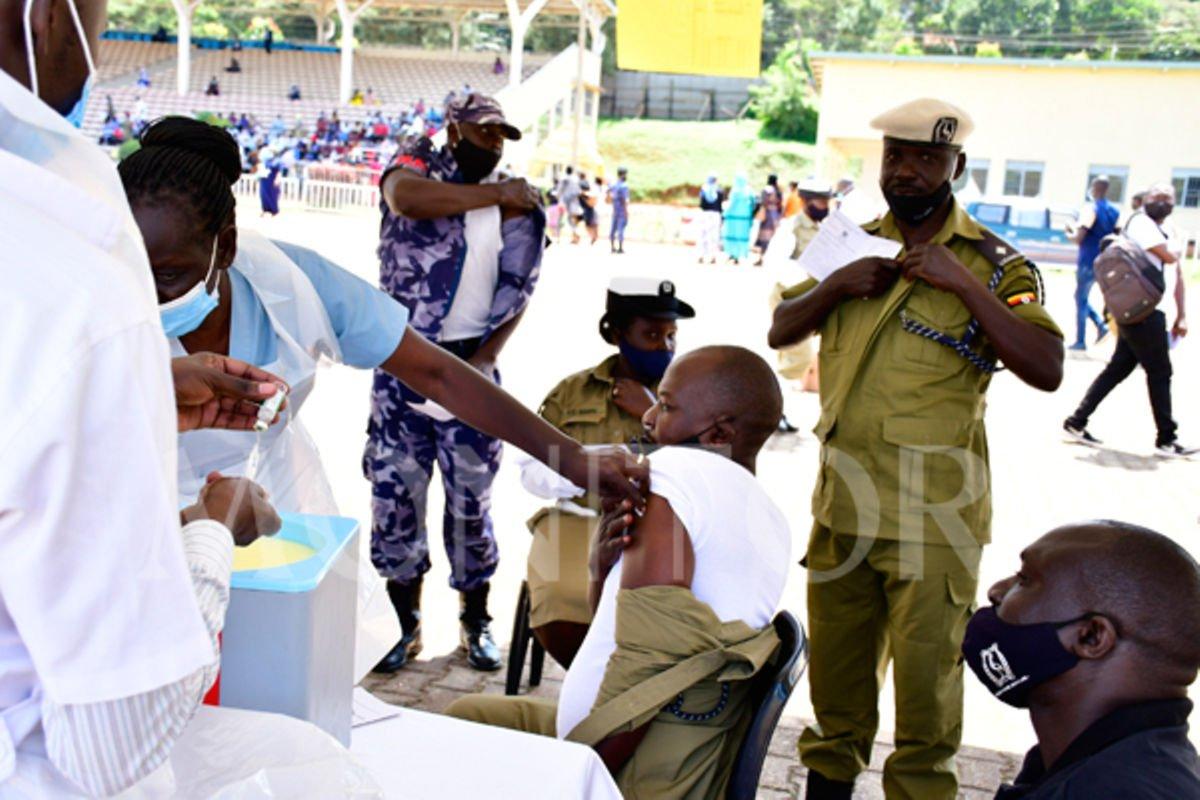
Africa-Press – Uganda. The government has confirmed plans to block the unvaccinated from accessing places of worship, schools, markets, hotels, restaurants, bars and all public offices when the economy reopens fully next month.
Dr Chris Baryomunsi, the ICT minister, yesterday confirmed that Cabinet has approved the proposal to block the unvaccinated from accessing public services and places.
“We [Cabinet] approved a recommendation from the Ministry of Health to extend the vaccination mandate to different categories of workers. A vaccine mandate means if you are not vaccinated, businesses, schools or workspaces and others can legally stop you from using their building or accessing their services if they choose to,” he said.
“This means that we (government) shall not compel Ugandans to get vaccinated. Getting vaccinated is voluntary but workplaces, business premises, organisers of events have rights legally to stop you from accessing those areas if you have not been vaccinated,” he said.
Ministry of Health officials yesterday told Daily Monitor that the move is intended to give Ugandans a fighting chance in the face of Omicron variant that is ripping through nations. Uganda has so far registered 25 cases of the new variant.
The Ministry of Health is now recommending that unvaccinated Cabinet members, MPs, health workers, security officers and social workers should be the first to be restricted from work because they are leaders that should be exemplary and the majority were prioritised in the vaccination that started in March.
Operators of public transport (including hotels, restaurants, bars, and food delivery), and staff within the hospitality sector, also fall in the category of those who should be the first to be restricted, according to the official document from the ministry that Daily Monitor saw yesterday.
The revelation comes at a time when the government is racing to avert a third wave of the pandemic following a drastic rise in Covid-19 cases and a notable widespread violation of preventive measures in the population.
Dr Jane Ruth Aceng, the Health minister, is today expected to address the threat of Omicron variant and the rising infections when she updates the country. The minister is expected to mention the vaccination mandate without providing the details since the President will officially announce the new Covid measures before the New Year.
Ms Anifa Kawooya, the State minister for Health-in-charge of General Duties, told Daily Monitor yesterday that self-restriction and the vaccine mandate are major ways government plans to use to safeguard the population after full reopening of the economy. She explained that the country has enough vaccines.
“We are emphasising more of restrictions; self-restriction. This means that if you want to go to the church, ensure that you are vaccinated. Why do you want to endanger other people or yourself by refusing to take the vaccine?” the minister wondered.
She added: “In other places, we are ensuring a Covid mandate in that if you want to access an office, you should be vaccinated and if you want to occupy an office, you should be vaccinated.”
National Medical Stores, Ministry of Health headquarters, National Drug Authority, Finance ministry, different embassies in Kampala and Parliament a few months ago announced that all their staff should show proof of Covid-19 vaccination to access premises or secure their jobs.
The position was largely criticised and challenged on a legal basis, making some of the administrators such as those from Parliament to abandon the plan, but other agencies have been implementing it. The government has also vowed to implement the vaccination mandate on teachers, non-teaching staff and learners who are 18 years and above as schools reopen next month. But the government is allowing those who are partially vaccinated with the first dose as they wait for the second dose.
Ms Kawooya revealed that they are calling upon people who work in public places to ensure they are vaccinated and ensure that those who are coming to interact with them are also jabbed.
Since the vaccination exercise began in March, at least 8.3 million Ugandans have been inoculated with the first dose, meaning their immunity against Covid-19 is less effective. However, under the proposed Covid-19 rules, people who have received the first dose will be given access to restricted areas.
Only 1.4 million are fully vaccinated of the overall 22 million people the government is racing to inoculate so as to contain the pandemic effectively.
This means only 9.7 million people are so far vaccinated in the country even after the government acquired 30 million doses of vaccines.
But some vaccine recipients this paper interviewed yesterday and were due for the second dose of AstraZeneca said they were struggling to access the life-saving jab.
Ministry efforts
Ms Margaret Muhanga, the State minister for Primary Healthcare, said early this week that 19 million of the 30 million doses were dispatched to various districts. This means only about 11 million doses are remaining, which can only cater for around 5.5 million Ugandans when given two doses but there are 13million Ugandans who are unvaccinated.
Ms Muhanga expressed displeasure over low uptake of the vaccine among the elderly who are at higher risk of severe illness and death after infection.
The majority of Covid-19 deaths in the country have been among the elderly, according to information from the ministry. The country is currently experiencing a surge in Covid-19 cases and some experts fear the hospitals may become overwhelmed as it happened at the peak of second wave of the pandemic mid this year.
“By the time we reach Christmas when you all take off your masks, you meet your family members, take pictures with the older people, kindly help us get them vaccinated first before you get to the village,” Ms Muhanga said.
Available statistics from the ministry as of December 8 show that only 690,000 of the targeted 3.3 million people who are 50 years and above had been inoculated with at least the first dose since March despite being prioritised.
This sharply contrasts with the 144,947 health workers of the targeted 150,000 who have received at least their first dose.
Ms Kawooya, however, told this newspaper yesterday that they are now employing new tactics of taking vaccines to communities as opposed to inoculating people at static sites such as hospitals that limits access to the elderly who may not have transport to reach the centres.
Vaccine hesitancy
But some experts say there is high level of vaccine hesitancy among the elderly. One of the elders in Lira District, without justification, told our reporter in October that she was told by some people the vaccines are meant to wipe out old people.
Ms Kawooya said the vaccine mandate will promote self-responsibility and increase vaccine uptake.
“If you want to go to a bar, why would you be vaccinated and the person who is serving you is not vaccinated? We are emphasising more restrictions to ensure that we control transmission,” she said.
“Why would you want to be vaccinated and the person in your family is not vaccinated? You are not doing anything. You are safe when the person near you is also safe. And Covid is here and there is a new variant that has come in,” she stated.
Dr Henry Kajumbula, the head of infection control and prevention at the government scientific advisory committee, told this newspaper that “for Covid-19 vaccine, there may be some protection against infection but the primary reason is to prevent severe disease.”
“Some vaccines are designed to protect against infection and others convert the toxins [that the infectious agent produces] that cause disease and so prevent illness,” he explained.
Since the outbreak of the pandemic last year in the country, the virus has infected 130,178 and killed 3,274 people in the country. The ministry hopes that the vaccine mandate will curb the transmission and thus prevent death.
Reactions
Church of Uganda Archbishop Stephen Kaziimba, who is the chairperson of Inter-Religious Council of Uganda, yesterday urged Ugandans to take personal responsibility of getting vaccinated and adhering to preventive measures.
“If we want our children to return to school, each one of use must do our part to keep the pandemic under control in Uganda. I urge everyone to get vaccinated; we thank the Ministry of Health for working tirelessly to secure vaccines for all Ugandans. The vaccines are safe –they will not hurt you,” he said. “Please continue to wear your mask, social distance and wash your hands,” he added.
But the chairperson of Bar, Club and Entertainment Owners Association, Mr Rugiirwa Katatumba, said the vaccination mandate is discriminatory and unacceptable. “It is not practical to implement the proposed vaccination mandate. Both the vaccinated and unvaccinated should be allowed in the bar,” he said.
For More News And Analysis About Uganda Follow Africa-Press