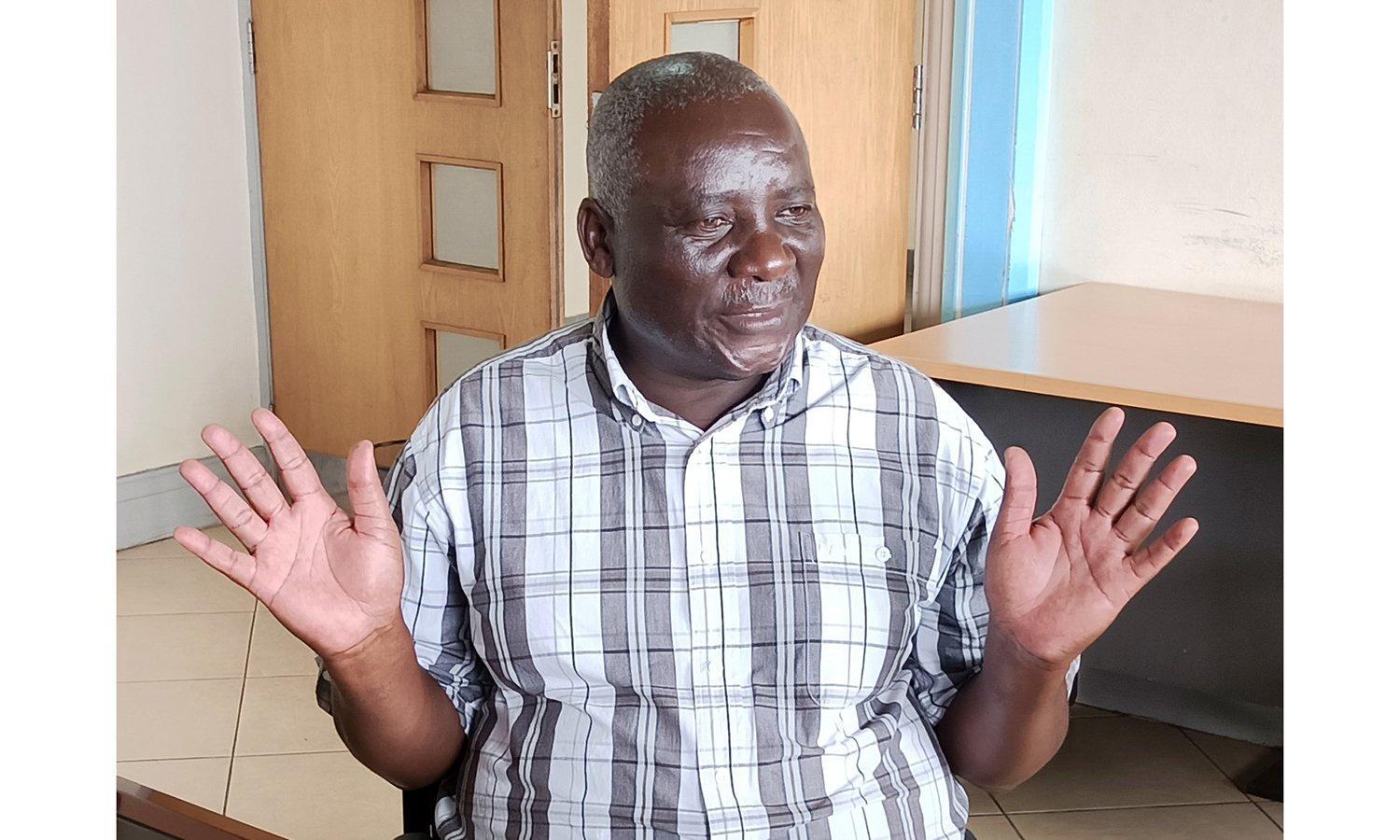
Africa-Press – Uganda. He is on the run—from creditors, family, landlords and friends. He appears sick, elderly, destitute, alone, and poor when you see him. He depicts a harsh world when he strings together multiple alphabet letters to describe his situation.
He once was rich, one would say. Rich enough to live comfortably in a three-bedroom home with two cars, a few acres of land, and a contented family. But everything is reversed, much like when you tilt your phone to obtain a good angle for Dr Driving while playing a mobile racing game.
Mr Neggrey Oyeri did that in the job market, and it completely changed his life.
He left his hometown of Tororo in April 2018 to work out a contract with a Chinese company to build a long trench on a road in eastern Uganda. His expertise was in stone pitching, which he was required to perform at the Nondwe Trading Centre in Mayuge, Bugweri County.
Stone pitching refers to a construction technique used primarily in civil engineering to stabilise slopes, prevent erosion, or create retaining walls. It involves the placement of large stones or rocks in a specific pattern or arrangement to form a barrier or structure.
Mr Oyeri says: “The President of Uganda was on TV saying that nationals should engage in projects that are set up in the country, talking about the Musita-Lumino-Busia-Majanji road. I got interested, left Tororo District and went to Mayuge to ask for this job.”
The aforementioned road runs through Uganda’s eastern region and links the towns of Musita in Mayuge District and Busia in Busia District, which is located near the country’s international border with Kenya.
Mr Oyeri’s competence was questioned by the project’s contractors, M/S China Railway 18th Bureau Group Co. Ltd (CRBGCL).
Mr Oyeri says he was ultimately subcontracted for the work without a sub-contract, but CRBGCL assured to provide him one once he completed the job. He nodded and got going.
He said he used all of his funds to purchase the necessary quarrying stones, hire some labourers, and purchase some equipment.
Everything ran smoothly. More equipment was hired.
According to Mr Oyeri, when his money started to run low, he called his friends who were involved in the stone transportation business to ask for assistance.
However, both of them reportedly ran out of money after providing more than 300 trips of stones (from a four-stone transportation dump truck).
Mr Oyeri says he accumulated a lot of loans promising to pay after completion of the work. Mr Oyeri adds that he sought the assistance of another friend, Mr Edward Ngobi, a businessman in Musiita Village, Mayuge District, who provided 36 trips of stone on credit. This was, however, insufficient to complete the task.
“That is how I managed to finish the work. I used 488 trips of stone to do that so that I could cover the trenches—side by side of the road—of 2,387.64 square kilometres,” Mr Oyeri says.
‘Arrested development’
He was under the contractor’s supervision by May and June of 2018. For the third time that year (supervision for measurement was meant for three times), Mr Oyeri was not given the opportunity to be supervised because, by October, he had been arrested due to accumulating debts from creditors that he had failed to settle.
His creditors decided to lock him up because they could no longer stand his delays.
By this point, he had begun to demand payment from CRBGCL. It was met with a rejection.
It got to the point where he was unable to consistently fulfil his promises to his landlords, creditors, and employees.
“I told the people at home to sell my two cars. I withdrew all the money I had on my bank accounts, borrowed from more friends, but all that money wasn’t enough because even the cars had depreciated and we needed quick cash,” Mr Oyeri narrates.
Police were informed by Ms Esther Nyakato that Mr Oyeri had failed to repay a Shs9.2 million loan.
“I was taken directly to court and sent to prison from October 2018 to May 2019. When I was released, the chief magistrate told my creditor to sell my property, which was my only house with all the developments I had set up on it,” he narrates, adding that this resulted in a discrepancy of more than Shs300 million between the amount owed and the value of land and property taken.
More problems
Mr Oyeri says his sick father said to him: “How are you going to look after the children when you have not been paid?” When his father went unconscious right after that, “I got a friend to help me take him to Tororo hospital, but the doctors advised us to take him right away to Mbarara Regional Referral Hospital so they could do a body scan.” A clot would be discovered in his brain.
Here, a friend helped Mr Oyeri’s family obtain housing, while the father stayed in the hospital for treatment across three weeks. Three days after checking out of the hospital, his father died at a friend’s place.
Surveyors were even securing the perimeter of Mr Oyeri’s property when his family went for his father’s funeral. Mr Oyeri struggled to give his father a befitting send-off not least because he has not received payment for his work since 2018. Attempts to get help from the Prime Minister’s Office, the anti-corruption unit, and the Inspector General of Government (IGG) office have been unsuccessful.
Tough times
Mr Andrew Oluka, the chairman of LC1 at the location where the work was done, says Mr Oyeri was actually employed by and supervised by his contractors, who he refers to as the “Chinese.”
“He was imprisoned by his creditors due to the debts that he had failed to settle. We had a meeting with those Chinese people, and they promised to pay him, but I am told they haven’t.”
Mr Oluka says he has no idea why the “Chinese” did not give “the man” his money after he completed the task at hand.
“I saw him working and I even gave him [a] loan to help him with his tasks. The house he used to rent while working on the construction site is still not paid to this date. His clothes and property are still here [five years later],” he adds.
Currently, My Oyeri’s debt totals more than Shs400 million. He rents a tiny room that appears uncomfortable. His family that rents in his village in Tororo is being sought after by the landlord as well.
He says if the property he lost to creditors had not been tampered with, it could have brought him about Shs800 million.
Through pick-up business, special hire and selling fresh food from the village, the two vehicles he sold were bringing in an average of Shs200,000 per day for him.
None of his eight children have returned to school.
He would have graduated two children by now, but a lack of tuition has stalled any progress.
Press has seen letters that Mr Oyeri has sent to the Prime Minister’s Office pleading for financial assistance, even as little as Shs28 million, to help his children return to school, pay their rent, and eventually pay off some debts.
Unra setback
Furthermore, court records allowing his creditor to sell his real estate in 2020 have been confirmed by our reporters. We have viewed records from CRBGCL where Ms Winnie Namuli, acting on behalf of CRBGCL, oversaw and approved Mr Oyeri’s works.
It should be noted that although Mr Oyeri did not receive a sub-contract, documents viewed by this paper list his company, Parak (U) Ltd., as one of the listed businesses for stone pitching sub-contracting, a job he was performing. This document has Mr Wan Longgen’s signature. Mr Wan is the project manager of CRBGCL.
On August 25, 2023, the Uganda National Roads Authority (Unra) received a letter from Prime Minister Robinah Nabbanja, urging the entity to intervene in this issue because the subcontracting company, CRBGCL, “has failed to meet its side of the bargain to pay the subcontracting company [Mr Oyeri’s firm]” his Shs185.6 million.
The permanent secretary in the Ministry of Works and Transport received a copy of that letter.
In response, Unra stated in October 2023 that it had met with both parties multiple times and that it had observed the absence of a subcontract agreement between them.
Additionally, Unra stated that it could not find enough proof to back up the claimant’s assertion that he is entitled to Shs185.6 million.
“The claimant was not a nominated sub-contractor for whom Unra was partly responsible for making Unra privy to the sub-contract. The respondent engaged the claimant privately, on terms agreed upon amongst themselves, without Unra’s involvement. Unra cannot, therefore, enforce the sub-contract,” Unra wrote.
According to CRBGCL’s records, Mr Oyeri’s company was filtered out of consideration for stone pitching works because of inexperience in that kind of job. CRBGCL says despite this, Mr Oyeri persisted in lobbying for the offer by enlisting the community and district political heads to do his bidding.
“In the interest of political respect, we then considered giving the complainant a chance to have a trial,” Mr Wan Longgen wrote in a letter to the principal private secretary in the Speaker of Uganda’s office dated October 3, 2023.
Final nail
The project manager gave Mr Oyeri sand and cement to help offset some of his payments, as well as a supervisor to safeguard their interests on the building site. Following a period of ongoing observation, Mr Wan claims to have discovered a financial shortfall between the amounts of advanced cement deducted from Mr Oyeri’s executed measure works.
He says he notified Mr Oyeri of this discrepancy in order to prevent any additional “theft of material” from occurring.
“In summary, the value… claimed by the complainant is not known to us; instead, we demand from the complainant a value of Shs4.8 million… for the realised loss as a result of the complainant’s mismanagement of their [CRBGCL’s] works,” Mr Wan wrote.
Mr Oyeri, however, disputes this. He claims that a CRBGCL supervisor was able to keep an eye on the daily intake of cement and sand, with no impropriety registered.
For More News And Analysis About Uganda Follow Africa-Press