Faridah N Kulumba
Africa-Press – Uganda. At the beginning of this month, tension escalated among Ugandans residing along the Uganda-South Sudan border, specifically in the Kerwa and Kochi sub-counties within the Yumbe district after South Sudanese authorities claimed ownership of more than 20 villages.
The most affected communities who have found themselves in the two country’s territorial dispute, are found in Kaboro A, Keriwa, Kaboro B, Tiria, Sokokobidri, Pasara, Junjubita, Mafuu, Ujuruko, Milia, Koloro, Woroworo, Oloko and Tinji villages all in Kerwa sub-county. In the Kochi sub-county, the villages that are being claimed by South Sudanese authorities include Fitina Mbaya, Alema, Milia, Feyo, and Gobiri.
How it all started
According to James Gale, Local Council (LC) III vice chairperson for the Kerwa sub-county over the past few months, South Sudanese authorities started using force by allocating land to their people in the affected villages, which are deep inside Ugandan territory.
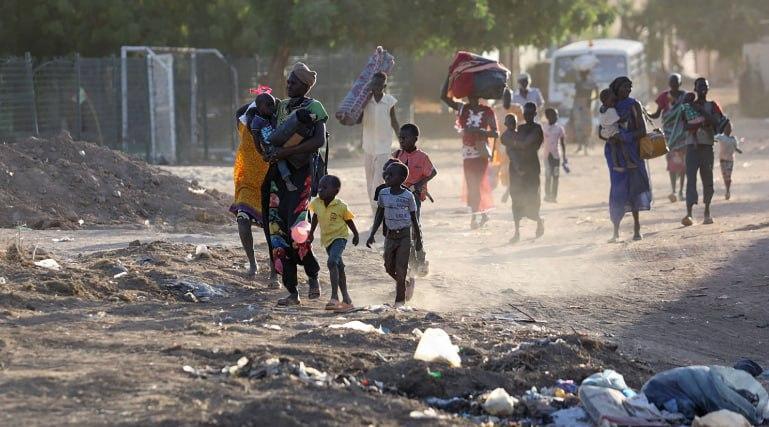
South Sudanese action resulted in the displacement of numerous Ugandan households residing along the border.
Who are the South Sudanese settling in Uganda
The investigations conducted by Ugandan authorities suggest that many of the individuals settled by South Sudan in the disputed border areas are refugees from Ugandan settlements who fled back to South Sudan due to food shortages.
This complex situation arises in the wake of food cuts and prioritization strategies implemented by the United Nations World Food Programme (WFP) and the Office of the Prime Minister (OPM).
In July this year, the WFP together with the OPM announced food cuts and a prioritization strategy for the most vulnerable refugees in Uganda as needs outstrip resources. The situation forced several Ugandans to abandon their homes due to fear of being captured by the South Sudanese authorities.
This border dispute has a long history, spanning from Oraba in the Koboko district to the Lefori sub-county in Moyo district. It has resulted in the displacement of numerous households and substantial property losses.
The two neighboring countries’ territorial disputes
It has now been over a decade since the two countries have been embroiled in a dispute over the border stretching from Oraba in the Koboko district to the Lefori sub-county in the Moyo district, which has led to the displacement of several households and loss of property.
In 2009, the President of Uganda Yoweri Museveni, and his Sudanese counterpart President Salva Kiir Mayardir met in Moyo district and agreed that farmers from both countries could utilize the vast virgin farmland along the border without any party claiming ownership of the land until the boundary between the two countries is redefined, which hasn’t been done.
In May, leaders from both South Sudan and Uganda reaffirmed their commitment to restoring peace and harmony between the two neighboring countries. They emphasized their respect for the sovereignty, territorial integrity, and unity of border communities in both Uganda and South Sudan.
In the past years, there have been several border clashes between Uganda’s army and South Sudan’s soldiers. In July 2022, four South Sudan People’s Defence Forces (SSPDT) soldiers and one National Police Service officer were shot and killed by the Uganda People’s Forces (UPDF).
In June 2022, the UPDF killed an SSPDF soldier and wounded two others after two forces clashed. South Sudan State officials accused the UPDF of encroaching into and carrying out food and mechanized patrols in South Sudan territory. The UPDF set up a base in the Chugi area of Owiny-Ki-Bul Payam. The move compelled the SSPDF to react. Resulting in an exchange of gunfire in which the SSPDF soldier was killed.
In October 2020 SSPDF reported that two of its soldiers were killed and another captured by the UPDF. The incident happened when the UPDF entered South Sudan territory and opened fire on the SSPDF at the border town of Pogee.
Efforts made to resolve border clash issues
In January 2019, the government of Uganda and South Sudan formed a joint technical border committee of 26 members to resolve border tensions between the two neighboring nations by demarcating borders.
Uganda had 13 members and the other 13 members were South Sudanese. These 26 members were tasked to sensitize the people living along the border so that they knew that the committee was informed to demarcate the border.
Even though both countries have come up with solutions to solving border clashes by forming committees, these stalled due to a lack of funds according to the South Sudanese Ministry of Foreign Affairs. There was also limited time to enable the two countries to complete the sensitization exercise amongst the border communities.
In 2015. Uganda and South Sudan formed an 18-member Joint Border Committee to start the demarcation to resolve border disputes. Forming this committee followed accusations from both countries accusing each other of encroaching into their territories creating tensions among the border communities.
It is absurd that the border clashes between Uganda and South Sudan continue to escalate, with its impact felt by residents living in the contested villages.
The urgency to address this issue is underscored by the displacement of households and the disruption of government initiatives. The path to resolution remains elusive, despite previous agreements, leaving affected communities in a state of uncertainty
For More News And Analysis About Uganda Follow Africa-Press