Africa-Press – Uganda. The government of Iceland has pledged over Shs 21.2 billion to UNICEF Uganda to strengthen government-led programmes supporting vulnerable children, adolescents, and families across the country.
The funding, channeled through two complementary grants, will enhance national systems in social protection, education, early childhood development (ECD), and water, sanitation, and hygiene (WASH).
The contribution marks a renewed phase of collaboration between Iceland and UNICEF, aimed at improving the delivery of critical services at both national and district levels.
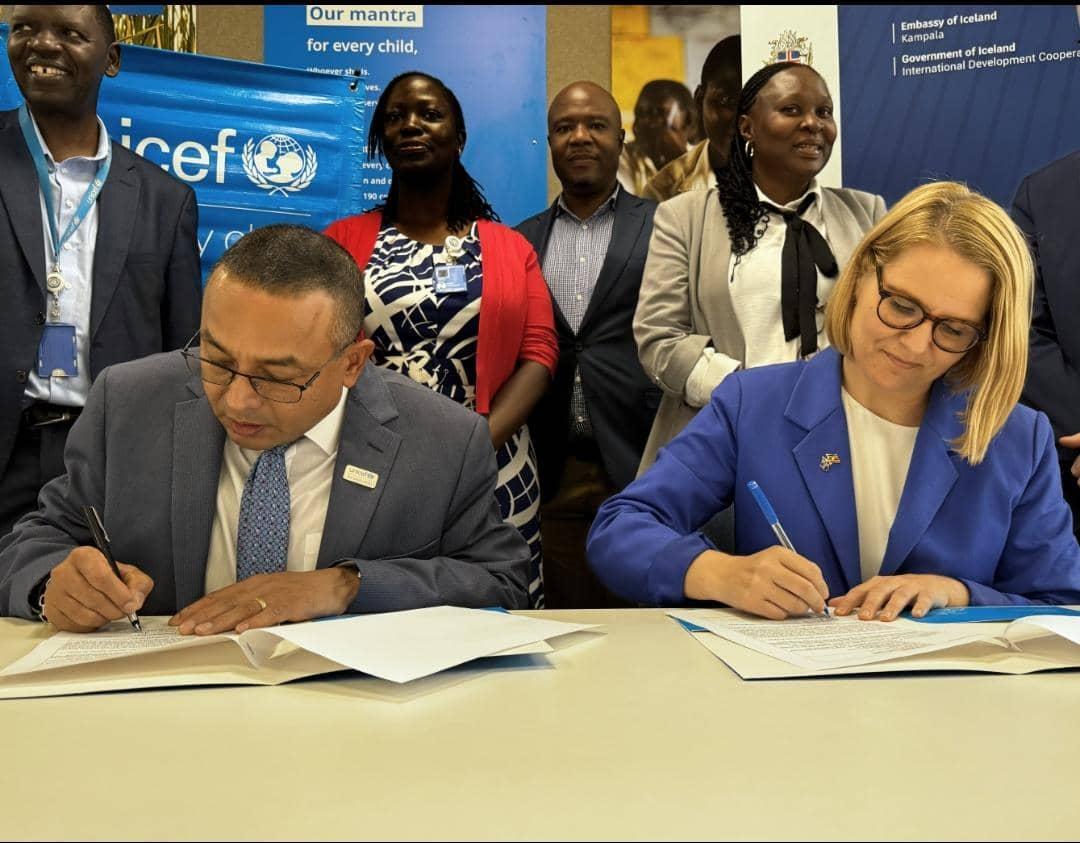
On Wednesday, Iceland and UNICEF signed a Shs 15.4 billion multi-year grant for Phase II of the “Empowering Adolescent Mothers and Their Children: A Dual Generation Approach,” running from January 2026 to December 2029.
The programme targets adolescent mothers aged 12–19 and their children aged 0–5 in Kikuube and Kyegegwa districts, addressing challenges such as early pregnancy, school dropout, and child vulnerability.
“This investment allows us to continue empowering young mothers to rebuild their lives through education, skills training, and early childhood services for their children,” said Hildigunnur Engilbertsdottir, Iceland’s Head of Mission in Uganda.
“With Iceland’s continued support, thousands of adolescent mothers will secure better futures for themselves and their children.”
Phase II aims to reach 3,000 adolescent mothers with integrated support including social protection and cash assistance, education and skills development pathways, early childhood development services, mentorship and psychosocial support, and gender-responsive and disability-inclusive services.
UNICEF notes that the programme offers a scalable model for Uganda’s national response to teenage pregnancy, strengthening human capital development and social protection systems.
A second agreement worth Shs 5.8 billion was signed to support the WASH in Institutions Exit Programme, running from January 2026 to June 2027. This initiative consolidates years of progress in WASH systems across five refugee-hosting districts in West Nile: Adjumani, Arua, Madi-Okollo, Terego, and Yumbe.
The programme is expected to benefit nearly 140,000 children, women, and community members through rehabilitation and expansion of water and sanitation facilities, strengthening operations and maintenance systems, capacity building for schools, health facilities, and district authorities, and promotion of market-based sanitation solutions.
“Iceland remains a strategic partner in advancing national programmes for children,” said Dr. Robin Nandy, UNICEF Representative in Uganda.
“These new investments reinforce sustainable, government-owned systems that will continue to serve communities long after external support phases out.”
The funding builds on Phase I, which supported 871 adolescent mothers through cash transfers, mentorship, skills training, and school re-enrolment, while also strengthening early learning and child-protection services.
The WASH exit programme shifts from direct implementation toward locally-led service delivery, aligning with Uganda’s National Development Plan IV, SDG 6, and the national WASH sector reform agenda.
During the signing, Iceland and UNICEF also presented a policy brief titled “Strengthening Transparency and Accountability in Land Service Delivery in Mityana and Gomba Districts”.
The brief outlines actions to improve integrity, reduce corruption risks, and promote inclusive land governance.
If fully implemented, the investments are expected to improve access to essential services, reduce vulnerabilities among adolescent mothers, strengthen early childhood development outcomes, improve water and sanitation in schools and health centres, and support sustainable, government-led systems.
UNICEF pledged to continue working closely with sector ministries, district governments, and community partners to ensure sustainability, local ownership, and the expansion of successful models.
For More News And Analysis About Uganda Follow Africa-Press