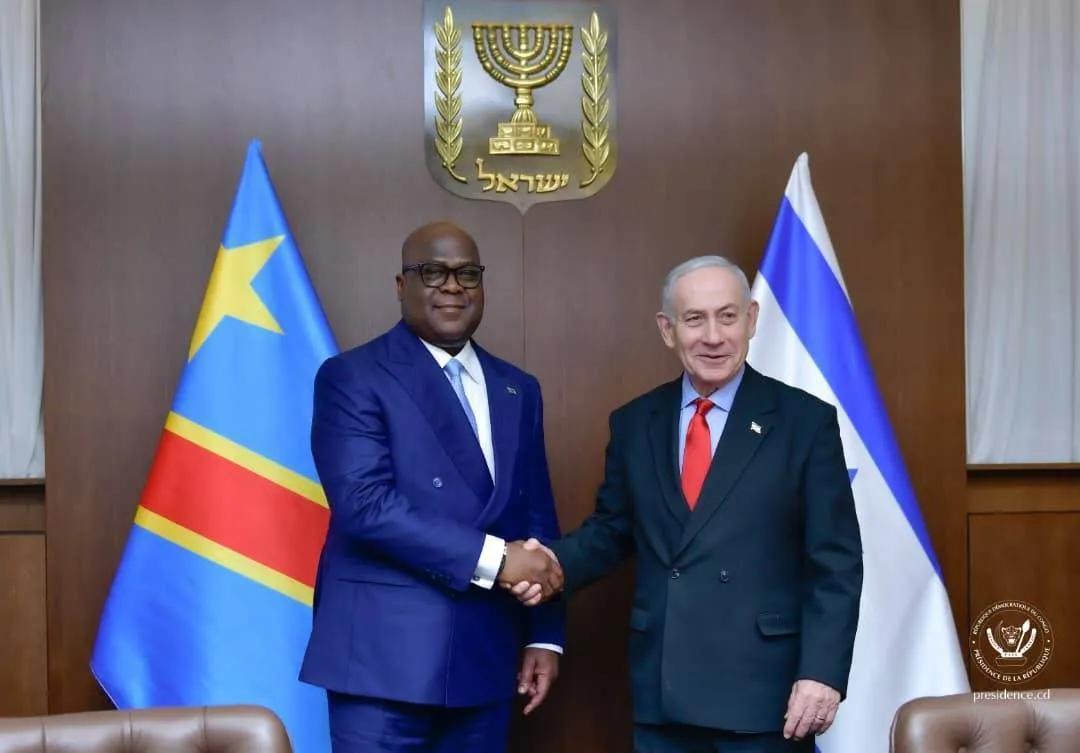
Africa-Press – Uganda. The visit of the President of the Democratic Republic of the Congo, Felix Tshisekedi, to occupied Jerusalem has drawn attention to Israel’s attempts to solidify its presence in Africa, amid regional fears of expanding Israeli influence.
Tshisekedi left Israel on Wednesday, concluding a three-day working visit during which he held discussions in Jerusalem with President Isaac Herzog and Prime Minister Benjamin Netanyahu. This was his second visit in nearly five years, following a previous trip in 2021.
Experts in African affairs point to efforts by Tel Aviv to expand its interests and gain leverage to enhance its influence, moving towards closer ties with countries like the Democratic Republic of the Congo and entities such as the separatist region of Somaliland, in pursuit of economic and security gains.
More than one Arab and Islamic country, including Egypt, Turkey, and Somalia, has expressed its rejection of the Israeli presence in Somaliland, warning of threats to regional stability.
During the visit, Tshisekedi’s discussions with Netanyahu focused on security and defense issues, as well as agriculture, energy, infrastructure, and advanced technology, according to a statement from the Congolese presidency via its account on the platform X.
The Congolese president reiterated his country’s commitment to Israel’s security while simultaneously calling for the protection of civilians, respect for international law, and continued dialogue as a means to address regional crises, as reported by international radio.
The Democratic Republic of the Congo and Israel are increasingly aligning, with Herzog having visited the Democratic Republic of the Congo in November 2025.
Relations and Interests
Hussein Al-Bahiri, an expert in African affairs at a national center for Middle Eastern studies, believes that the visit reflects a development in relations aimed at achieving mutual interests; the Congo seeks security and military support to confront its internal crises with rebels, while Israel pursues a foreign policy aimed at expanding its influence in Africa generally, and Nile Basin countries specifically, to mitigate international pressures resulting from its violations in the occupied Palestinian territories and to demonstrate its ability to diversify its external partnerships.
He added that the Democratic Republic of the Congo represents an important source for Israel to obtain untapped natural resources and precious minerals such as copper, aluminum, lithium, and cobalt, which are used in strategic industries like batteries and drones, thus providing Israel with significant economic gains as well.
Chadian political analyst Saleh Ishaq Issa expressed his belief that the visit reflects a shift towards a broader partnership encompassing political, security, economic, and technological aspects, in light of the challenges facing the Democratic Republic of the Congo in the east of the country, and the need to develop the capabilities of the army and security agencies, benefiting from Israeli expertise and technologies in intelligence, surveillance, training, and defense.
Rising Presence
Israel is striving to solidify its presence in Africa. At the end of last year, it recognized the separatist region of Somaliland, amid Egyptian, Somali, Arab, and Turkish rejection of this path.
Israel maintains relations with African countries such as Ethiopia, South Sudan, and Uganda, and reopened its embassy in the Zambian capital Lusaka in August 2025. It also has security, military, and trade relations with countries like Chad, Nigeria, and Cameroon.
Israel also maintains military cooperation with Rwanda; its ambassador in Kigali met with the Minister of Defense and the Chief of Staff of the Rwandan army last March to discuss ways to enhance cooperation between the two sides.
Al-Bahiri believes that Israeli expansion in Africa and the Nile Basin, which was preceded by establishing a foothold in the Horn of Africa and the Red Sea through the recognition of the Somaliland region near Bab el-Mandeb and international shipping lanes, “directly and indirectly impacts Egyptian national security, given Israel’s strong presence in an area considered a strategic depth for Egypt, opening the door for Tel Aviv to use its relations with the basin countries as leverage to resolve some outstanding issues between the two parties.”
Issa states: “The growing Israeli presence in Africa tends to be a strategy with common features implemented selectively according to the specifics of each arena, rather than a series of separate moves,” noting that the security dimension has become a central element in expanding Israeli relations with African countries, alongside economic and diplomatic interests.
Partnership Network
The case of Somaliland, according to Issa, reveals the “geopolitical dimension” of Israeli policy; the location of this area on the Gulf of Aden and its proximity to Bab el-Mandeb gives it direct importance for the security of navigation and the Red Sea, especially with the growing threat from the Houthis.
Israel has become the first government to officially recognize Somaliland, a step that carries implications that extend beyond the bilateral relationship to repositioning Israel in a strategically sensitive area.
In the Democratic Republic of the Congo, different interests emerge; the rapprochement is more closely related to the need for security and technological cooperation, alongside investment opportunities and the utilization of vast mineral resources.
This indicates that Israel does not employ a single tool in Africa, but rather a mix of security, technology, investment, and diplomacy according to the nature of the state, its location, and its needs, according to Issa. Thus, Israeli policy in Africa can be viewed as a flexible strategy rather than a uniform plan.
Issa concludes: “The overall goal is to build a wide network of partnerships that serve Israeli interests in security, navigation, trade, countering Iranian influence, and gaining political support, while the tools differ from one country to another.”
The rising Israeli expansion in Africa could lead to a reshaping of some regional balances, particularly in the Horn of Africa and the Red Sea, as Israeli presence transitions from scattered diplomatic and economic relations to a presence more closely linked to security, ports, maritime routes, and technology.
Issa believes that the presence of an Israeli partner in Somaliland could open the door to new security and intelligence arrangements and increase competition among the existing powers in the region.