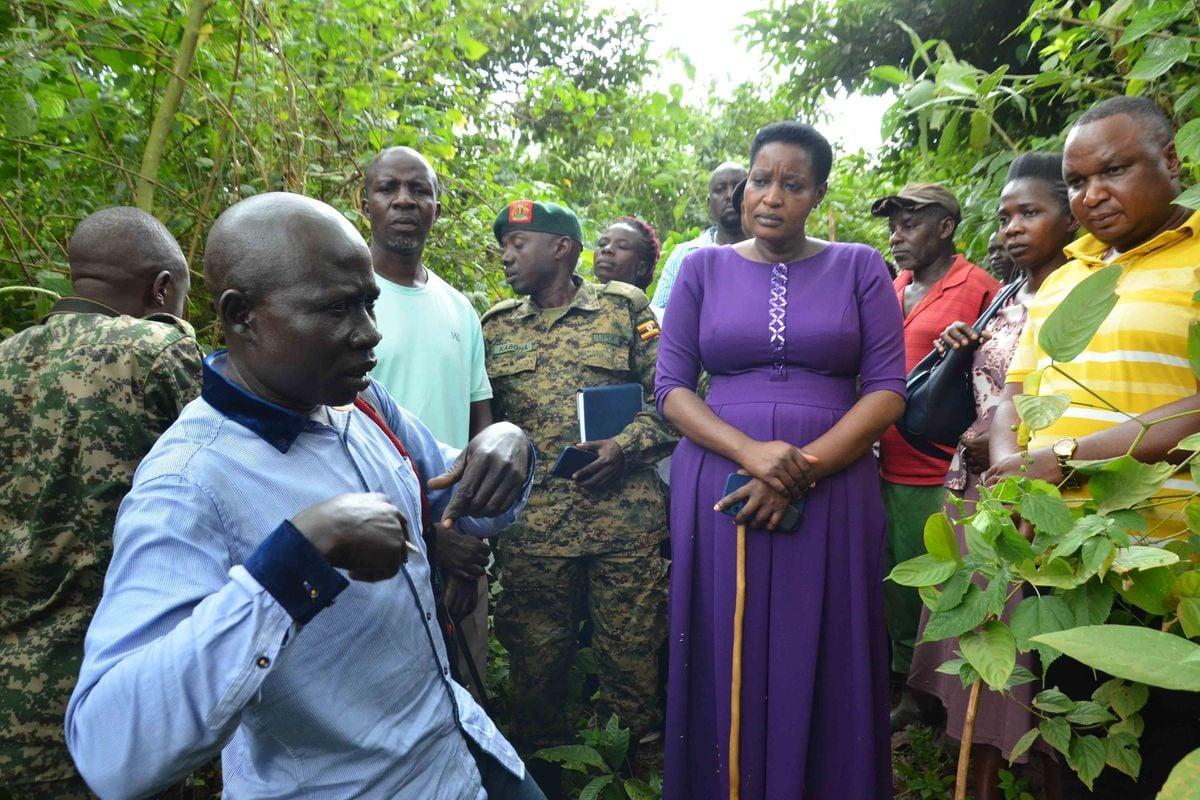
Africa-Press – Uganda. The Wakiso District Resident District Commissioner (RDC), Ms Justine Mbabazi, has ordered police to arrest encroachers on Nakindimba Forest Reserve in Kakiri Town Council, Wakiso District.
Nakindimba Forest Reserve measures 142 hectares.
President Museveni used the forest as his base to attack Kakiri Police Station during the guerrilla war that brought the current government to power in 1986.
According to Ms Mbabazi, this is the reason the President asked her to investigate and give a full report about encroachers.
“During the launch of UZIMA bottled water plant in Kakiri Barracks, recently, the President tasked me to lead the investigations of people behind the destruction of this Nakindimba [forest] and what we have found out today [last week] is that some people have land titles on this forest and that’s why we have moved with police, soldiers and National Forestry Authority officials (NFA) and Forestry officers from Wakiso,” Ms Mbabazi said on Friday.
A section of the forest has been cut down and replaced with natural trees such as musambya, musiizi (melias derachi), prunus Africana, cordia africana and croton macropacas, and the exotic Eucalyptus trees.
Ms Mbabazi also ordered Kakiri police to record a statement from Mr Charles Ojando, the NFA forest supervisor in Kakiri, and Ms Harriet Nankya, the forestry officer for Wakiso District, after they failed to answer some of the questions regarding the forest degradation.
“I have also asked police to investigate encroachers who have planted Eucalyptus trees and banana plantations on the forest land. I need the police to also find out the people who have been the owners of this land since the 1980s to help us with some facts about the forest land. And to the encroachers, I need them to be arrested and prosecuted for acting outside the law,” the RDC added.
It is now two years since the UPDF were deployed to safeguard the forest.
Maj Charles Kabona, the spokesperson of the UPDF First Division, said: “UPDF is working with all other security organs to secure the forest land and all encroachers are going to be prosecuted.”
Mr Ojando said at the time of his deployment, indigenous trees such as Mivule, Mahogany, and Misizi had been depleted.
He said they have partnered with organisations such as Nature Uganda to restore the depleted part of the forest.
The Busujja Village chairperson, Mr Ronald Kibirige, said local leaders had failed to protect the forest because some of the encroachers had the backing of powerful people at the district.
“I really thank the RDC, police and other stakeholders who have helped us save the remaining parts of the forest,” he said.
Background
Currently, more than 90 percent of Ugandans rely on wood fuel for cooking, with the urban population using mainly charcoal while their rural counterparts use firewood.
Forests and woodland account for 15 percent of Uganda’s territory, but the country’s forest cover has dwindled from 24 percent in the 1990s to 8 percent.
With new markets for charcoal in Kenya and Rwanda, in addition to logging for timber and agricultural land, the pressure on forests can only increase, authorities warn.
If deforestation continues at the present rate, Uganda will lose all its forest by 2050.
According to United Nations data, as of 2018, about 42 percent of Ugandans had access to electricity — many were too poor to afford it. Statistics add that between 2016 and 2017, 90 percent of all households used wood fuel for cooking.
For More News And Analysis About Uganda Follow Africa-Press