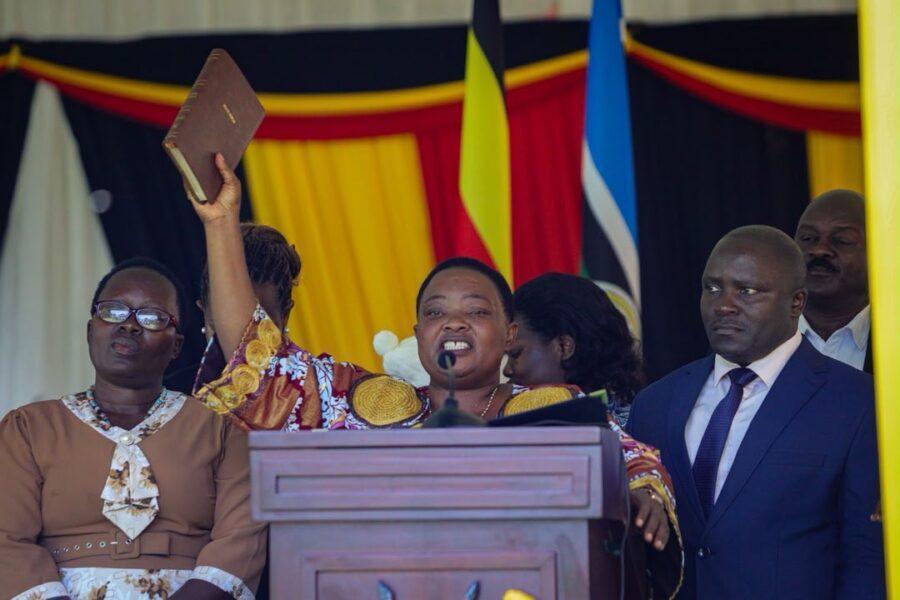
Africa-Press – Uganda. On this day, June 21, 2021, Uganda made history when Robinah Nabbanja was officially sworn in as the country’s first female Prime Minister since independence in 1962.
The swearing-in ceremony took place at Kololo Ceremonial Grounds during the inauguration of President Museveni’s new Cabinet following the 2021 general elections.
Nabbanja’s appointment marked a major milestone in Uganda’s political history and elevated her from a relatively low-profile ministerial position to one of the most powerful offices in government.
Her rise represented more than a personal achievement. It signalled a shift in the political direction of the ruling National Resistance Movement (NRM), with Museveni describing his new team as a “cabinet of fishermen” — a reference to leaders drawn from grassroots political mobilisation and local organising rather than some of the established political heavyweights who had featured prominently in previous administrations.
Nabbanja’s own journey reflected that philosophy. A trained teacher by profession, she previously served as a district councillor, Resident District Commissioner and later Woman Member of Parliament for Kakumiro District before being entrusted with the premiership.
The appointment also carried significant regional importance. Coming from the Bunyoro sub-region, Nabbanja’s elevation was widely interpreted as recognition of the area’s strong support for the NRM during the 2021 elections. Her appointment strengthened Bunyoro’s influence within government and placed the region at the centre of national political decision-making.
As Prime Minister, Nabbanja quickly developed a leadership style that differed from many of her predecessors. Rather than operating primarily from her office, she became known for frequent field visits, surprise inspections and direct engagement with public officials over service delivery concerns.
Her tenure has been heavily associated with overseeing the implementation of the Parish Development Model, the government’s flagship programme aimed at transforming subsistence households into participants in the commercial economy. She has also played a visible role in disaster response operations and social protection programmes across the country.
Her years in office have not been without challenges. The Office of the Prime Minister came under intense public scrutiny during investigations into the Karamoja iron sheets scandal, which involved materials intended for vulnerable communities.
Despite the controversy and political pressure that followed, Nabbanja retained the confidence of both Parliament and the President.
Five years after her historic swearing-in, Nabbanja remains one of the most influential figures in Ugandan politics. Her continued political relevance was demonstrated again in May 2026 when Parliament overwhelmingly approved her continuation in office.
Her appointment on June 21, 2021, remains a landmark moment in Uganda’s political history — one that broke a long-standing gender barrier and established a new chapter in the country’s leadership.
For More News And Analysis About Uganda Follow Africa-Press