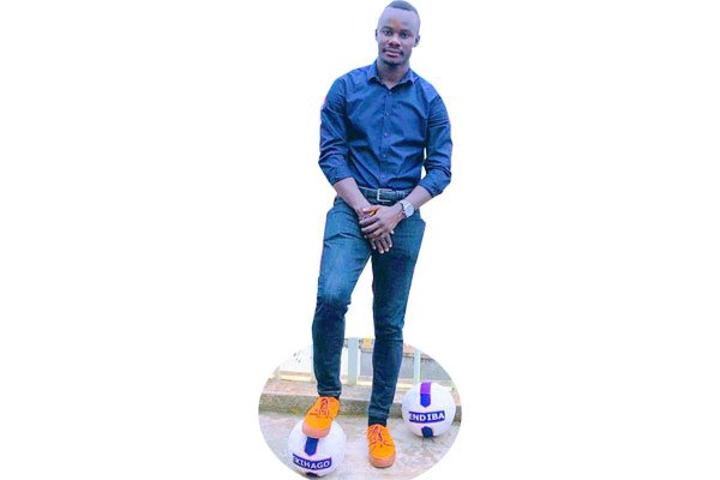
Africa-Press – Uganda. Douglas Smith, the founder of Sportrise, makes sports balls out of recycled plastic. But they have not yet secured a machine for making soccer balls which costs about Shs120 million minus the taxes.
Mr Douglas Smith adores sports. This dates back to when he was young and barely of school going age.
Every opportunity he got to play, it was football or soccer. Since he and his village mates did not have access to an ‘ehihajo’ (a Runyankole word meaning an expensive ball), it always brought excitement to them despite only being able to make and own a ball made from banana fibres.
Since he wanted to fulfil his dream, he settled for an early retirement two years ago.
Turning point
On realising that he would not go far because he did not have the opportunity, he had to find means of helping other children get it.
For the years he played, the 27-year old Smith always used an imported soccer ball. This rattled him as the balls were not durable, yet they were expensive.
This prompted him to come up with a non-profit organisation called ‘The Smith Soccer Foundation’ in 2016 in Rwenkobwa in Ibanda district during his Senior Six vacation. “The biggest challenge was acquiring soccer balls for the kids yet the foundation was in the village,” he says, adding that although he had got a volunteer to donate soccer balls from the USA, it was still so costly to transport and import them.
“I realised that the only way for every child to win a ball was to open up the first Ugandan football manufacturing company. But I had to bring the idea to life by researching on how balls are made,” he says.
For the past three years now, Mr Smith uses soccer to bring about a positive social impact in communities. He embarked on research that would later see him make his own soccer balls out of recycled plastic.
“Most of the soccer balls used in Uganda are imported because there hasn’t been any manufacturing company in Uganda. This makes them very expensive and not durable,” Mr Smith says.
In Uganda, over 2,000 metric tons of waste is generated out of which about 30 per cent is plastic.
“After doing intensive research and studies, I came up with the idea of manufacturing soccer balls locally from recycled plastic waste,” Mr Smith, who is pursuing a Diploma in Medical Laboratory Technology, reveals.
At the dawn of 2020, Sportrise was born. Sportrise is a social enterprise in Ibanda locally manufacturing durable and affordable soccer balls from recycled plastic waste.
Smith’s raw material is Polyethylene Terephthalate (PETE) which is the commonest type of plastic in Uganda as it is derived from disposable plastic water and soda bottles.
It takes around 100 plastic bottles to make one ball. It also requires rubber to make a ball.
“We have up to 10 plastic collection centres in Ibanda. We employ some young people that do the collections. We are currently innovating a digital way of encouraging young people to earn as they collect and drop plastics at our collection centres,” he narrates.
At Sportrise, Smith employs 27 people directly and indirectly.
Costs
In one year, the 27-year old has earned about Shs12 million from selling soccer balls and sportswear.
“We have earned Shs12 million in sales from both Sportrise balls and Sportrise wear since May 2020 and have so far raised Shs120 million in seed funding. Whereas our sport wear is made of fabric, we are presently undertaking research on the feasibility of manufacturing sportswear (sportrise wear- including jerseys and footwear) from recycled plastic waste,” Mr Smith says.
Currently, an ordinary Sportrise ball costs between Shs40,000 and Shs50,000 for those that are customised.
On the market, whereas the imported durable soccer balls for leagues cost between Shs80,000 and Shs100,000; the non-durable soccer balls range between Shs50,000 to Shs60,000 and can last for a month or two.
Whereas Sportrise clientele are predominantly sports shops, local clubs, corporate companies, schools, individuals & politicians, Smith from Mirambi Cell, Ibanda District has partnered with football clubs to grow his sales.
“Last year, we signed a Memorandum of Understanding (MoU) with Ibanda Municipal SC third division team as their official kit sponsor on a two- year deal while they also play using our Sportrise balls. We plan to partner with many more clubs,” he explains.
Children from Sportrise Academy in Ibanda Municipality clad in Sportrise wear train at Ibanda University. PHOTOs/RACHEAL NABISUBI
Challenges
Being a first time business founder venturing in virgin territory of local football manufacturing, Smith faces challenges. These include; a number of locals who expect locally made products to be very cheap costing between Shs15,000 and Shs20,000.
In addition, they have not yet secured a machine for making soccer balls which costs about Shs120 million minus the taxes.
“Uganda has no football manufacturing plant where the team can benchmark to learn more about the ball making process. This calls for flying out of the country which is costly for a startup,” Mr Smith elucidates.
Heavy reliance on imported products also limits the acceptability of my product.
“People want high quality products yet it is veryhard convincing them to support the Buy Uganda Build Uganda (BUBU) initiative. ”