By Mohammad Hasab Al-Rasoul, Regional Affairs Researcher
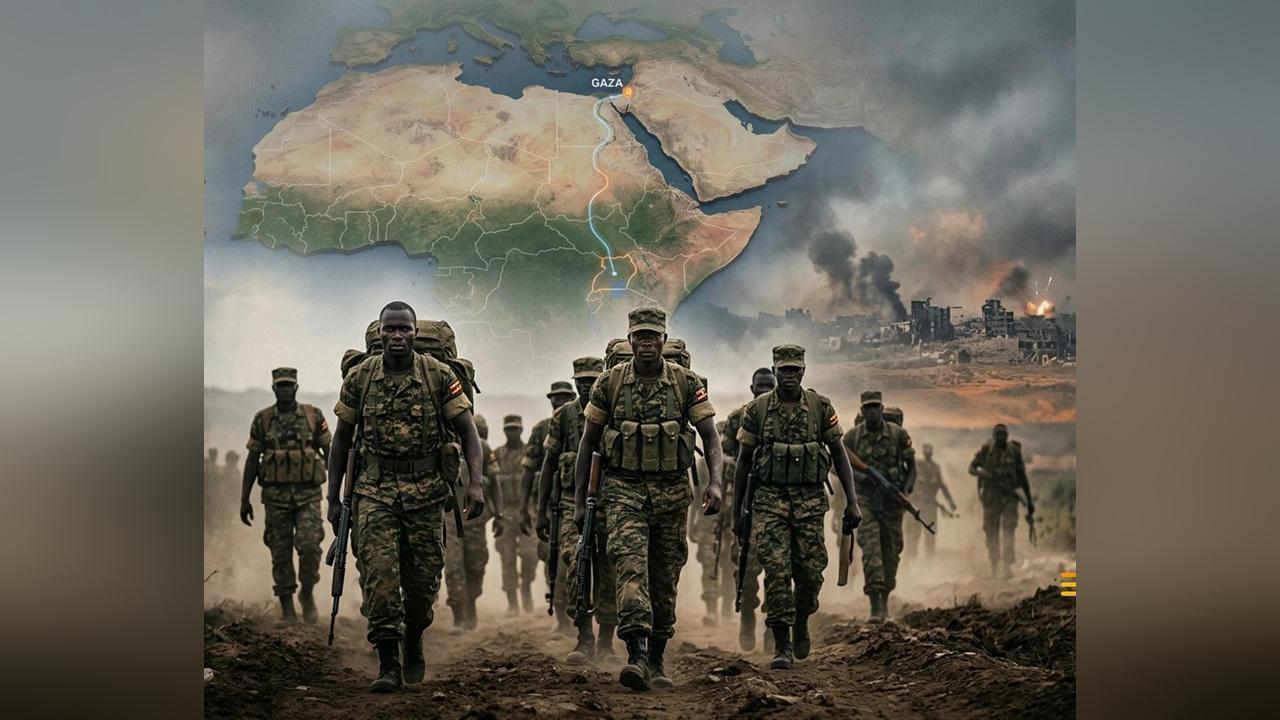
Africa-Press – Uganda. On August 6, 2023, the Ugandan Parliament approved the deployment of troops to Gaza as part of what is termed an international stabilization force. This decision represents a continuation of Kampala’s policies and its commitment to participating in peacekeeping operations, marking a significant shift in the Ugandan military’s focus from the African sphere to the heart of the conflict in the Middle East.
This move is rooted in historical and political calculations, as well as ideological motivations and familial ambitions, viewing rapprochement with Israel and the West as a ticket to future power in Kampala.
The Paradox of History: Uganda Rejected
The year 1903 marked the connection between the Zionist movement and East Africa when Britain offered Zionist leader Theodor Herzl land in the Uganda Protectorate as a potential homeland for the Zionist project. However, the offer was not accepted two years later. Ironically, Uganda, which was rejected by the Zionists as a homeland, has become, decades later, a strategic ally that places its military capabilities at the service of the entity in Gaza.
The Fluctuating Relations: From Severance to Alliance
After gaining independence from Britain, Israel established close ties with Kampala, which took on political, military, economic, and cultural dimensions. However, Idi Amin severed these relations when he rose to power in the early 1970s, taking a supportive stance for the Palestinian cause, a decision that came at a cost.
With Yoweri Museveni coming to power in 1986, diplomatic relations were restored after eight years, and Uganda became a platform for Israel to project its influence over East Africa and the Nile sources. In a context of mutual cooperation, Tel Aviv was able to leverage Kampala to serve its security and diplomatic agenda within African nations and organizations.
Muhoozi: A Cry from Entebbe to Tehran
On a dark evening in April 2026, Muhoozi Kainerugaba, the son of President Museveni and a potential successor, made statements reflecting the impetuousness of a general leading his country’s army. He announced via the platform “X” Uganda’s readiness to send 100,000 soldiers to defend Israel, considering any attack on Israel as an attack on his country, asserting that he would personally lead that force. He described Jerusalem as the “holy land” and threatened that one brigade of his army could seize Tehran in two weeks!
The Evangelical Movement in Uganda
Muhoozi’s statements reflect the deep influence of the evangelical movement in Uganda and its ability to craft an ideological discourse adopted by a figure within the power structure, based on the belief that protecting Israel is a theological condition for salvation and the return of Christ. Some estimates suggest that a quarter of Uganda’s Christians adhere to this evangelical dispensationalist doctrine. From this belief, Muhoozi derives his rhetoric to leverage his country’s military capabilities in exchange for Zionist goodwill, gaining legitimacy and securing Western acceptance.
A Memorial in Entebbe
Muhoozi practically embodied this orientation days before the parliamentary discussions by inaugurating a memorial for Yonatan Netanyahu – the brother of the current Prime Minister of the entity – in the courtyard of Entebbe Airport, attended by Israelis. He stated that he erected it in honor of the bravery of the leader of the Entebbe operation.
Here, a paradox emerges between father and son. While Muhoozi is busy courting the entity, Yoweri Museveni is playing a balancing act, having hosted Iranian President Ebrahim Raisi in Kampala in 2023, illustrating the nature of the ruling family’s inclinations, oscillating between the Machiavellianism of the father and the folly of the son.
Investment in Missions: From Africa to Gaza
Uganda has solidified its position as a regional security actor through its participation in three main fronts: South Sudan, where its intervention has granted it political and economic influence alongside military leverage; Somalia, where its troop presence has enhanced its role in an environment marked by intense regional and international competition; and Congo, where Kampala sees a strategic extension due to its location and mineral wealth, which are vital to its interests.
These engagements have opened new avenues, highlighted by a request from U.S. President Donald Trump, through envoys in July 2026, for President Yoweri Museveni to join the “international stabilization force.” Kampala received the request as an investment opportunity that would establish its international presence and affirm its status as a security actor responsive to Washington.
A Dangerous Mandate: Disarming Palestinians
The UN Security Council established, through Resolution 2803/2025, an “international stabilization force in Gaza,” with a mandate that includes securing borders, protecting civilians and humanitarian corridors, training Palestinian police, and participating in disarming Palestinians and dismantling military infrastructure, allowing for the use of “all necessary measures.”
This is where the sensitivity and danger lie. Engaging in any operation to disarm Palestinians represents a significant shift in the nature of the mission, especially since the entity has refused to cease fire and withdraw from Gaza. This refusal positions Uganda, alongside other countries participating in the “stabilization force,” as direct parties in the Israeli-Arab conflict, marking a fundamental difference from any previous mission in Africa.
However, Kampala, preoccupied with profiting from such engagements, views participation as an American-Israeli cover that fortifies the ruling regime, which has been in power for four decades, opens Western doors, and serves a more pressing internal agenda concerning succession and ensuring power transfer from Museveni to Muhoozi. In this equation, Kampala bets that the political and diplomatic returns will outweigh the risks, yet this bet remains fraught with questions about the cost of this adventure, especially if the mission turns into a direct confrontation.
Parliamentary and Popular Opposition: Why Fight in Gaza?
Opposition MPs led a rejection front reflecting genuine concerns. MP John Baptist Nambithe called for a comprehensive assessment of previous military operations, noting that the nature of fighting in Gaza is fundamentally different. MP Patrick Nsamba described the decision as a “matter of life or death,” while MP Joseph Ssewongo demanded details on soldier protection. The most pointed question came from MP Hassan Kiryomera: “If the ceasefire agreement collapses, which side will our army fight for?”
Outside Parliament, a significant segment of Ugandan society, including intellectuals and community leaders, expressed their disapproval, considering the move a bias towards occupation and warning of its repercussions. However, these voices mean little to the authority in Kampala, which has ruled its people with an iron fist for decades under American cover and approval.
The Entebbe Alliance: From Past to Present
The Entebbe Alliance was not born overnight; its roots trace back to the era of Milton Obote’s rule, severed during Idi Amin’s time, before being revived by Museveni, entering a new phase with its acceptance to enter Gaza.
Today, Western research centers view Kampala and Tel Aviv as a “new revival of the Entebbe Alliance,” with the “Middle East Forum” describing Kampala as a key link in the circle of Israel’s partners to counter Iranian influence in sub-Saharan Africa and the Red Sea corridor.
Kampala’s Goals in Gaza
Kampala enters the Gaza adventure to achieve multiple objectives: enhancing its regional and international role, providing diplomatic immunity for the ruling regime against pressures related to freedom, human rights, and peaceful power transfer. In contrast, Israel sees Uganda as a security foothold overseeing the Horn of Africa and Central Africa from deep within the continent.
Field Challenges and Their Implications
Ugandan forces in Gaza will face an environment vastly different from what they are accustomed to, with the nature of the population and its high density, the Mediterranean climate of Gaza, alongside the destroyed infrastructure complicating their operations and mixing their cards with any direct friction.
The stance on Gaza is an ethical and legal one that does not allow for neutrality. The practical bias imposed by the nature of the mission may place Kampala’s authority in confrontation with history, as its soldiers will be part of a equation: either alongside a people striving to liberate their land or on the side of occupation. This value-laden and political dimension raises questions about Uganda’s stance on historical justice and the rights of peoples, starkly contrasting with a deep-rooted African legacy of opposing colonialism.
Current Gains and Future Risks
Kampala appears confident that its decision will achieve its goals and yield quick gains: enhancing its regional and international role, providing diplomatic immunity for the regime against pressures related to freedom, human rights, and power transfer. In contrast, Israel sees Uganda as a security base overseeing the Horn of Africa and Central Africa from deep within the continent.
However, the anticipated gains come with risks. Entering the Israeli-Arab conflict is not like any previous mission. Uganda has deployed its army in Somalia not to protect stability but to invest in regional crises. By entering Gaza, it will find itself in a cauldron it has not known, at the heart of one of history’s most clear-cut and complex issues, where interests intertwine in a manner that does not allow for improvisation. Every step in this field carries consequences that may overwhelm Kampala’s capacity to absorb, as the issue is not merely a political decision with a military dimension but a bet on the future of a country burdened with crises in a changing and volatile regional and international environment.
A lingering question remains: What will Uganda do if the mission shifts from peacekeeping to direct combat? And what if an agreement imposed by Trump collapses unjustly and without regard for justice? Days will reveal the truth, and then Kampala will discover whether it has drifted into a more costly adventure than it had imagined.
Uganda remains faced with a fateful test: Will it emerge from this adventure with the gains it dreamed of, or will it be burned by a conflict in which it has no stake?