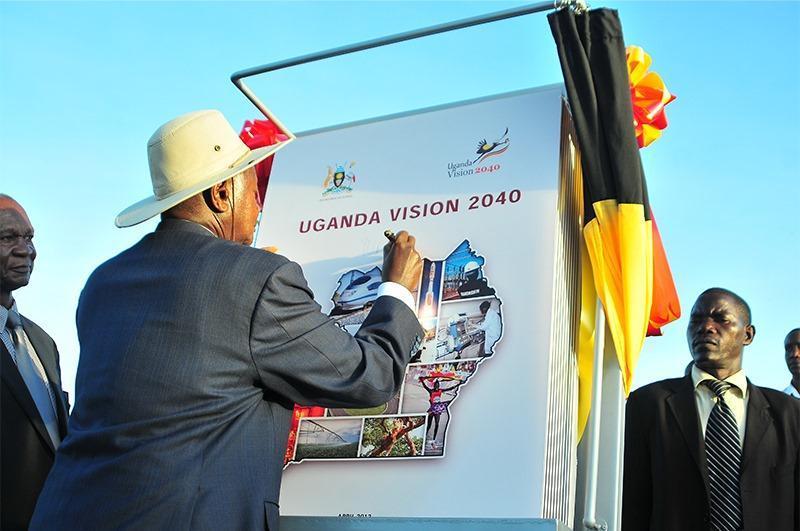
Africa-Press – Uganda. On this day in 2013, Uganda officially launched its long-term national development framework, Vision 2040, outlining a 30-year plan to transform the country from a predominantly peasant-based society into a modern, prosperous, and competitive upper-middle-income economy.
The blueprint was unveiled by President Yoweri Museveni and positioned as the overarching guide for all government planning and policy direction.
At its core, Vision 2040 set ambitious economic and social targets aimed at raising living standards across the country.
The plan projected an increase in per capita income from about $506 at the time of launch to $9,500 by 2040, alongside an expansion of the economy to $581 billion.
It also aimed to reduce poverty levels to below 5 per cent and shift the majority of the workforce out of subsistence agriculture into more productive sectors.
Infrastructure development formed a central pillar of the vision, with commitments to expand transport networks, including expressways and a standard gauge railway, alongside major investments in energy such as hydro and nuclear power, and the growth of information and communication technology systems.
Rather than being implemented as a single programme, the strategy was structured into phased five-year plans under the National Development Plan framework.
These cycles were designed to build foundations, accelerate industrialisation and, in later stages, drive large-scale economic transformation through value addition and export growth.
The plan also identified key “fundamentals” such as peace and security, infrastructure, human capital and science and technology as enablers for unlocking opportunities in sectors like oil and gas, tourism, minerals and agriculture.
By the mid-point of the Vision 2040 timeline, progress has been mixed.
Uganda has recorded gains in energy generation, supported by major hydropower projects, and expanded its road network, including the Entebbe Expressway. The oil and gas sector has also moved closer to production following key investment decisions.
However, several flagship projects, including the standard gauge railway, have faced delays, while challenges persist in reducing the subsistence economy despite interventions such as the Parish Development Model.
Structural constraints have also slowed implementation. Gaps in skills development, governance challenges and rising public debt have limited the pace at which some targets can be achieved, particularly in social sectors like health and education.
As Uganda moves into the next phase of implementation, focus has increasingly shifted toward industrialisation and value addition, with policymakers aiming to process more raw materials locally to create jobs and retain greater economic value within the country.
More than a decade after its launch, Vision 2040 remains the country’s central reference point for long-term development, shaping both ambition and debate about Uganda’s economic future.
For More News And Analysis About Uganda Follow Africa-Press