Africa-Press – Uganda. Dear Mr President, I have seen a copy of a European Parliament resolution dated February 11, 2020, on the political situation in Uganda. The resolution raises a number of concerns and allegations. It also makes a number of recommendations that are, in many respects, both surprising and of utmost concern to my government.
I wish to convey the following response to the issues and allegations contained in your letter as follows; At the outset, I wish to note that relations between Uganda and the European Union (EU) are both historical and strong. As a country, we acknowledge and value the partnership with the EU as a bloc, and with its individual member states. Nonetheless, we strongly believe that the sustenance of the relationship depends on the upholding of the universally accepted principles of mutual respect, non-interference and respect for sovereignty.
We, therefore, will always welcome engagement with any of our international partners on any matter, provided we all adhere to these principles, which in our view, are sacrosanct. I am writing this letter to you at a time of the coronavirus (Covid-19) pandemic, which has affected lives greatly here in Uganda, in the European Union and beyond. Since the outbreak of the pandemic, the government of Uganda in its approach has, like any other government around the world, prioritised the protection of human life, since without life it is impossible for our people to enjoy any other rights.
To ensure that the country responded adequately and mitigated the impact of the pandemic, the Government, through the Ministry of Health, developed guidelines and standard operating procedures (SOPs) to align and standardise its response to prevent and curb the spread of the pandemic. These SOPs applied to all the people in the country irrespective of one’s gender, status, pursuits, etc. Despite the regrettable fatalities, we are proud of our record in preventing deaths and limiting the spread of the pandemic. As of February 14, out of over 852,444 individuals tested, Uganda has 39,979 confirmed cases, and 328 recorded deaths.
We believe that the primary duty of the government is to its citizens. The one thing, therefore, that we have not compromised, and cannot compromise about, more so in the midst of the pandemic is the security and well-being of the people. Accordingly, my government has since the outbreak of the pandemic taken strict measures to ensure that everyone complies and respects the law no matter who they are. In order to comply with the election road map, the Electoral Commission, following guidance from the Ministry of Health developed SOPs for the conduct of the elections, which were adopted following consultation with all the presidential candidates and/or their representatives, to ensure the conduct of a credible election amidst the pandemic.
The SOPs and guidelines applied to ALL candidates. The candidates were urged to comply with them and were frequently reminded to do so. However, the choice and political stratagem of some of the presidential candidates, particularly those of interest – Hon. Robert Kyagulanyi and Mr Patrick Oboi Amuriat – was from the very first day of presidential nominations on November 2 and 3, 2020, to defy the measures in place. These two candidates repeatedly told or intimated to their supporters that Covid-19 was a hoax, incited them and willfully breached the SOPs, organising mass rallies, thereby putting the lives of everyone, not just themselves and their core supporters, at risk in the midst of the pandemic.
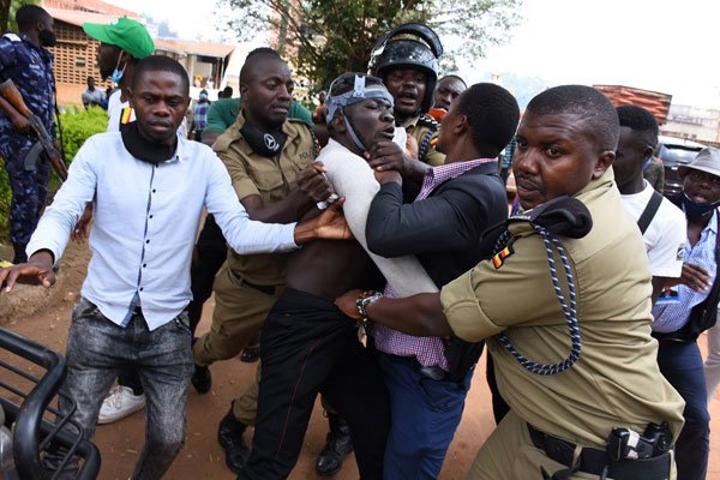
As a result of his open defiance to the SOPs, Hon Kyagulanyi was arrested by the police on November 18, 2020. His arrest was followed by extremely violent riots by his supporters characterised by the rioters mounting illegal roadblocks, assaulting innocent people and robbing them, and brazenly assaulting security personnel. This took place in the capital city of Kampala and a few other parts of the country. As it turned out, these riots were not spontaneous but pre-planned, supposedly to “test the system”.
It soon became clear that some of the political leaders had planned to frustrate the election and even financed the prior purchase and storage of the weapons used by the rioters such as old car tyres, rocks, hammers, firebombs, etc. Faced with rioters armed with the above dangerous weapons, and intent on threatening to cause grievous harm to the public and security personnel, law enforcement agencies took action, to protect the public against violence, crime and other harmful acts, as required of them by the law. You and your esteemed colleagues will, no doubt, agree with me that no country would tolerate or do nothing about such a state of criminal behavior.
This, therefore, resulted in the arrest of a number of suspects. Some were charged in courts of law and released on bail, while others were remanded in prison. From the beginning of the campaigns, Hon Kyagulanyi and Mr Amuriat promised a ‘Plan B’, which according to them, was (and remains) a plan to commit violent acts, organise an insurrection, and “make Uganda ungovernable”. During the campaigns, they repeatedly stoked fear and incited violence, which was a clear and present danger to the security and stability of the country and its citizens. We do not believe that any country that upholds democratic values would tolerate such a plan. Uganda certainly would not, because of its commitment to democracy and the rule of law.
It is against this background that the government deployed the security forces in Kampala and the rest of the country. This was done to reassure the public that there would be an election and order during the elections. It was also a clear and necessary message to those that intended (and had plans) to disrupt peace to change course. The outcome of this deployment was an election whose peaceful, free and fair nature, has been acknowledged by most in the country and beyond.
Let me emphasise that the law enforcement agencies in Uganda are a product of our history. They recognise the sanctity of life and have always upheld human rights in the execution of their constitutional duties, balancing the needs of security, with ethical concerns for the rights and wellbeing of all Ugandans. That is why the country remains peaceful and stable. The government is on record as stating that the incidents of November 2020 were regrettable and will continue to be investigated, with a view to determining conclusively if and where operational mistakes were made by individual security personnel, thereby unlawfully causing death in particular cases.
Needless to say, where it will be determined that particular individuals acted outside the law, they will be held accountable in accordance with the law. The government has already extended condolences to the families that lost loved ones and has also undertaken to compensate those whose loved ones were innocent victims of the situation brought about by the violent riots or properties to criminal gangs and rioters. The government is proud of the historic milestone achieved in the recent elections. Ugandans all around the country came out in large numbers to freely and peacefully express their democratic choice. The government was able to ensure a favourable space for candidates at presidential, parliamentary and local levels to canvass support from the electorate. Elections of special interest groups including the youth, persons with disabilities, women, the army and the elderly were also peacefully and successfully conducted. The elderly, as a special interest group, chose their representatives to Parliament for the first time in the country.
I am, therefore, quite frankly concerned how the EU Parliament in its resolution downplays the threat of the Covid-19 pandemic in Uganda. This is especially when we are well aware of the stringent steps that individual EU member countries have taken in an instant for the common good, imposing travel and social restrictions, while others are currently in lockdown and contemplating further measures.
In December 2020, following a surge in transmission of the virus and deaths and following advice from health experts, campaign meetings for all elective offices in some parts of the country were suspended for all candidates (including the incumbent President). All the measures taken to this day were/are based on scientific health advice. The Covid-19 pandemic was never a pretext restricting opposition activities as alleged in the EU Parliament resolution, and it is regrettable that the Parliament views, or has been made to view it, that way. I am also perturbed by the statement in the said resolution that refers to the process and the results declared by the Electoral Commission.
This statement is clearly partisan in tone and intent. We see this as an attempt to undermine and challenge the Electoral Commission and its work. Such a statement being issued at this time in particular, when the conduct and outcome of the election is a subject of adjudication in the courts of Uganda, is quite unfortunate to say the least. Needless to say, the determination on whether the election was in compliance with the law rests with the courts and our expectation and request is that everyone, including our international partners, respect that.
The statement is an assault on the independence of our institutions, a mockery of the rule of law which, ironically, the proponents of the resolution wish to espouse, and is clearly an unacceptable attempt to influence the outcome of the ongoing court process. On the issue of lesbian, gay, bisexual or transgender (LGBT) persons, Uganda as a country has a set of laws some of which predate our own independence. In fact no new law has been enacted. These laws in place, which include laws on same-sex reflect the culture and values of our people and it is not within the power of the Government to compel them to change their cultural values or views overnight.
That notwithstanding, nobody, contrary to all sorts of claims that go around from all sorts of groups and actors, gets discriminated upon, persecuted and prosecuted on the basis of their sexual orientation in Uganda and the government would challenge anyone, including the EU Parliament, to bring such evidence up. However, the government does not condone any promotions of sexual orientation of any kind. The resolution further falsely alleges the arrest from a shelter of homeless young people who identify as LGBT in March 2020.
There are no shelters for LGBT persons in Uganda and it is on the record that the individuals in question were arrested for violating Covid-19 rules and arraigned before a court of law. The charges were subsequently withdrawn by the Office of the Director of Public Prosecutions during the Covid-19 Pandemic, following a decision to de-congest prisons. All the 19 individuals were accordingly released from prison following the withdrawal of the charges, and it is surprising that this issue comes up in a resolution that is supposed to be on the “political situation in Uganda”.
The other surprising issue raised in the resolution is that concerning Mr Nicholas Opiyo is before the courts of law. Mr Opiyo was charged with an offence, which is a prosecutable crime under the laws of Uganda. His trial will be held in an open and transparent manner. We once again call on our partners to respect our institutions handling this matter and not try to influence the said institutions in violation of the well-known rule against sub judice.
On the threat of sanctions, referred to in the resolution, the government of Uganda views the threat as regrettable, unwarranted and an unwelcome and barely-disguised attempt to intimidate officials entrusted with ensuring the security and wellbeing of all Ugandans into shirking from their responsibility. While we are aware that it is the prerogative of the EU member countries to determine who travels to their respective territories or does any business thereon, we do not think that the sanctions would be a helpful gesture or measure and it is our hope that those advocating it will reconsider their stance. Needless to say, all government of Uganda officials will remain steadfast in carrying out their constitutional roles.
The rights of Hon. Kyagulanyi are repeatedly referred to in the resolution. However, Hon. Kyagulanyi is a citizen of Uganda and like all other citizens has the corresponding obligation to not infringe on the rights of others in the enjoyment of his rights as our Constitution mandates. After the election results were announced, there was credible information that he wanted to use the heat of the moment to foment chaos, riots and an uprising as he had previously promised. Indeed, after the results were declared he continued to make inflammatory statements aimed at inciting people to violence.
Foreign Affairs minister Sam Kutesa. PHOTO /ABUBAKER LUBOWA
The government urged him and all other candidates to desist from making such statements and, if they felt aggrieved, to seek peaceful and lawful means of redress. A security deployment was made at his residence to preventively address that threat. The government subsequently complied with the court order in respect to withdrawal from his residence, because it was simply the way things are done in the country – commitment to the rule of law.
On the freedom of the media, the right of people to information is in our Constitution. The Uganda government strongly believes that the media is an important part of a democratic society and is essential to the protection of human rights, fundamental freedoms and socio-economic transformation. We also believe that people need free media to provide them with accurate information and informed analysis and to hold Governments to account. That is why the government created conditions that have led to there being over 310 privately-owned radio stations, 48 television stations and 56 licensed online publishers in Uganda.
Relatedly, the government has also prioritised the development of ICT Infrastructure and the Internet. This commitment is evidenced by the wide coverage of ICT infrastructure in the country, the significant increase in internet penetration and the sharp reduction in the cost of broadband Internet. However, during the recently held elections some individuals and groups, began using social media platforms as a tool to distribute vile messages, incubating their hate online and encouraging it to spread. They continued to stoke fear and incite violence against certain ethnic and political groups, which was a clear and present danger to the security and stability of the country and its citizens.
The declared aim was to get as many people on the street as possible to cause trouble and “make Uganda ungovernable”. Indeed when the rhetoric reached certain people, the online messages turned into real-life violence. When the severity and viciousness of the messages became apparent, the government decided to temporarily shut down the Internet. This was a necessary step to stop the vitriolic language and incitement to violence, which was a threat to our democratic process and the security of the country and its citizens.
The reason the Internet was shut down was made public and the Internet has since been restored. There is proof that the action by the government worked, because the country is peaceful and has moved on, and should therefore be applauded rather than condemned or politicised. Regarding the imposition of taxes on Internet use, the power of the government to levy tax, including consumption tax, is enshrined the Constitution and other relevant laws. The ‘over-the-top” (OTT) tax, commonly known as the social media tax, was established for online services such as WhatsApp, Facebook and Twitter. The tax is one of the sources of revenue for provision of services such as health, education, transport, security, and infrastructure.
It is, therefore, surprising that purpose and effect of the tax (which is not very unlike certain revenue measures that some members of the EU have contemplated) has repeatedly been twisted and politicised. This was a fiscal measure put in place before the elections and could not have been put in place to suppress freedom of expression. On the observation of the elections, we have always welcomed the participation and support from local and international partners to our democratic process. However, it is not true as stated in the resolution that the EU offered to send a small team of electoral observers and the offer was declined.
The facts are that, following an invitation by the Ministry of Foreign Affairs on behalf of the Electoral Commission in December 2019 and July 2020, the EU responded formally, informing the government that EU missions will conduct a “diplomatic watching” exercise. The EU requested accreditation for its diplomats, provided a list of the said diplomats and was specific in saying that the EU will not deploy an Election Observer Mission (EOM).
That accreditation was granted and 56 of those requested were accredited. All this is a matter of public record. It is, therefore, quite a surprise to us that it has been alleged or insinuated that the government declined to accredit Observers from the EU. Likewise, the US government as per custom was invited to observe the elections but ultimately did not deploy the 68 observers that were accredited by the Electoral Commission because, according to the US Embassy in Kampala, it was not possible to deploy them at the time. It is also surprising how this matter is being twisted in this resolution.
On the recommendations made by the 2016 EU Election Observer Mission, the government has consistently underscored that it will be up to our people to decide what reforms they want to have in line with our Constitution, which explicitly provides for their sovereignty. Needless to say, a number of electoral reforms have been implemented on the basis of the lessons learned from the elections of 2016, and we call upon all our partners to interest themselves in those reforms in order to appreciate the robustness of our electoral legal framework which, by most accounts, is one of the most progressive in Africa and beyond.It is unfortunate that His Excellency the President’s expressions of concern on the attitude and actions (both overt and covert) of some of our partners and as such his call for mutual respect has been twisted as being ‘anti-western rhetoric’.
Uganda is a non-aligned country but it is also a longtime partner to the West’ on many issues and in many areas. These were just statements of fact and words of caution to our Western friends that when commenting on or pushing certain agendas in Uganda, there is need for in-depth knowledge about the country and, to avoid statements and actions that may unwittingly undermine the security and stability of the country.
As Mwalimu Julius Nyerere, late president of the United Republic of Tanzania, said during a diplomatic standoff with the then government of West Germany in 1964, “Independence means the freedom to make our own mistakes”. These times have been the most secure and stable in the history of this country and we do not take that stability for granted; we jealously guard it.
On the alleged abductions, forcible detention and missing persons, it is important to underline that anyone suspected of wrongdoing in Uganda is guaranteed due process. All those arrested will be investigated and those found with cases will be charged in courts of law. The alleged abductions, forcible detention and missing persons are being looked into as the Inspector General of Police has already informed the public. That notwithstanding, it is important to note that there has been a lot of misinformation on this matter. An example is the gruesome social media photos of a young NUP supporter, one Mr Seggawa, who was allegedly abducted and tortured by security agents. The truth of the matter is that, the photo making rounds is of another person and not Mr Ssegawa.
The person suffered an accident on January 27, 2021, and sustained injuries on both arms and leg. The images were smuggled from Mbale Regional Referral Hospital where the victim was undergoing treatment and photo-shopped to incite negative perceptions against security agencies. It is unfortunate that some media houses fell victim to the calculated and malicious propaganda by NUP, including its party president Hon. Robert Kyagulanyi, who affirmed that the fractured hand belonged to their supporter Ronald Segawa, which was false and a fabrication. These images and related false narratives are deeply offensive to the victim, the family and friends. On the NGOs, the government of Uganda recognises the critical role played by NGOs in the advancement of democracy and the betterment of society. However, all NGOs registered in Uganda are expected to comply with the law. The Financial Intelligence Authority (FIA), a government agency mandated to detect and deter money laundering, received credible information that some NGOs namely; Uganda National NGO Forum and the Uganda Women’s Network (UWONET) on December 9, 2020, were involved in certain unlawful activities.
In accordance with its mandate, the FIA caused the freezing of their accounts, pending investigations. The matter is under investigation by the Criminal Investigations Department of the Uganda Police Force. The International Criminal Court petition referred to on allegations of multiple human rights violations, is unfounded. It is an attempt to move the political contest between Mr Kyagulanyi (and his local and foreign backers) from Ugandans to the international arena. It will be of no consequence from a legal and political point of view, as none of the alleged acts or incidents merit the involvement of the International Criminal Court. It is regrettable that the European Parliament refers to Mr Kyagulanyi’s frivolous complaint to the court, which is not unlike many such that the court receives from all kinds of adventurers, political posturers and charlatans from across the world on a daily basis, as if it is a pronouncement by the court itself.
I wish to once again underscore that we are concerned about the timing of the resolution, both from a public health and political point of view. It surprises us that the resolution does not take Covid-19 seriously, at a time when the WHO estimates that more than 2.36 million people have died around the world. We are proud of our health workers and security forces that have contributed to the comparably low fatalities and transmission numbers in Uganda.
We consider the resolution ill-timed and an unhelpful to our efforts to combat the Covid-19 and also in our democratic journey. The government of Uganda is committed to ensuring domestic tranquility, the security and welfare of its citizens. The country has continued to enjoy peace amidst the Covid-19 pandemic and remains steadfast in making progress on all fronts.
We would like to reassure the EU Parliament that this peace and progress will continue and the country has moved on since the election. Finally, I wish to assure you that the government of Uganda remains committed to good governance in the country, in accordance with our constitution and international commitments.
The government of Uganda also remains desirous and committed to strengthen our partnership, and to continued dialogue on all matters of mutual interest or concern but, as already mentioned, this will be best achieved if we all continue to adhere to, and keep reminding ourselves of the time-honored and non-negotiable, principles of mutual respect, non-interference and sovereignty. Please accept, Mr President, the assurances of my highest consideration.
By Sam Kutesa
The writer is the Minister of Foreign Affairs