By Faridah N Kulumba
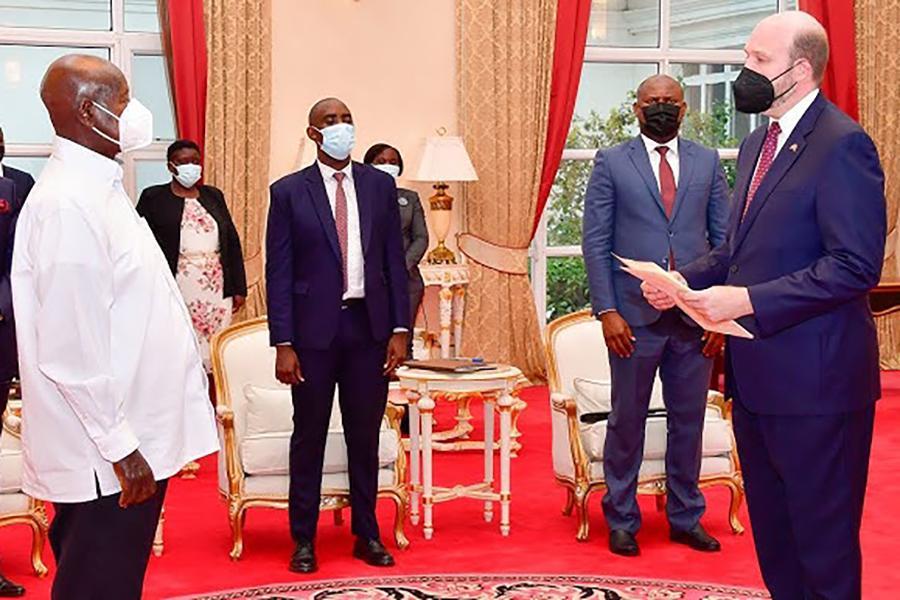
Africa-Press – Uganda. The president of the Republic of Uganda H.E Yoweri Kaguta Museveni held a meeting with the United States Ambassador to Uganda, William Popp on 10th October this year at State House Entebbe to discuss diplomatic issues. The meeting came just days after the Chief of Defence Forces, also First Son Gen Muhoozi Kainerugaba, publicly demanded an apology from Amb Popp to President Museveni over the diplomat’s alleged misconduct. This followed the U.S. Department of State imposing sanctions on four members of the Uganda Police Force (UPF) over accusations of involvement in gross violations of human rights, including torture and cruel treatment, the move Muhoozi sees as undermining the government of President Museveni. Ambassador Popp refused to apologise saying either the U.S. Embassy nor the ambassador had received any formal request to apologize from the Ugandan government on any matter.
The meeting
According to officials, who preferred anonymity to speak freely, the meeting was attended by several security officials and other key stakeholders in the diplomatic community. Senior Presidential Press Secretary, Sandor Walusimbi, said he was “not aware of such a meeting” when contacted by a local media. “I don’t know about it,” he emphasized. It is understood that President Museveni and Ambassador Popp agreed that deliberations of the meeting were not shared with the public. This was aimed at avoiding unnecessary altercations on social media.
Diplomatic tension
In the past few years, the diplomatic relations between Uganda and the U.S. have been tense. The escalation of the diplomatic tensions between the two nations started in 2023 when President Museveni signed the Anti-homosexuality bill into law. The U.S. reacted by sanctioning Ugandan officials and discouraging their business people from investing in Uganda. The U.S. government also scrapped Uganda from the beneficiaries of the Africa Growth Opportunity Act (AGOA) which provided eligible sub-Saharan African countries with duty-free access to the U.S. market for over 1,800 products. In only this year, the U.S. has imposed sanctions on about eight Ugandan officials. In May, the U.S. sanctioned Speaker of the Parliament of Uganda Anita Among, and former ministers Mary Goretti Kitutu and Agnes Nandutu over accusations of involvement in corruption or human rights abuses. In addition, Peter Elwelu, former deputy chief of the Uganda Peoples’ Defense Forces (UPDF) was also sanctioned “due to his involvement in gross violations of human rights”. While commanding defence forces, Elwelu was involved in extrajudicial killings committed by UPDF members.
Partisan- Sources say Ambassador Popp, U.S. Embassy political officer Shirm Christopher, and the Central Intelligence Agency (CIA) chief for Uganda have been quietly strengthening the capacity of opposition groups to challenge President Museveni in the 2026 general elections. The alleged support from the U.S. Embassy also includes millions of shillings to anti-government non-governmental organizations. The second area of contention is the increased U.S. sanctions against Ugandan security officers ahead of the 2026 elections. Ugandan officials say the current crop of officers at the U.S. Embassy in Kampala has been working with the U.S. State Department in Washington to use sanctions as a tool to intimidate security personnel from cracking down on lawlessness perpetrated by opposition figures. “What the U.S. Embassy officials are trying to do is create a climate of fear within Uganda’s security establishment so that police and the army do not act against opposition especially as we prepare for the 2026 elections,” a source said, adding, “That is interference in Uganda’s internal matters and also an attempt to undermine the government and the country’s democratic processes.”
U. S’s defence
Matthew Miller, the Department of State Spokesperson, in a statement to this publication, says the United States is the largest and longest-standing international partner with Uganda and the Ugandan people with a relationship spanning over 60 years. “Our nearly USD 1 billion (approximately Ush3.7 trillion) supports local institutions and organizations every day to improve the health, education, and prosperity of millions of Ugandans. The embassy, the Ambassador, and the United States government continue to work directly and normally every day with Ugandan authorities on a full range of issues,” he said in a statement.By publicly designating these individuals, the United States underscores its commitment to advancing human rights for all Ugandans and holding accountable those responsible for violations. In a statement, a State Department spokesperson emphasized, “These actions reflect our ongoing efforts to support human rights and promote accountability for those who commit abuses. The United States stands firmly with the people of Uganda in their pursuit of justice.” “Following US law, the United States is committed to supporting justice for victims and accountability of those involved in human rights violations around the world. This includes denying or restricting travel visas to visit the United States for individuals with demonstrated evidence of committing abuses. As friendly nations, we maintain an open and honest dialogue with Ugandan authorities about the protection of human rights as enshrined in the Ugandan Constitution and international declarations and agreements,” the statement added.
Warning
President Museveni has always warned the Western community, particularly the United States against meddling in Uganda’s domestic affairs, saying a new legislation could be drafted to penalize collaborators of foreigners. “Interfering in the internal affairs of other countries is morally and practically wrong,” said Museveni in a national address, adding, “Morally wrong because the question is: ‘What superior intelligence do you have to think that you can understand the problem in my house better that we the occupants?’” However, after Gen Muuhoozi lashed at the U.S. envoy to Uganda, President Museveni retracted an anti-US. In a statement issued Monday, President Museveni said Uganda and the United States have had fruitful bilateral relations for over 60 years and that Uganda considers the US a key development partner.
For More News And Analysis About Uganda Follow Africa-Press