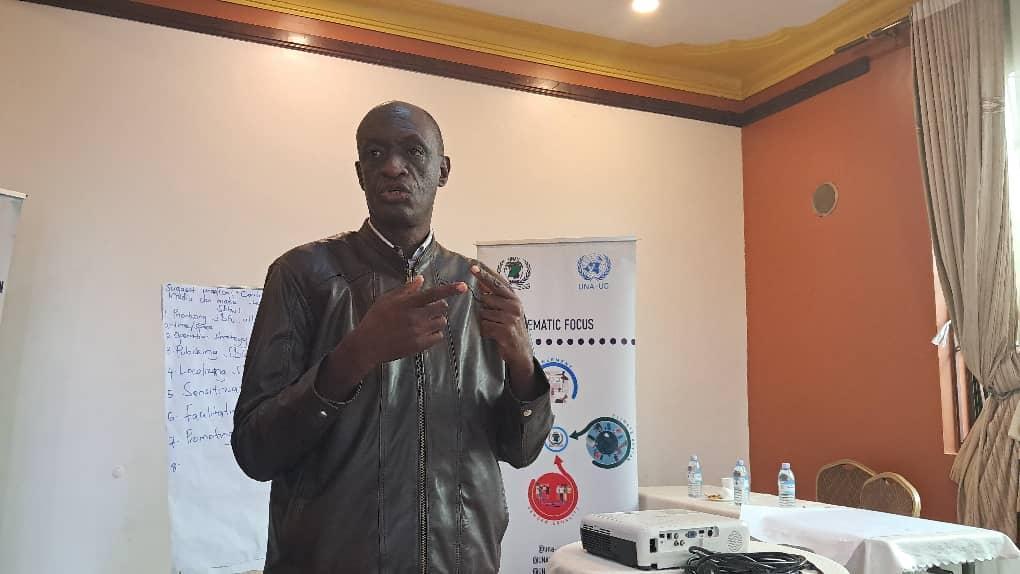
Africa-Press – Uganda. President of the United Nations Association of Uganda (UNAU), George Muwanguzi has urged stakeholders to adopt realistic and resource-conscious approaches to development, citing Uganda’s struggles with debt, misallocation of resources, and inefficiencies in implementing projects.
Speaking at an engagement on the country’s progress toward achieving the Sustainable Development Goals (SDGs), Muwanguzi the importance of comparative analysis and accountability in driving sustainable growth.
Muwanguzi highlighted the need to learn from countries excelling in development while adapting strategies to Uganda’s unique circumstances.
“Uganda has vast resources, but we need to utilize them efficiently. It’s not just about money but also how we manage and allocate these resources,”Muwanguzi said.
“We cannot copy Norway’s approach wholesale, but we can draw lessons while being realistic about our capabilities.”
He criticised the country’s reliance on debt to finance infrastructure projects, pointing out the costly delays and inefficiencies that erode the intended benefits.
“For instance, if a road project worth $200 million is supposed to be completed in two years but takes ten, the interest accrued and lost business opportunities are significant. We must scrutinise these delays and their economic implications,” he noted.
Muwanguzi the media and civil society to question government expenditures, especially in areas like classified spending and runaway costs on less critical ventures.
“If classified expenses account for a significant portion of the budget, we must ask why this is happening while essential services like healthcare are underfunded,” he said. “We need transparency and justification for every expenditure, comparing it to similar allocations in other countries to gauge efficiency.”
The UNAU President called on journalists to step out of their comfort zones and investigate the real impact of government spending on development.
He stressed the importance of questioning delays in project implementation, budget misallocations, and the opportunity costs of poor financial management.
“Cancer patients are spending hours in understaffed hospitals while funds are diverted to less critical areas. Media must highlight these discrepancies to inform the public and pressure decision-makers to prioritise better,” Muwanguzi.
Muwanguzi acknowledged that Uganda is lagging behind in achieving its SDG targets, attributing this to inadequate planning and resource mismanagement.
He emphasised the need for a collaborative effort involving government, civil society, and the media to realign the country’s development agenda.
“In the next five years, we can only do as much as we can, but we need to work smarter. The media is uniquely positioned to raise awareness, question inefficiencies, and propose actionable solutions,” he stated.
The Secretary General of the United Nations Association of Uganda (UNAU), Richard Baguma, commended the media for its pivotal role in fostering awareness and accountability on Sustainable Development Goals (SDGs) but urged journalists to delve deeper beyond event-based reporting to catalyse meaningful development.
Baguma emphasised that while the media has played a satisfactory role in holding stakeholders accountable, providing platforms for public discourse, and disseminating critical information, there is room for improvement in making development concepts more comprehensible and actionable for ordinary citizens.
“The media acts as an information broker, asking the questions people would ask if they could access us directly,” Baguma said. “However, beyond reporting events, the media needs to strive for deeper interpretations of development issues, breaking down complex concepts like human capital development or flagship programs like the Parish Development Model.”
Baguma highlighted corruption as a major impediment to Uganda’s development, urging the media to “scratch below the surface” and expose the structural factors hindering progress.
He called for interpretive journalism that helps communities understand the implications of policies and programs while holding those in power accountable.
“Development is a process, not an event,” he noted. “The media must push itself to explain what these processes mean for the average person and to create ownership of development efforts among citizens.”
Baguma praised the media’s efforts in translating complex terminologies like “Gross Domestic Product” and “Sustainable Development Goals” into relatable concepts for grassroots communities. He also lauded the sector’s role in extending the reach of development narratives beyond urban areas, ensuring inclusivity in Uganda’s growth agenda.
“Many community members do not understand English, yet most policies and programs are communicated in that language. The media bridges this gap, ensuring that development discourse is accessible,” he explained.
Looking forward, Baguma stressed the need for all stakeholders including government, civil society, and cultural institutions to collaborate with the media to foster grassroots development.
He noted that this partnership would enhance public awareness, ownership, and engagement with Uganda’s development agenda.
As Uganda transitions to a new development plan, Baguma urged the media to maintain its critical role in driving the national development narrative while fostering greater accountability and transparency among leaders.
“This partnership with the media is indispensable for meaningful development,” he said.
For More News And Analysis About Uganda Follow Africa-Press