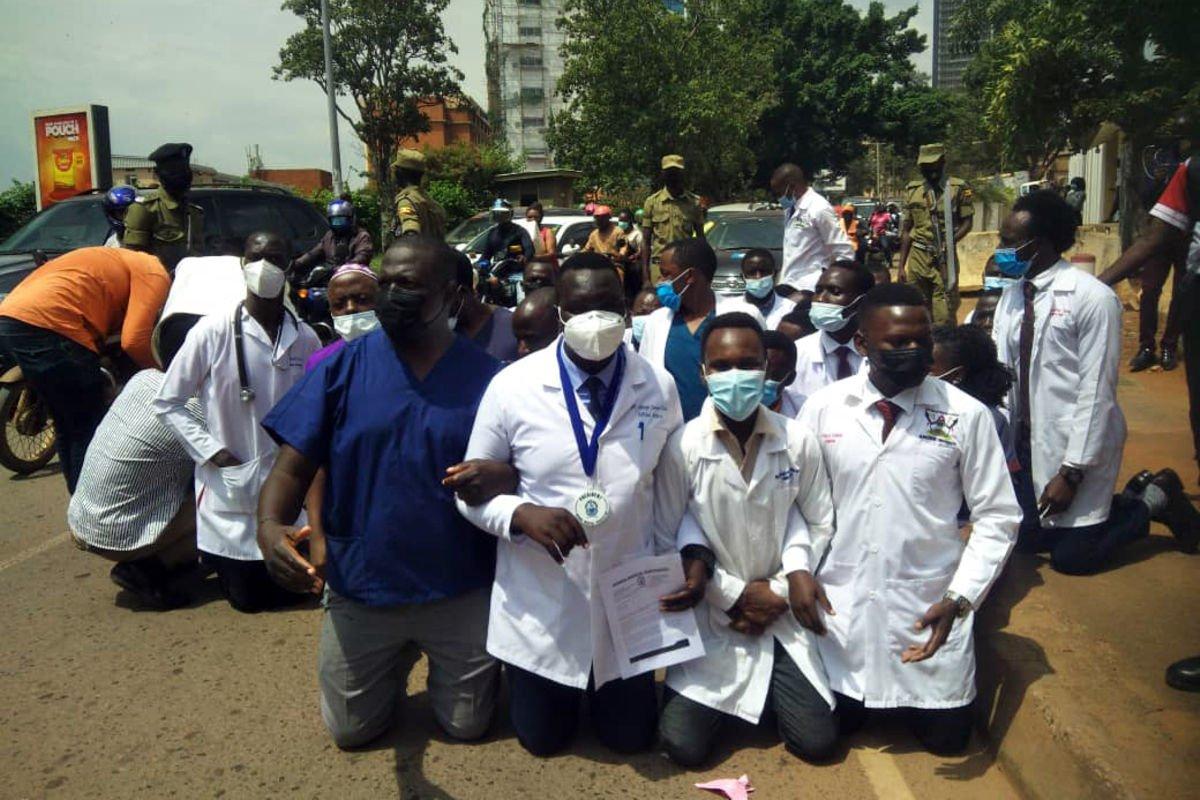
Africa-Press – Uganda. The medical laboratory professionals’ strike that started yesterday has thrown government hospitals into crisis as the personnel shun work along with medical interns and medical officers.
The strike by lab professionals, the scientists that conduct medical tests, is coming at a time when the country needs increased surveillance to avert the shocking rise in Covid-19 cases and the Omicron variant.
The Uganda Medical Laboratory Technology Association (UMLTA), with 10,000 members, the Federation for Uganda Medical Interns (FUMI), with 1,403 members, and the Uganda Medical Association (UMA), say they are striking because of low pay and the failure by government to respond to their grievances.
But now, the health workers under Uganda Nurses and Midwives Union (UNMU), a body with 18,000 members, have also threatened to go on strike because of salary disparities in the health sector.
Mr Jacob Were, the head of clinical laboratories at Mulago National Referral Hospital, told this newspaper yesterday that the strike is having devastating effects on patients as the few professionals in place are only handling emergency cases.
He said on a daily basis, the hospital has about 70 personnel in all the laboratories, but yesterday, they were less than 10.
“Laboratory testing is very critical in the management and treatment of patients because more than 80 percent of decisions in patient care are reliant on the quality test results that come from the lab,” he said.
“This industrial action leaves such a huge gap to a point we are seeing increasing numbers of confirmed cases of Covid-19. If the labs are closed, the country will not be able to tell who is infected, who is affected and who has the disease,” he said.
Unsuspecting Covid-19 patients are often detected in hospital lab tests because the symptoms of the disease are similar to those of other respiratory diseases. This lab confirmation saves the patient from the risk of getting wrong treatment, death and or spreading the virus unknowingly.
Dr Simon Peter Eyoku, the head of Kidney Unit at Mulago, told this newspaper that they can’t treat their patients without medical lab results.
“You cannot run internal medicine without the lab, because you need a lot of investigations to make diagnosis so medical lab work is paramount,” he said.
The UMLTA leaders say they are striking because of failure by government to address 12 issues, including failure to absorb more than 3,000 graduates in the profession, low pay, poor working condition and lack of housing, among others.
But the absence of lab workers were not only felt at Mulago as the industrial action is countrywide.
At Kiswa Health Centre IIII in Nakawa, Kampala, not a single government-employed lab personnel turned up for work yesterday.
But some students from Makerere University, who are training at the facility, were handling patients.
One of the facility officials, who preferred anonymity to speak freely, said the labs are being managed by certificate holders yet there are some sophisticated equipment they can’t operate. This was the same concern raised by Mr Were of Mulago.
Laboratory professionals have varying qualifications from certificate, diploma, degree, masters and PhD, and all of the quality of work is greatly reliant on the level of their qualification.
The official at Kiswa said: “In a health centre III that handles more than 10,000 city dwellers, there are only four lab assistants – certificate holders. Government doesn’t want to employ technicians and technologists, it is just there dwelling on lab assistants. There would be better services if they brought onboard the right cadres.”
“This facility is supposed to have a lab technologist, technician and a lab assistant but it is only relying on assistants [certificate holders],” the official added.
But the senior nurse in-charge of the facility, Ms Irene Nabukwasi, said they are not experiencing any impact of lab professionals’ strike.
“As you can see, patients are getting care,” said.
At Kisenyi Health Centre IV, another facility in Kampala, the laboratory was closed when our reporter reached the premises at around 1pm, and patients who were coming for testing were bounced.
The office of the officer in-charge of the facility was locked.
Mr Emmanuel Ainebyoona, the spokesperson of the Ministry of Health, appealed to lab professionals to consider dialogue and desist from the strike at the time when the country needs them most.
“We shall engage them and look at the issues they are raising and we see what is possible to be solved and which one is mid-term and long-term. But they need to ensure they don’t disrupt services at such a critical time when we are going into festivities and also when we have an increase in Covid-19 cases,” he said.
Statistics from the Health ministry indicate that the daily number of cases was as low as 32 on December 2, when 5,864 samples were tested. But it shot up drastically in the last seven days, with as high as 357 cases reported on December 18 alone when 6,497 samples were tested.
FUMI, the body that comprises intern doctors, pharmacists and nurses, started their strike on November 8 and they were joined by medical officers under UMA on November 22.
Some doctors at Mulago said the intern doctors have resumed work after the government agreed to pay them Shs2.5m. Medical interns were previously earning Shs750,000 per month.
Nurses threaten to go on strike
The Uganda Nurses and Midwives Union (UNMU), a body with 18,000 members, announced yesterday that they will go on strike if government doesn’t address disparities in payment for health workers.
UNMU said in a statement that it received information regarding the disparities in allowance scales of degree nurses from that promised by President Museveni.
The President promised medical interns an allowances half of their seniors in the profession. The negotiated allowance for graduate nurses and midwives is Shs4.8m and so the intern nurses were supposed to get Shs2.4m.
“The minister of Information [Dr Chris Baryomunsi] ought to have put that allowance of graduate nurses at Shs2.4m but to our surprise, the graduate nurses were promised Shs1.5m and their counterparts, the doctors, Shs2.5m. This kind of discrimination in the health sector will not be tolerated at all,” the statement reads.
For More News And Analysis About Uganda Follow Africa-Press