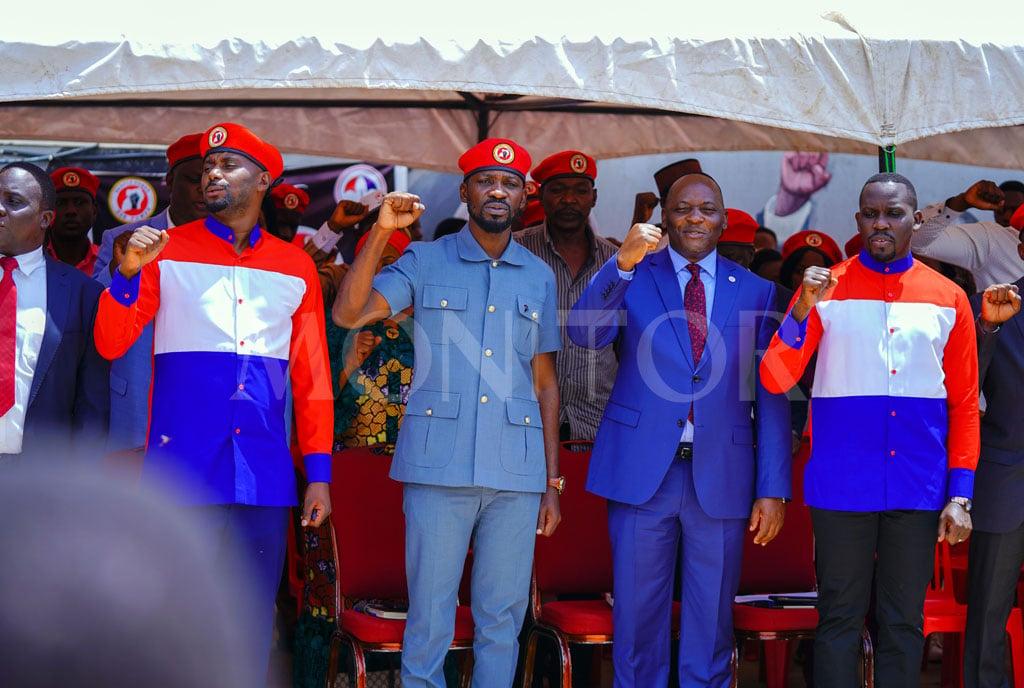
Africa-Press – Uganda. For the three years the National Unity Platform (NUP) has been in existence, the contents of its constitution have been one of its sticking issues.
Midwifed after Mr Robert Kyagulanyi Ssentamu, alias Bobi Wine’s People Power and Mr Moses Kibalama Nkonge’s National Unity, Reconciliation and Development Party (NURP) supposedly had a meeting of minds in 2020, NUP’s easy ‘childbirth’ belied many ‘labour’ complications.
After a fight over the ownership of NUP stuck out like a sore thumb, Mr Kyagulanyi’s faction decided to dispense with the constitution they had inherited from NURP. Mr Kibalama’s faction had apparently formulated the said constitution in 2004.
After the marriage of convenience collapsed, Mr Kyagulanyi’s NUP set up a Constitutional Review Commission led by Mr Medard Lubega Sseggona, the Busiro East lawmaker. The commission included, inter-alia, all of Mr Kyagulanyi’s deputies—Mr Mathias Mpuuga (central region), John Baptist Nambeshe (eastern region), Jolly Mugisha Ekyomugasho (western region) and Lina Zedriga (northern region).
Term limits
This past week, NUP, in a two-page document, unveiled findings of Mr Sseggona’s constitution review commission. What particularly raised eyebrows is the inclusion of a clause that prospectively fronts two term limits on all positions within the party structure. This includes Mr Kyagulanyi’s position—the presidency.
Similar restrictions have also been put on all elective positions outside the NUP structure such as Members of Parliament, Local Council chairpersons, and councillors, among others.
“The constitution imposes the two five-year term limits on all party leaders, as well as elected leaders under the party flag,” NUP said in a statement, explaining that one can’t be a party president, a party chairperson, or secretary general for more than two terms.
The statement added: “Likewise, a person can’t be a Member of Parliament or councillor, at the same level under the NUP flag for more than two terms. This provision will be operational beginning with the next elective term.”
Mr Alex Waiswa Mufumbiro, NUP’s deputy spokesperson, told Monitor that “no leader shall hold a position for more than two terms.” He further revealed that the nascent party will expect its leaders “to progress to another level or serve in another position.” There will, he added, be no third term for NUP’s flag bearers across the board.
Not a first
NUP isn’t the first political party to put term limits on its positions. The Forum for Democratic Change (FDC) also did this when it was established in 2005. Dr Kizza Besigye, its founding president, didn’t exceed the two terms. Ms Alice Alaso, FDC’s first secretary general, served two terms before forming the Alliance for National Transformation (ANT) with Mr Mugisha Muntu.
Where NUP has outdone FDC is by instituting term limits on all elective positions outside its structure. When the party was formed, it framed its campaign around changing the status quo and challenging seasoned politicians.
With more than 78 percent of Uganda’s population aged below 30, NUP saw a position to place itself. It set out to appeal to Uganda’s legions of youth.
“This is a party that is dominated by the youth and they believe the youth should always have hope, which was the main motive behind the term limits. Because within the party, there is a group that says they are tired of the old-timers and they are the majority,” a lawyer who was part of NUP’s constitutional review committee, said, adding, “Ultimately, the constitutional review team had to go with the popular view in the party.”
Mr Joel Ssenyonyi, the party’s spokesperson, said NUP’s constitution didn’t “match the times [since it] was made in 2004.” He added that one of NUP’s aspirations is to “lessen the powers of the president.”
President Museveni has entrenched himself in power by removing both the presidential term limits and age limits. Observers say the presidency in the country has also become overbearing, diminishing the concept of checks and balances that remain on paper. NUP says it wants to chart a different, more democratic path.
“I can understand the background from which they come that overstaying in office in Uganda has become a political problem in undermining democracy,” Mwambutsya Ndebesa, a senior lecturer at Makerere University’s College of Humanities and Social Sciences, says, adding, “There have been MPs and ministers who have been in their positions for more than 20 years, so in reaction to that, they seem to have reacted and gone overboard.”
Lessons from DP
According to sources who have been party to the formulation of NUP’s constitution, during the recent review, lessons were borrowed from Uganda’s oldest political party—the Democratic Party (DP).
“DP had a youth branch, the Uganda Young Democrats, but its leaders took long to leave those positions and the end wasn’t good. They didn’t give space to others,” said Samuel Muyizzi Mulindwa, DP’s former chief legal advisor, who decamped to NUP.
Using DP as a yardstick was easy for NUP since many of the latter’s top officials—including Mr Sseggona and Mr Mpuuga—crossed from DP to NUP before the 2021 General Election after falling out with DP president general Nobert Mao.
“With DP, they had Benedicto Kiwanuka, Kawanga Ssemogerere, John Ssebaana Kizito, who handed over to Mao, who has since refused to organise any credible elections within the party. That’s why DP is now in all sorts of problems. You need to have a process that allows new ideas and new faces,” Mr Muyizzi reasoned.
Mr Ndebesa, however, warns that dealing with term limits in a cookie-cutter manner can have its downsides.
“I think the question of limiting terms is relevant in situations where the officeholder wields a lot of power to shape events and direction. I mean an MP has no power to shape direction or policy,” he observed, adding, “They just participate in a political situation to give some kind of oversight but really not to shape politics.”
Shorn of experience
Analysts have warned that the wide-ranging changes that NUP is proffering could end up leaving the nascent party shorn of old, wise heads.
“You need experienced people. You need people with institutional memory, but at the same time provide change. It’s the question of balancing and not going to the extreme,” Mr Ndebesa opined, adding, “What NUP has decided is to the extreme, but you see extreme is not democracy. Democracy has its positives and pitfalls. So, when you overdo democracy, you actually harm democracy.”
Ever since NUP took over from the FDC as Uganda’s leading Opposition party, the main complaint from within and without has been that many of its legislators have barely performed in the House. One of the reasons proffered is that NUP has many first-time lawmakers.
“Many of my colleagues are now in Parliament,” Mr Mpuuga, the Leader of the Opposition in Parliament (LoP), said in March, adding, “They need a lot of guidance on how Parliament operates and the procedures.”
To counter the dearth of experienced lawmakers in the party, NUP says it has put in place an elder’s council. The council will be composed of experienced party members, whose role will be to guide the novices.
“The constitution introduces an advisory council comprising former party presidents, party chairpersons, deputy chairpersons, deputy presidents, secretaries general, former leaders of government business or leaders of the Opposition, and honorary members. The role of the council is to advise and give guidance on the general direction of the party at any time,” NUP said in its document.
Statistics show that almost six out of 10 lawmakers don’t make it back to Parliament after every general election. Observers say this renders NUP’s term limit restrictions on lawmakers redundant.
“Actually, there has been a high turnover of MPs and councillors. So, looking at that background, there is no need to limit them because you find that 80 percent or 70 percent of the incumbents lose but on the other hand, you see that [President Museveni] has been here for decades,” said Mr Ndebesa.
NUP constitution
“The constitution imposes the two five-year term limits on all party leaders, as well as elected leaders under the party flag,” NUP said in a statement, explaining that one can’t be a party president, a party chairperson, or secretary general for more than two terms. The statement added: “Likewise, a person can’t be a Member of Parliament or councillor, at the same level under the NUP flag for more than two terms. This provision will be operational beginning with the next elective term.”
For More News And Analysis About Uganda Follow Africa-Press