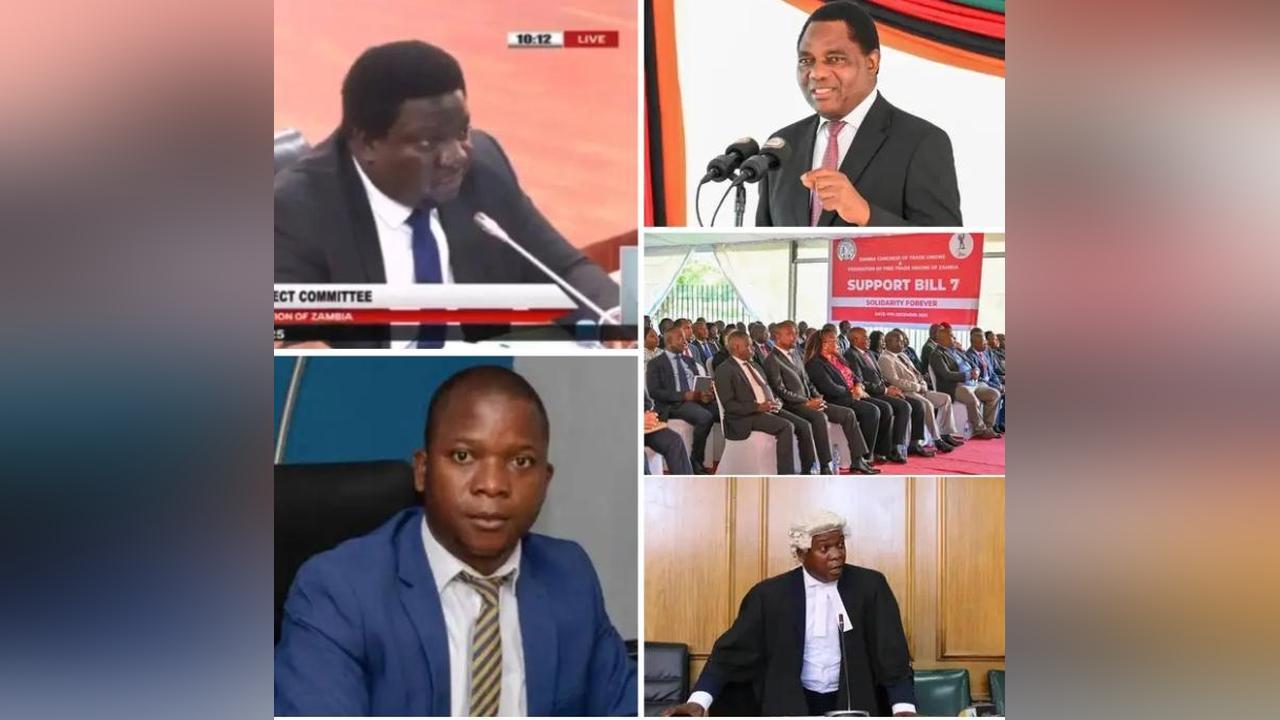
Africa-Press – Zambia. The political temperature around Bill 7 is rising fast, and Thursday’s dramatic encounter between the Law Association of Zambia and the Parliamentary Select Committee has become the latest fault line. LAZ entered the room determined to challenge the constitutionality of the Bill. The Committee insisted the session was limited strictly to substantive clauses.
When LAZ refused to move beyond its introduction, Committee Chairperson Imanga Wamunyima said, “LAZ has made a submission which it does not wish to read or speak to. You have only addressed your introduction. We now require you to speak to the key issues relating to the objects of the Bill.” With LAZ standing its ground, the session ended abruptly.
Critics online claimed Wamunyima was “bought,” but the Chairperson maintained that procedural concerns were sub judice and outside the mandate of a Select Committee, which is not a court.
LAZ President Lungisani Zulu defended the association’s stance by citing the Constitutional Court’s findings in the Munir Zulu and Celestine Mukandila case. He argued that the initiation of Bill 7 breached Articles 1, 2, 5, 7, 8, 9, 61, 90, 91 and 92 of the Constitution. “Any act or omission contrary to the Constitution is illegal,” Zulu said.
However, the Select Committee countered that the Court did not declare Bill 7 itself unconstitutional, only that the initiation process was flawed.
The distinction matters. Parliament insists it is considering a “proposed law,” one that has not yet been interpreted by any court. This is why the Committee pressed LAZ to speak to its written submission on the Bill’s content, which LAZ declined to do.
On the sidelines, some LAZ members now argue the association has crossed into political advocacy. They have petitioned for an Extraordinary General Meeting; asking whether LAZ’s affiliation to OASIS Forum still reflects the will of its membership. These petitioners want a vote “by poll” to settle the matter.
The rising intra-institutional debate signal a broader struggle over legitimacy: who speaks for the nation, and who defines constitutional propriety. LAZ nearing crossroads.
Meanwhile the political narrative around the Bill continues to shift. Early criticism focused on content i.e. delimitation, mixed-member representation, the two-thirds threshold. Now most opposition commentary has moved almost entirely to process, as the legal case is easier to frame than the technical details of electoral reform.
But the claim that “there was no consultation” sits uneasily with the fact that the Technical Committee received more than 11,864 submissions, one of the largest consultative data sets in Zambia’s constitutional history. Whether this number is adequate is a fair debate. However, dismissing it outright feeds the perception that some groups believe national processes require their personal endorsement before they qualify as “legitimate.”
While legal battles and political pressure groups occupy the spotlight, State House is deliberately repositioning itself through dialogue. On Thursday, President Hakainde Hichilema hosted labour unions at State House and described the meeting as “frank and constructive.”
Hichilema added, “We firmly believe that however complex our national difficulties might be, they are best resolved through dialogue rather than through actions that endanger life and property.”
The timing is not accidental. With opposition voices framing the regime as authoritarian, the President continues to reclaim the language of consultation and stability.
These developments unfold as the Select Committee moves into its most consequential week. Its report will shape parliamentary debate and determine whether MPs find enough political courage to vote according to principle or factional loyalty.
The youngest MP in the House, Chairperson Wamunyima, sits at the centre of this storm. His insistence on procedural discipline has angered PF-aligned voices online who accuse him of partisan alignment.
However, the Committee’s work is guided by strict Standing Orders: it is not a forum for judicial review. It is a fact-finding body mandated to receive submissions on content and send recommendations to the House.
As the Bill moves toward the Second Reading next week, Zambians should prepare for an escalation in both rhetoric and legal manoeuvres. But the essential democratic truth remains unchanged. Parliament will decide this Bill.
Supporters and opponents alike must rely on MPs, not hashtags, to determine the outcome.
The public must stay informed, but clarity begins with understanding what each institution can and cannot do.
Readers with information, insights or opinion pieces are invited to write to us at [email protected].
For More News And Analysis About Zambia Follow Africa-Press