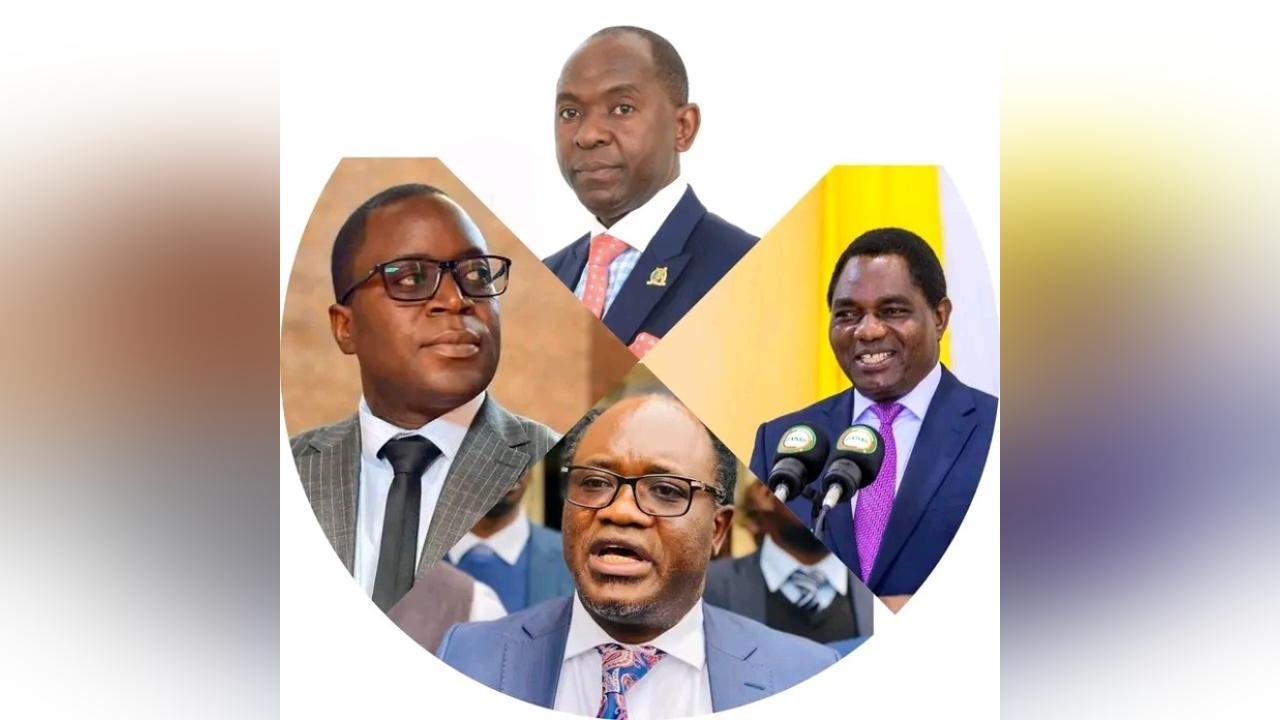
Africa-Press – Zambia. *_Rising voices like Makebi Zulu and Brian Mundubile signal generational promise—but only Kelvin Fube Bwalya embodies the hardened electoral strategy needed to seize power_*
As Zambia approaches its pivotal 2026 general elections, the political landscape reveals a tension familiar to democratic systems worldwide: the balance between youthful leadership and seasoned electoral strategy. The governing United Party for National Development (UPND), having endured over two decades in opposition prior to its 2021 victory, is neither institutionally fragile nor politically naïve. To assume otherwise would be to misread both history and the mechanics of democratic consolidation.
Within opposition circles, a growing discourse has positioned figures such as Makebi Zulu and Brian Mundubile as potential standard-bearers. Their credentials, rooted in legal advocacy, parliamentary experience, and constituency-level organization, are not without merit. Indeed, in mature democracies, the cultivation of new leadership is both inevitable and necessary. However, the transition from local or factional influence to national electoral command is neither linear nor guaranteed.
Comparative political analysis underscores a critical point: national elections demand not merely popularity, but sophisticated logistical coordination, coalition-building, and crucially, the capacity to safeguard electoral integrity. In this regard, the profile of Kelvin Fube Bwalya (commonly referred to as KBF), leader of the Zambia Must Prosper party, invites serious consideration.
KBF’s political trajectory, particularly 2011 with Micheal Sata, 2015 and 2016 with Dr. Edgar Chagwa Lungu, 2026 With Hakainde Hichilema, intersects with key moments in Zambia’s recent electoral history. Observers have frequently noted his operational acumen during this period, including his involvement in strategic mobilization and electoral planning. While political narratives often simplify such contributions, the broader consensus among analysts is that his experience reflects an understanding of both the formal and informal dimensions of electoral politics.
Internationally, opposition movements that successfully unseat incumbents, whether in Eastern Europe, Latin America, or parts of Africa, tend to coalesce around figures who combine organizational discipline with strategic foresight. The defeat of entrenched ruling parties rarely occurs through fragmented efforts or experimental leadership alone. Rather, it requires what scholars of comparative politics term “electoral convergence”: the alignment of diverse opposition actors behind a candidate capable of commanding both trust and tactical coherence.
In this context, the Zambian opposition faces a structural dilemma. Fragmentation, often driven by personal ambition or ideological divergence, risks diluting its electoral viability. The notion that an incumbent administration, particularly one as recently legitimized as the UPND, would relinquish power without a formidable challenge is, at best, optimistic and, at worst, strategically negligent.
It is within this analytical framework that KBF’s candidacy gains salience. Critics have characterized him as polarizing or self-interested, labels not uncommon in competitive political environments. Yet such critiques, while politically potent, do not necessarily negate his demonstrated competencies. Indeed, history offers numerous examples of contentious figures who nonetheless proved electorally effective.
The comparison to figures such as Vernon Mwaanga, renowned for his political maneuvering during earlier eras, may be imperfect but is instructive. It highlights a recurring theme in Zambian politics: the enduring value of strategic intelligence in navigating complex electoral terrains.
None of this diminishes the importance of emerging leaders like Makebi Zulu and Brian Mundubile. On the contrary, their roles may prove indispensable in shaping the long-term future of the opposition. However, the immediacy of the 2026 contest demands a pragmatic assessment of capabilities. Elections of this magnitude are not merely contests of ideas but tests of organizational resilience and strategic execution.
Ultimately, the question confronting the opposition is not simply who represents its ideals, but who can most effectively translate those ideals into electoral victory. If unity remains elusive, the consequences may extend beyond a single electoral cycle, potentially entrenching the ruling party’s dominance and narrowing the democratic space.
The 2026 elections, therefore, are not “just another election.” They represent a distinctive moment in Zambia’s democratic evolution.
Whether the opposition can rise to this challenge will depend less on rhetoric and more on its willingness to align ambition with strategy and, perhaps, to recognize the value of experience in the unforgiving arena of national politics.
For More News And Analysis About Zambia Follow Africa-Press