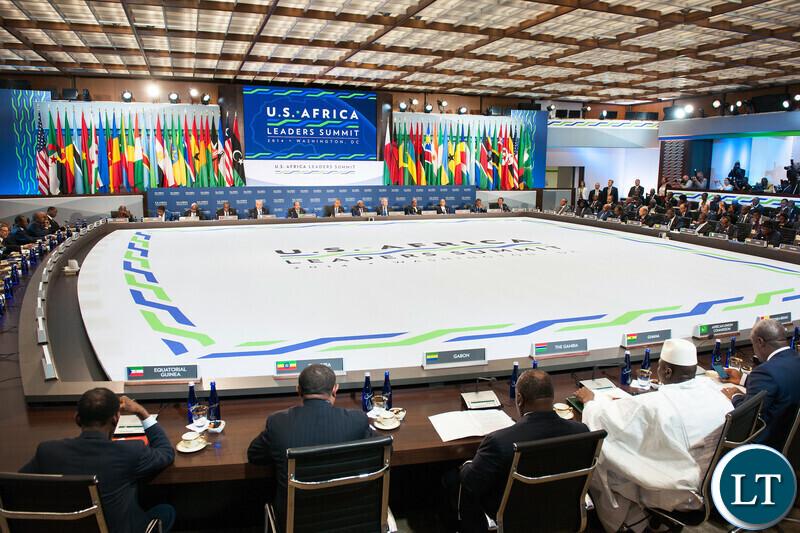
Africa-Press – Zambia. This week, I saw my President boarding a plane to go to the United States of America (USA) to attend the Africa-USA Summit for 2022 being hosted by President Biden from 13-15 December. The USA traditionally holds similar summits but often through the Africa Growth Opportunities Act (AGOA), a legislation that provides free market access for most African countries’ exports to that country. The Heads of State from the two sides, African countries and the USA will be making new pledges or repeating old ones of increasing trade as an engine of economic development. African leaders are known for reminding rich countries, “Africa needs trade not aid” and they will be repeating that. I don’t agree because I don’t see how Africa, which has nothing to trade can ask for that. Africa needs aid to develop its supply capacities to trade.
Even if they repeat the need for the two partners to continue to trade with each other, one rationale behind the Summit is that the USA is looking for ways to challenge China’s presence in Africa on the one hand. On the other hand, the USA continues to fear China’s global hegemony. For those unaware, China has overtaken the USA in global exports of all products on the one hand, and on the other global exports of manufactured goods in absolute values.
Some will remember that the USA is challenging China at the World Trade Organization (WTO) to behave as a developed not developing country in its commitments to the organization where it is expected to cut import tariffs almost the same level as rich countries. The USA submitted to the WTO a long proposal containing statistics showing almost all economic, technology, trade and investment areas in which it said China has made as much progress as rich countries.
So, while repeat of pledges to trade with each other will certainly be one of the subjects on the table, I doubt if details of the reality on the ground will be discussed. Global economic governance requires that African leaders report frankly to their citizens outcomes of economic issues that they’re engaged in with their global partners. Global economic governance requires that our leaders are transparent and accountable. One way is to present to Summits like this, and report back to citizens, all economic issues of the agenda, including facts about what’s going on, on the ground.
One subject I have in mind is the deteriorating trade partnership between Africa and the USA that few citizens in Africa may know about, but which the majority are unaware of, despite repeated public pronouncements of flourishing partnership. On the one hand, the USA is very vocal that trade between Africa and itself is strong. On the other, African leaders are always asking for continued extension of AGOA to allow them to trade more with the USA. And the hypocrisy continues. In addition, there’s a lot of self-approbation by African NGOs, private and public sectors and the African Union that give the impression that trade between Africa and the USA is doing well. Citizens deserve the right to know the truth.
The truth is that trade between the two has, since 2008 been falling lamentably. AGOA was granted in 2000 and, according to Figure 1 below, yes, this was followed by a strong correlation of Africa’s rising exports to the USA, from $20 billion to $110 billion in 2008, the highest peak. But no sooner did Africa and the USA celebrate than exports began to dwindle uncontrollably, down from $110 billion reported in 2008 to $35 billion in 2021. On the other hand, USA exports to Africa are miserably low, only $7 billion in 2021. Zambia, my country exported only $52 million worth of goods to the USA. In ranking in of the fifty-five African countries’ exports to the USA, Zambia ranked number thirty-one. I hope our President was armed with these statistics in his global marketing of our country.
It’s incomprehensive that Africa is divesting its exports from the most important market in the world that Asian countries continue to fight for. African officials continue to appease ourselves with cheap praises while Asian countries are condemning themselves for what they perceive as exporting less to the USA although you and I know it’s significant. It shows they’ve a more competitive culture than we, who praise little things. Asians fight and win big wars while we fight and win small ones and praise ourselves. Africa should know that it has failed to take advantage of free market access to the USA. We will always complain and give excuses while Asian counterparts are integrating in global value addition and networks. When the USA attends Asian Summits, its an opportunity for countries there to showcase their massive gains from exports to that country and ask for more market access because they’ve global competitive products. Africa has nothing.
Africa is so uncompetitive that today, it’s no longer necessary to compare its global performance with the Asian region. All you do is simply compare with small Asian countries. For example, Bangladesh, an Asian least developed country is not given free market access like AGOA to the USA which Africa enjoys. Yet, Bangladesh exports more textile and clothing products to that country, seen in Table 1 below than Africa. Table 1: Africa’s exports to USA of textiles and clothing products in $ millions 2021 Bangladesh 7,012 Africa 2,567 Source: Unctadstat
The explanation for Africa’s eroding trade with the USA is simply that Africa has diversified its export market, shifting from the USA to China, plus the traditional argument that we simply have nothing to export. In 1995, as shown in Table 2 below, Africa exported more to the USA than to China. But check 2021 and you will see the huge shift of almost threefold exports to China compared to those to the USA. But this diversification has had no corresponding diversification in exports. Africa’s exports are largely primary commodities in return for China’s exports of manufactured goods to Africa.
Table 2: Africa’s exports of all products to China/USA in $ Billions 1995 2021 Africa to China 1.4 93.7 Africa to USA 16.8 34.8 Source: Unctadstat This shift is one of the reasons for the Summit. Yet, Africa can argue that the USA has not helped it in export value addition. Very few countries like South Africa, Mauritius and Lesotho are exporting manufactured goods while the majority export primary commodities. Of course, Africa shifted the market to China for reasons other than trade, including infrastructure-building, aid, etc. Otherwise, in both markets, the configuration of unevenness is the same.
Free market access is no longer a relevant development model amid limited export products. The correct development model is development of production, productivity, and ability to export dynamic manufactured goods. One driver of that is foreign direct investment (FDI) from the USA to Africa. Replication of the USA-Viet Nam model can be tried. One reason why Viet Nam has overtaken Africa in global exports of manufactured goods is the contribution of FDI from the USA although the major part comes from within Asia because FDI exists in Hong Kong, Singapore, South Korea, and China, unlike in Africa. The USA played a major role in the Brazilian economic miracle. There must be a robust shift in the way Africa negotiates its economic interests.
For More News And Analysis About Zambia Follow Africa-Press