Africa-Press – Zambia. In January 2022 a total of 409,441 pupils in Zambia progressed to start their secondary school education in Grade 8. At the same time only 140,338 pupils will have started their senior secondary education in Grade 10 due to lack of places in senior secondary schools. This will translate to roughly two-thirds of children who complete primary school not being able to have a full secondary school education.
The UNESCO Education 2030 Framework for Action endorses two key benchmarks for public financing of education: According to UNESCO, achieving the target for basic education by 2030 requires that countries spend at least the amounts listed above. The table below shows how the Zambian expenditure compares to these targets. It shows a decreasing trend of funds allocated to education with the last three years falling below the minimum recommended by the UN.
Table 1: Spend on Education by the Government of the Republic of Zambia (GRZ) Additionally, it is worth noting that by international standards the absolute amount of government spending per pupil in Zambia is low. The average amount spent per pupil across primary and secondary schools in Zambia in 2017 was $476 (purchasing power parity adjusted value). This is similar to the average for African countries but well below the average values in Latin America ($2000) and Asia ($2500 – $4000).
The quality of education outcomes in Zambia remains low. The Organisation for Economic Co-operation and Development (OECD) Programme for International Student Assessment (PISA) showed that in 2017 only 5% and 2% of sampled 15 year old pupils achieved the minimum level of proficiency in reading and mathematics respectively. This compared unfavourably to international OECD averages of pupils minimum level of performance of 80% in reading and 77% in mathematics.
It is acknowledged that there are many factors that contribute to the poor educational outcomes in Zambia, such as: These issues are well known and need attention in tandem with those raised in this article.
The latest estimate of the overall national electricity access rate at household level in Zambia is only 31%. Approximately 67% of the population in urban areas and only 4% in rural areas have access to electricity in their homes.
As part of the national strategy document, Vision 2030, GRZ has set electrification targets at 90% percent for urban and 51% percent for rural areas to be reached by 2030. The rural electrification target is based on the electrification of 1217 Rural Growth Centres (RGCs) through grid extensions, mini-hydro, and solar photo-voltaic (PV) installations as outlined in the Rural Electrification Master Plan (REMP) of 2008.
To achieve the rural electrification target of 51% by 2030 approximately $50 million per annum financing is required for the Rural Electrification Fund (REF). The national budget allocations for rural electrification have averaged at $15 million over the past seven years which is well below the $50 million required to achieve the stated rural electrification targets by 2030.
At the request of the Ministry of Energy and the Rural Electrification Authority the United States Agency for International Development Southern Africa Energy Program (USAID SAEP) has generated a geospatial model to determine the least-cost electrification solution for each household in Zambia. The model considers electricity demand, generation capacity and cost data to determine the least cost technology for each household. The four technologies considered are grid extension, solar mini-grid, hydro mini-grid and solar home systems.
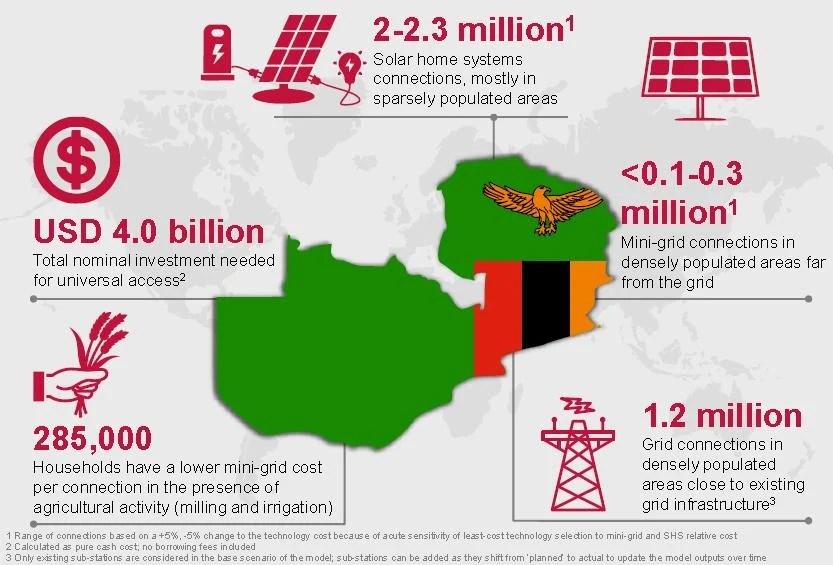
The model shows that approximately $4 billion (non-discounted amount in 2017 real terms) would have been needed to achieve universal electricity access in Zambia by 2030. Solar home systems (SHS) would be the most affordable technologies for around 62% of households currently without electricity. Grid connections are deemed to be the most suitable solution for 34% of households without electricity. The remainder of un-electrified households (4%) would benefit from solar mini-grid solutions. This is summarised in the plot below.
Figure 1: Universal Electricity Access Snapshot for 2030 The addition of productive agricultural activity such as milling and irrigation would increase the mini-grid selection to 7% of the total and reduce solar home systems to 59%. The map of least cost solution is shown spatially in the figure below. Figure 2: Map of Least Cost Technology Type with Productive Agricultural Use Included
In South Korea, in the 1960s and 1970s, rural electrification allowed farmers to achieve agricultural modernisation that included improvements in crop yield, cropping intensities, area farmed and productivity, as well as decreased labour and time costs. Electricity is also crucial in increasing the value added that farmers can derive from further processing of their produce and also for using information and communication technology (ICT) to obtain information on market conditions.
The cost of solar electricity has reduced dramatically in comparison to other technologies in recent years. It is now the cheapest source of electricity for new power plants with a levelised cost of energy of $0.04/kWh. This has been due to the advances made in the entire production process of solar panel modules including increased R&D efforts creating greater efficiencies of the panels and increased economies of scales in manufacturing.
Zambia has an average solar irradiation of 5.5 kWh/m²/day with approximately 3,000 sunshine hours annually providing good potential for photovoltaic and solar thermal applications. At an irradiation conversion efficiency of 20%, solar panels would be able to generate 1.1 kWh/m2 of electricity per day. The AEP Zambia Geospatial Model assumes different electricity consumption levels for un-electrified rural and urban settlements as shown in the table below. The solar panel sizes required to fulfil the household electricity demand for each settlement type have also been calculated.
Table 2: Estimated energy demand and solar PV sizes required for different settlements Settlement type Appliances included in model Daily demand per household (kWh)
It is noted that due to their high energy consumption levels modern energy cooking solutions do not appear in the proposed electrification systems. A higher consumption and payment level would be required to include cooking solutions. However, a study into developing a grid or solar PV battery-supported electric cooking concept called eCook has shown that the estimated cooking energy requirement for a 5 person household is a minimum of 1.9 kWh. This would increase by a factor of 4 the proposed energy required for newly electrified rural settlements and double it for newly electrified low income urban settlements.
The differences in the structure between a centralised system and one that is decentralised or distributed are shown in the figure below. A centralised system, like the current electricity grid in Zambia, has very few dominant centres (electricity generation points) with all the other nodes within the network feeding from these centres. Failure of a central node can cause failure of all the other nodes. This has been the case with the country-wide electricity deficits experienced in 2015 and 2019 following low water levels at the Kariba Dam power station.
A more distributed electricity generation network would have many sources of power generation and be more resilient to the effects of a single failure. The various linkages would also mean that there is less scope for a single failure in the distribution network to cause large network-wide failures, as has been the case on occasion. Distributed networks can also be created in a more modular fashion, with small sections developed at a time, leading to smaller capital outlays. Figure 3: Centralised, Decentralised and Distributed System diagrams
Complex systems both in nature and manmade evolve through innovations and deviations from the norm. Similarly experiments at the cutting edges can provide the transformation needed to create distributive and regenerative (sustainable) systems. It is argued that finding the leverage points in a system can help achieve the necessary change for overall transformation. By making small changes at the right point, such as the provision of electricity to all schools, larger development changes can be achieved in the wider economic system.
Deforestation is a major problem in Zambia, with annual rates estimated at around 250,000 to 300,000 hectares (out of a total of 49.5 million hectares of forest). The role that the use of charcoal and firewood plays in deforestation is significant:
Charcoal production is the biggest single driver of wood extraction and the primary cause of deforestation and forest degradation contributing to the degradation of 190,000 hectares of forest annually. The high dependence on wood fuel is due to low electricity access, the high cost of efficient alternatives coupled with low incomes and inadequate enforcement of legislation and coordination among key sector institutions.
The use of solid biofuels such as firewood and charcoal for cooking can cause household air pollution that results in respiratory illnesses, heart problems and death. Indoor air pollution causes more than 4 million premature deaths around the world every year with 50% being in children under the age of 5. Women in rural areas of Zambia are particularly affected by this due to the burden of collecting fuel and cooking that predominantly falls upon them. Innovative solutions for clean cooking are needed urgently to address these most basic needs while also delivering climate benefits.
A review of the links between education outcomes and the presence of electricity in schools shows that the lack of electricity in schools has persisted across the world despite growth in large-scale electricity networks. Studies have shown that electrification of homes, schools and communities produces positive educational effects such as: A number of challenges in providing electricity to all schools have been identified as follows:
There are 9733 primary and secondary schools in Zambia of which approximately 80% are in rural areas and do not have access to electricity. Increasing access to electricity in addition to other school infrastructure improvements and better teacher training are necessary for Zambia to attain the education outcomes required for sustainable development.
Schools should be selected as the sites from which to achieve universal electrification using a mixture of grid connections, off-grid solar home systems and solar mini-grids. Electrifying all schools would provide a much needed boost to the quality of education provision and increase the development of local economies. This would act as a catalyst to connecting domestic dwellings to local electricity networks and then eventually to wider grid networks.
For More News And Analysis About Zambia Follow Africa-Press