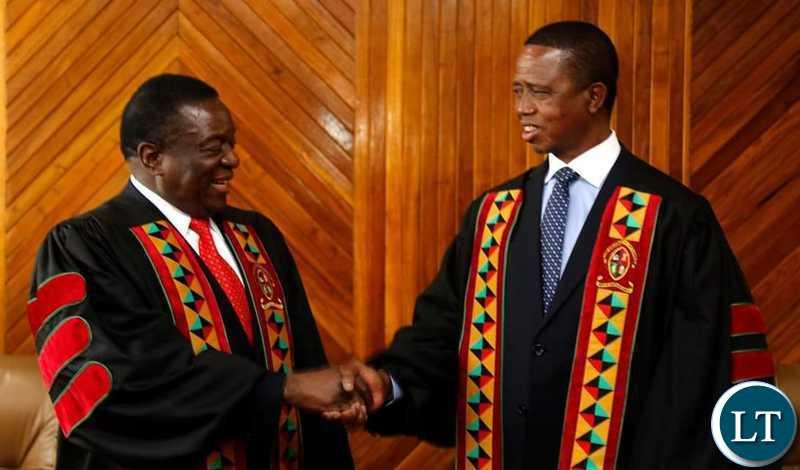
Africa-Press – Zambia. IN JUNE 2019 the University of Zambia (UNZA), my institution, awarded President Edgar Lungu and Zimbabwean President Emmerson Dambudzo Mnangagwa honorary doctorates in law for ‘exceptional leadership and upholding the rule of law’, in short good for good governance.
Although Lungu himself advised that he should not be called ‘Dr’ Lungu, his followers have no heeded and he hasn’t corrected them. He said, “Firstly, I am not a Doctor. I do not have a doctorate and I do not wish to be called Dr. Edgar Lungu. There is so much talk about the doctorate to be conferred on me by the University of Zambia which I am greatly humbled with.”
Whether or not to call Lungu “Dr” is not the focus of this article. It is rather on whether he has earned the PhD in ‘governance’ conferred on him. When former USA president Barrack Obama was awarded the Nobel Peace Prize, just one year into his presidency in December 2009, his critics said to him, “You have been awarded, now earn it.” The statement clearly distinguishes deserving at the time of the awarding from earning it, at the end of the recipients term of public service. Hence, Obama said he took the award not as a reward for accomplishments but as a “call to action.”
For those who may not know, a Doctor of Philosophy (or PhD) is a degree at the highest academic level awarded following a course of study. PhDs are awarded for programmes across the whole breadth of academic fields. Because it is an EARNED research degree, those studying for a PhD are required to produce original research that expands the boundaries of knowledge, normally in the form of a thesis.
Wikipedia tells us that, “An honorary degree is an academic degree for which a university (or other degree-awarding institution) has waived all of the usual requirements, such as matriculation, attendance, course credits, a dissertation, and the passing of comprehensive examinations. The degree is often conferred as a way of honouring a distinguished visitor’s contributions to a specific field or to society in general.”
Lungu was awarded a PhD in good governance. Governance itself is said to consist “of the traditions and institutions by which authority in a country is exercised.” According to the United Nations, key measures of good governance are include: citizen participation; new styles of leadership; accountability and transparency; capable public management in economic management, service delivery, sustainable natural resource management and fiscal administration; and respect for law and human rights.
So my questions are: did Lungu deserve the award as at June 2019? And, has he earned it if he didn’t deserve it then? Can it be said that he regarded the award as ‘call to action’ in good governance and has he lived by the call?
To both questions my answer is a categorical NO. To the extent that the PhD is in good governance, he did not deserve it and he has not earned it. I know PF cadres will call me names for saying this but guess what, a PhD is an academic award. That’s why it is only gjven by academic institutions. In academics we argue with facts, with our heads (mutu) and not with our hearts (emotions). So if one cannot counter-argue at that level, sorry it is not for you. Sit down. You are not there.
The reasons I advance below are the same ones that were advanced by those that were opposed to the award both within and outside of the awarding body – Senate – as we read in the media. The University of Zambia Lecturers and Researchers Union (UNZALARU) for instance, condemned the development and argued that it was concerned that the timing and reasons advanced for conferring Lungu with a doctorate degree “were inadequate to satisfy the widespread indignation, ridicule and scorn the wider public would render”.
On behalf of UNZALARU Publicity Secretary Moffat Moyo said, “The union strongly advised against the conferring of the honorary degree, as such a move would bring negative publicity and impact to the university in the short and long term. The timing and reasons advanced were inadequate to satisfy the widespread indignation, ridicule and scorn the wider public would render.”
Moyo further argued that, “The current mood in the nation suggested that the idea was ill-conceived, ill-informed and lacked evidence on the ground for good governance in general and inadequate support to higher education by the current regime in particular.”
Ricky Mukonza, a public management senior lecturer at South Africa’s Tshwane University of Technology, said, “There is no reasonable justification for UNZA to award the two leaders honorary doctorate degrees, worse still for good governance. This is because their stints in power have been marred by controversies on governance-related issues.
“Lungu has been in the headlines for crushing dissenting voices in Zambia. ED’s [Mnangagwa’s] government stands accused of killing people in the aftermath of the 2018 elections as well as those who engaged in protests earlier in the year. Add to that the recent harassment of civil society activists. All this brings into question why the two leaders are receiving honorary degrees,” he said.
Garry Nkombo of the opposition UPND also highlighted some of Lungu’s failings, “I think if he deserves any honour that is fine. But that which they want to confer upon him is clearly not the one because it clear knowledge that Zambia’s governance record is at its lowest stage in the reign of President Lungu and there is no contest to that. The abuse of human rights has been rampant in his style of governance under his nose. The issue of arbitrary arrests of political enemies is in the front stage. The issue after the revelation by the Financial Intelligence Centre (FIC) tells us that our corruption index has risen exponentially and all other issues about the institutions of governance, including the police, have suffered a lot of abuse during this particular period of governance.”
I have argued in my previous articles that 2016 – 2021 has been the worst for our democracy and human and individual rights and freedoms since advent of the Third Republic (in 1991). Below are some examples of governance transgressions:
Individual rights and freedoms – notably assembly, free speech and movement: our constitution clearly grants Zambian citizens freedoms of assembly, movements, speech, etc. This is regardless of whether it is election time or not. However, in Lungu’s Zambia citizens right to assembly or hold demonstrations have been forbidden. Yet the PF in opposition freely held meetings whether it was campaign time or not. Lungu has repeatedly argued that there is no need for citizen assemblies after elections. Yet Michael Sata, as opposition PF leader, would be on the road soon after losing the elections of 2006 and 2008. We read that the opposition UPND have tried to do the same after the 2015 and 2016 elections but would be stopped. As I write, the opposition leaders, especially Hakainde Hichilema of the UPND, PF’s number 1 enemy, is being stopped from moving freely despite this being a campaign period. A group of civil society activists who tried to demonstrate against the purchase.
The annual reports by Amnesty International, for instance, summarise the groom picture on human rights abuses in Zambia: in 2020 it wrote that, “Legislation, intimidation and harassment were used by the authorities to repress the right to freedom of assembly. In June, the President issued threats against members of civil society organizations and anyone else who planned to protest against infringements of their right to freedom of expression. He called on the Minister of Home Affairs to “deal with these boys” whom he said promoted “anarchy”. On 30 September, the Inspector-General of Police said civil society members and traditional leadership were “inciting anarchy.”
In 2021 Amnesty report reads, “Zambian authorities have escalated their attacks on dissent by thwarting a planned anti-corruption protest leading to organisers streaming their protest from the outskirts of Lusaka. According to a coalition of civil society organizations, Zambian authorities are escalating their attacks and intolerance for the rights to freedom of expression and freedom of peaceful assembly, by clamping down on peaceful dissent in the country. We urge authorities to stop seeing protesters as enemies of the state, and instead take heed of the criticism and not silence them.”
The Public Order Act has been used selectively to silence voices of dissent. For instance, Fumba Chama, Laura Miti and Bornwell Mwewa were been arrested in December 2019 arrested and put cells for merely demonstrating against the purchase of fire tenders. Chama was also charged with unlawful assembly after he hosted a youth forum on good governance. The courts acquitted them and re-affirmed abuse of the POA by the police.
Corruption: as pointed out by Nkombo (above) the FIC and Auditor General’s reports have repeatedly pointed to high level corruption in public institutions. We live with PF party and senior government officials. We are all witness to what they were before and what they have become during Lungu’s tenure.
Flawed constitution: I have heard some PF campaigners for the 2016 election boast about Lungu having enacted a new constitution in January 2016. What they conveniently avoid to say is that the same Lungu and his PF initiated ‘reforms’ within months of launching the new constitution. The much campaign for Bill 10 was about addressing the many pitfalls in the 2016 constitution; by the way you will recall that MPs were forced to work throughout the night to complete the draft, as if the way was coming to an end. In the end funds were wasted for both the draft and Bill 10.
Political violence: as I wrote in this column as few ago, political violence, or Panga democracy as a call it, is a new culture introduced to the Zambian political culture in 2011 and escalated and perfected since 2016. Never before since 1991 did the country experienced such high levels of political violence and intolerance as during the last five years. We have learnt from interactions with political parties that they now have to recruit and train bouncers to repel PF bouncers. The end result is a cycle and NEW culture of violence in our politics. How sad! And the same culture has come to haunt the PF in form their own internal violence. Examples abounds.
Closure of media institutions:
since 2016 and even after June 2019 a number TV and radio have been shut down temporarily or permanently on very flimsy grounds in some cases. The Post Newspapers shut down permanently in November 2016; Muvi TV, Itezhi tezhi radio and Komboni were suspended. In 2020 Prime Television’s licence was revoked “in the interests of public safety, security, peace, welfare or good order”. All these activities have a net effect on press freedom and public access to a variety of information, both of which are vital ingredients of an effective democracy.
Abuse of ZNBC/Public Media: many now agree that ZNBC and other public media are their worst since 1991. For instance, 1991 the opposition MMD would place negative adverts on UNIP and they would run. The story was different under Lungu’s PF, 30 years into democracy.
I end here in the interest of space. I have no doubt that you my readers will add more facts to my argument that Lungu didn’t deserve, hasn’t earned the PhD. Period. The author is a researcher and scholar with the Institute of Economic and Social Research, University of Zambia. He is reachable on [email protected]