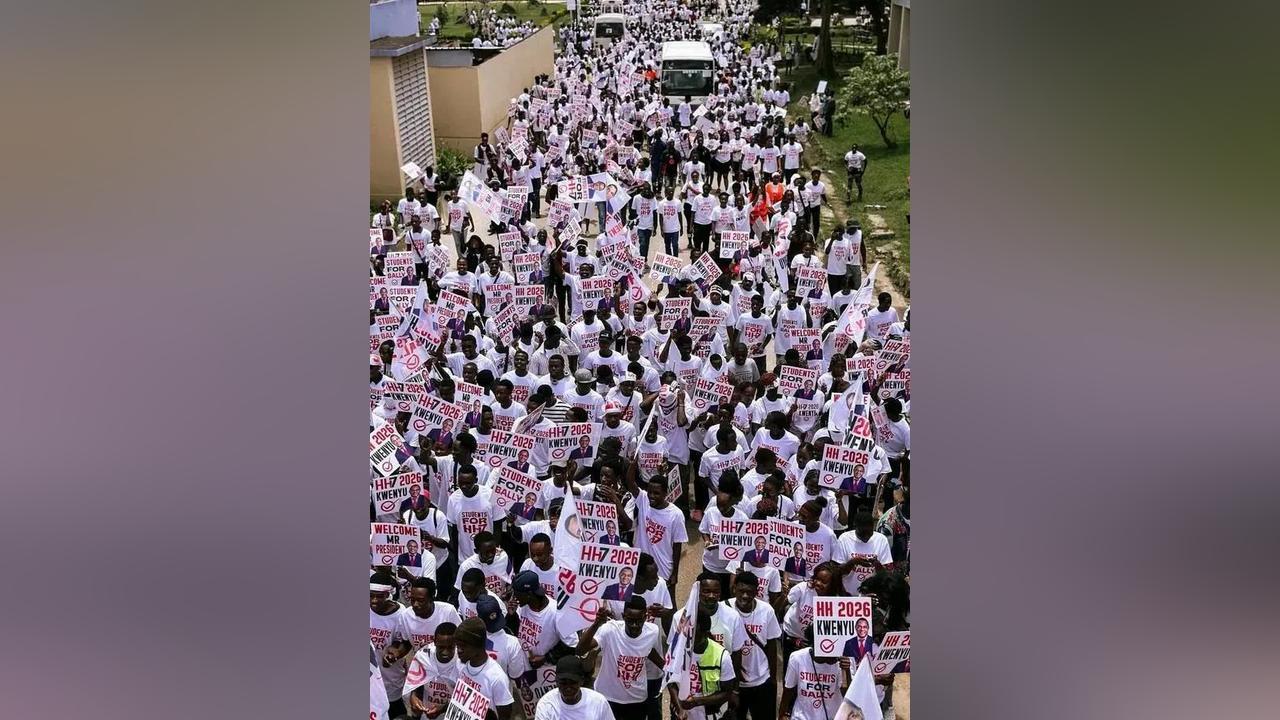
Africa-Press – Zambia. Arthur Davies Stadium in Kitwe does not usually look like this.
By mid-morning, the 20,000-capacity arena had filled with students dressed in white, waving placards reading “Students for Bally” and “HH 2026.” The turnout was not symbolic. It was strategic.
The Copperbelt remains Zambia’s most unpredictable electoral battleground, and in an election year, optics matter.
President Hakainde Hichilema’s one-day working visit to the province has quickly evolved into more than a courtesy engagement. It is a calibrated political moment anchored on one of his administration’s most consequential policies: education reform.
Students from public and private institutions across the Copperbelt gathered not merely to cheer, but to engage. Meal allowances. Accommodation deficits. Infrastructure backlogs. Youth unemployment. Skills development gaps. These are not abstract issues. They are lived realities.
The National Council of Students has indicated its intention to formally table concerns affecting learners.
Education has become the New Dawn administration’s most defensible legacy pillar. Since 2021, government policy removed school fees at primary and secondary level, expanded higher education loans and bursaries, and significantly increased tertiary funding allocations.
Speaking Friday at Parliament, the President reiterated that education is “the best investment, the best equaliser, and the best inheritance we can give our children.
On the Copperbelt, those words are not rhetorical. They intersect with political memory. The region has historically swung elections. It punished incumbents in 2011. It turned decisively in 2021.
Will 2026 see a flip?
The stadium images tell their own story. Thousands of young voters, many first-time participants in a general election, are now central actors in the national conversation. Youth demographics are not marginal. They are decisive.
But engagement alone does not translate to votes. Students are also asking harder questions. What happens after graduation? Are loans sustainable? Will skills programmes align with industrial expansion in mining and manufacturing? How does education convert into employment in an economy still recalibrating?
The President’s challenge on the Copperbelt is therefore dual. Consolidate goodwill built through free education. Convince young voters that opportunity will follow access.
As Zambia approaches August 13, 2026, the education file may well become the re-election fulcrum. And on a day when a sea of students gathered in Kitwe, the political message was unmistakable.
The campaign season has entered the lecture hall.
For More News And Analysis About Zambia Follow Africa-Press