By zambianobserver
Africa-Press – Zambia. The images coming out of North Western Province this week tell a story before any official statement does. Trucks packed with young men and women. Long queues boarding buses. Makeshift camps abandoned. Gold rush sites that were teeming with life days ago now thinning out at speed.
Prime TV footage from Mufumbwe and Kikonge captures a mass exodus underway. Illegal mining zones are emptying. And they are emptying fast.
This is not panic. It is calculation.
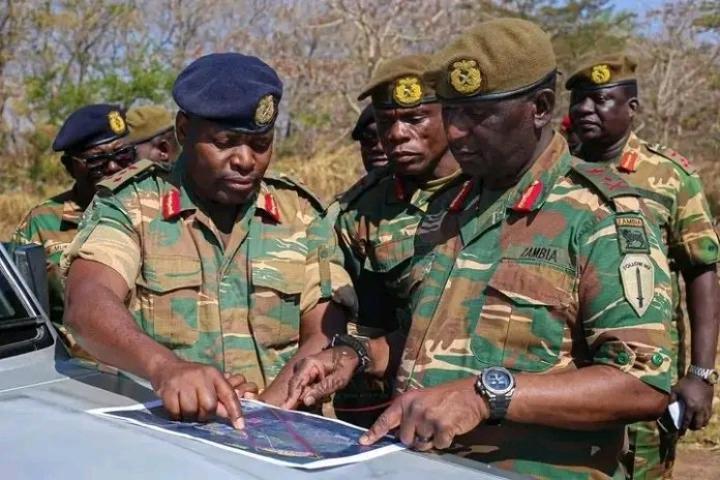
At the centre of this operation is Geoffrey Choongo Zyeele, the Zambia Army Commander whose presence on the Copperbelt and North Western axis has triggered the most decisive security response the mining sector has seen in years. His message to troops, provincial leadership and communities has been consistent. Illegal mining is no longer a policing matter. It is a national security threat.
The facts emerging from his briefings are sobering.
According to intelligence assessments shared by the Army, Zambia’s mineral zones have been penetrated by foreign backed networks operating through Zambian fronts. Kikonge, the commander told officials, had been “swamped by foreigners” and now hosts a Swahili market, a clear indicator of organised settlement rather than temporary movement. These are not isolated migrants. They are nodes in a wider regional system.
One individual currently in custody, presented during a military briefing, is a foreign national with a military background. His permit, authorised by the Ministry of Home Affairs, expired in March 2023. He remained in Zambia, operating illegally in mining zones. On his phone, officers recovered images of what the commander described as “precious stocks” of minerals already extracted and staged for movement. His interrogation is ongoing, with a clear objective. Identify which countries dominate illegal mining management and how minerals exit Zambia.
Weapons recovered during operations point to a deeper danger. Intelligence confirms the presence of firearms above 7.62 millimetres, beyond standard AK-47 capability. A sophisticated drone has been seized, equipment the Army says requires training well beyond civilian use. Boxes of ammunition. Explosives. These are not tools of survival mining. They are instruments of force.
This is why elite units have been deployed.
The Army has framed the operation as a strategic requirement to secure the Copperbelt and North Western mineral zones, areas described internally as economic centres of gravity. The commander has been explicit. Any individual who points a gun at soldiers will be neutralised. Not as punishment, but as rules of engagement in a live threat environment.
The scale of illegality is wider than Mufumbwe and Kikonge. In Mumbwa, Central Province, security agencies estimate more than 700 illegal foreign operators, many linked to East African business networks, are involved in gold processing. Zambians are being used to handle mercury based extraction, exposing communities to slow poisoning while profits move offshore. This is environmental crime layered onto economic sabotage.
As enforcement tightened this week, the reaction from entrenched groups was immediate.
Old gangs such as Jerabos, long associated with intimidation and political violence, have openly threatened to decampaign government and engineer regime change ahead of August elections. These threats are not abstract. Intelligence links some of these groups to illegal mining protection rackets and cross border smuggling routes. Their anger is not ideological. It is financial.
The commander described parts of the Copperbelt and North Western Province as hubs of impunity. Letters demanding money. Threats to loot. Stones thrown at leaders, including the incident in Chingola where the Commander in Chief was targeted last year. Security agencies trace that confrontation directly to resistance against enforcement in illegal mining zones.
This context explains why January matters.
Gold rushes do not wait for election calendars. They metastasize. Across Africa, from eastern Congo to Sudan, resource conflicts began with tolerated illegality and ended with militias. Zambia’s security chiefs believe the country was approaching that line. The decision now is to break the network before it hardens.
Opposition figures have responded with outrage. Calls have been made for the Army Commander’s dismissal. Others argue the operation is politically timed to influence Copperbelt voting patterns. The Army’s counter argument is blunt. Criminal networks do not pause for campaigns. Sovereignty does not go on leave.
What is unfolding on the ground suggests enforcement is working.
Illegal miners are leaving without force. Gold rush sites are thinning. Trucks are moving out. The Zambia Army says this phase is about clearing space for lawful mining so the Ministry of Mines can restore order, licensing and revenue flow. The operation will move beyond the Copperbelt and North Western Province into other mineral zones flagged by intelligence.
Zambia is not at war. But it is confronting a threat that grows quietly until it explodes.
The Zyeele wave is not theatre. It is pre-emptive containment. And the speed of the exodus suggests the networks understand the message clearly.
© The People’s Brief | Ollus R. Ndomu
Source: The Zambian Observer – The Zambian Observer
For More News And Analysis About Zambia Follow Africa-Press