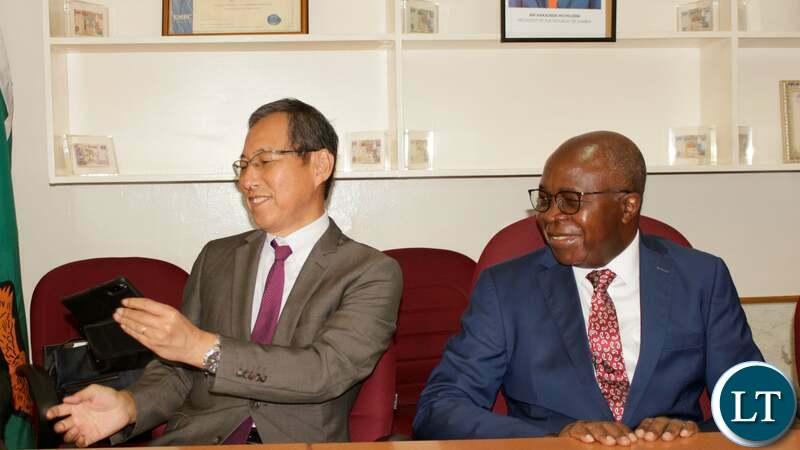
Africa-Press – Zambia. Japanese Ambassador to Zambia and COMESA, Mizuuchi Ryuta and Finance and National Planning Minister Dr. Situmbeko Musokotwane, MP, yesterday morning conferred to discuss development cooperation.
During the meeting held at the Ministry of Finance and National Planning Headquarter in Lusaka, Ambassador Mizuuchi Ryuta reiterated Japan’s strong support for Zambia’s debt restructuring process, and added that, the world’s 4th largest economy “also looks forward to the IMF board approval of Zambia’s programme once all the processes are completed.”
Mr. Ryuta confirmed that a private sector mission of Japanese firms, mostly those based in South Africa, will visit Zambia during the course of the year for information exchange and investment exploration purposes. At the meeting, Dr Musokotwane thanked Japan for its unwavering support for Zambia’s debt restructuring process and other developmental affairs.
He took the opportunity to invite the Japanese private sector to develop strong partnerships with their Zambian counterparts so as to optimize the best of both worlds in industrial development, manufacturing, commerce, and trade.
“We want to see more Japanese investors coming to set-up businesses in Zambia in collaboration with the local private sector for the mutual benefit of both parties,” he said.
The key beneficiary sectors of Japan’s (through JICA) cooperating and assistance in Zambia are education, health, energy and mining, and water resources and disaster management. Others include transportation, natural resource and energy, private sector development, and agricultural and rural development.
Dr. Musokotwane was accompanied at the meeting by Secretary to the Treasury Felix Nkulukusa and Permanent Secretary for Economic Management and Finance, Danies Chisenda. Japanese Ambassador to Zambia and COMESA, Mizuuchi Ryuta and Finance and National Planning Minister Dr. Situmbeko Musokotwane
Meanwhile, Zambia’s public sector debt rose 18% to $31.74 billion by the end of 2021 from end-June. This is according to a Ministry of Finance document published this week. This is at a time when Zambia is negotiating to restructure its crippling debt.
Foreign currency debt accounts for 54% of Zambia’s borrowing, rising 2% in the second half of 2021 to $17.27 billion. Local currency debt jumped 43% to $14.47 billion.
In 2020, Zambia became the first country to have defaulted in the pandemic era, buckling under a debt burden of more than 120% of GDP. It reached a staff-level agreement with the International Monetary Fund (IMF) in December 2021 on a $1.4bn three-year extended credit facility.
Finance Minister Situmbeko Musokotwane told Reuters in February that he hoped to get a formal IMF agreement signed off in May, but the timeline was deemed ambitious by analysts as the group of Paris Club creditors and China have yet to form a creditor committee. President Haikainde Hichilema pledged to deal with the “unsustainable” debt burden when sworn in as Zambia’s new leader in August 2021.
For More News And Analysis About Zambia Follow Africa-Press