By Mustafa Al-Mu’tasim, Secretary General of the Civilizational Alternative Party in Morocco
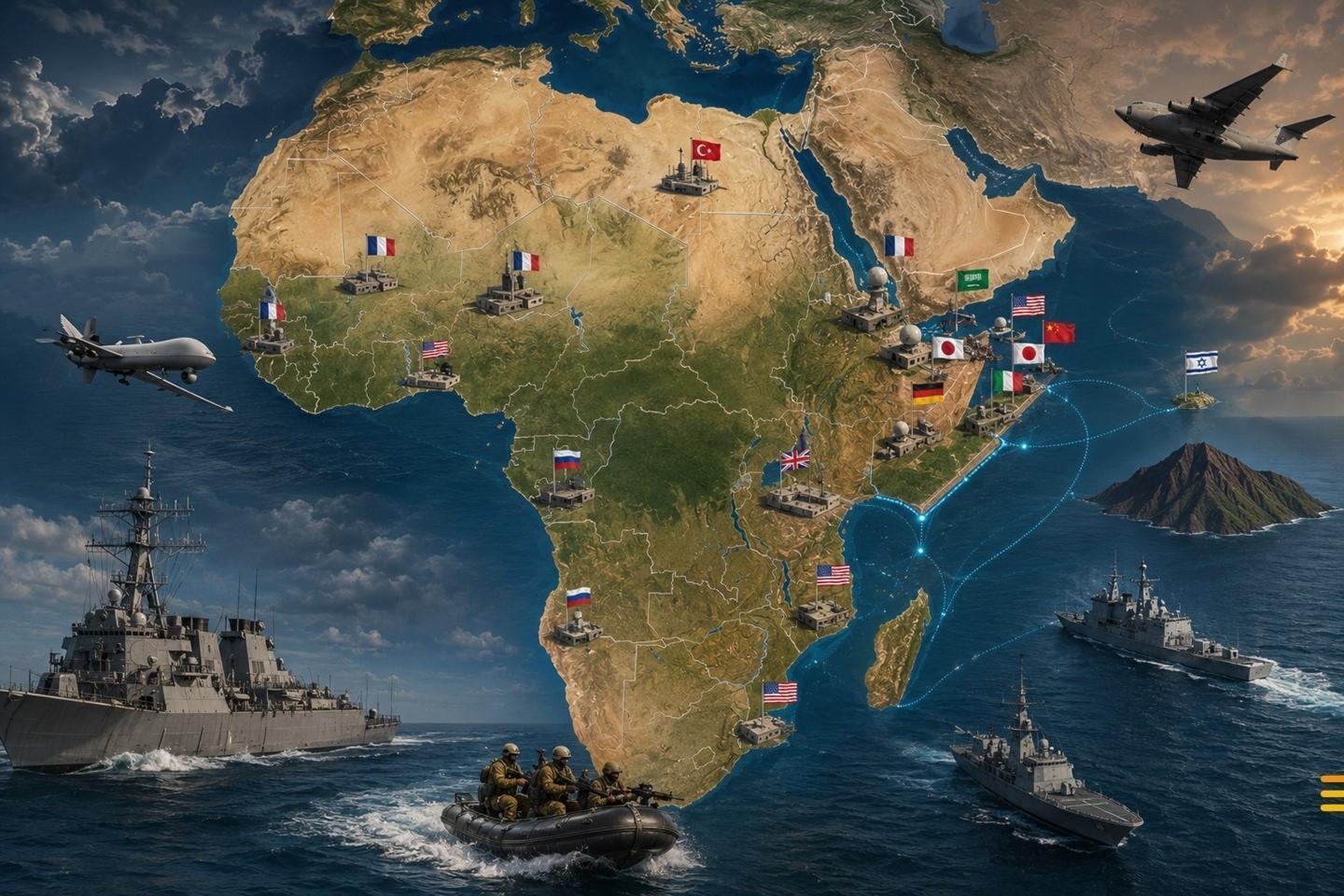
Africa-Press – Zimbabwe. Africa is a land of competition and conflict among global powers, hosting dozens of foreign military bases that spread across various contexts, such as combating terrorism and piracy, protecting economic interests and securing investments, supporting friendly regimes, controlling commercial maritime routes and straits, geopolitical competition, accessing resources, exploiting the continent’s wealth, maintaining geopolitical and cultural influence, and enhancing security cooperation with African governments.
Foreign Military Bases in the Horn of Africa
The significance of the Horn of Africa lies in its coastline along the Red Sea, the Arabian Sea, and the Indian Ocean, as well as its proximity to the Gulf of Aden and the presence of the Bab-el-Mandeb Strait. The Horn of Africa consists of four countries: Somalia, Eritrea, Djibouti, and landlocked Ethiopia.
Whoever controls this region can dominate Bab-el-Mandeb, one of the world’s most important waterways. The strategic importance of this strait emerged during the October 1973 War between Egypt and Syria on one side and Israel on the other, when Egypt imposed a blockade on ships of the Israeli entity to prevent them from passing to and from the Red Sea, and during the war on Gaza when Yemen prevented Israeli ships or those dealing with Israel from crossing Bab-el-Mandeb.
Currently, there are 19 military bases in the Horn of Africa belonging to 16 countries. The UAE is establishing a new base in the Somaliland region, in addition to four potential bases being set up by Turkey, Russia, and Saudi Arabia in the area.
Djibouti
Djibouti hosts nine military bases: three French, and six belonging to the United States, Germany, China, Japan, Italy, and Spain. The French military presence in Djibouti dates back to 1883, and after its independence in 1977, France retained its largest base in Africa. Its naval base, the French Special Forces Base, plays a role in supporting French nuclear submarines in the Indian Ocean and is relied upon for military operations in the region. The French base also includes German and Spanish troops as part of European Union operations to combat piracy.
Since 2013, Italy has had a drone base in Djibouti and provides logistical support for its fleet’s operations against piracy.
The United States has its largest military base in Africa in Djibouti, known as Camp Lemonnier, which serves as the joint command center for the Horn of Africa for combating terrorism and piracy. Since 2007, this base has become the center for American operations in Africa. Its operational scope includes not only the Horn of Africa but also Kenya, Seychelles, Sudan, Rwanda, Uganda, Tanzania, Mauritius, Liberia, and Niger. Camp Lemonnier hosts drones and F-15 and F-16 fighter jets, as well as British special forces involved in anti-piracy operations and protecting British vessels transiting Bab-el-Mandeb.
China, considering Djibouti part of its Belt and Road Initiative, opened a military base in 2017 to combat piracy in the Gulf of Aden and secure its investments and trade routes. Japan also established its first overseas military base since World War II in Djibouti to combat piracy. Since 2015, Saudi military presence in the Horn of Africa has increased due to the Yemen war. In 2016, Saudi Arabia agreed with Djibouti to establish a military base to support its naval forces and as a launch point in its war against the Houthis. The number of military bases in Djibouti could reach ten foreign bases.
Somalia
Somalia has five foreign military bases, including the American base “Balidogle,” which aims to combat terrorism against Al-Shabaab and ISIS. Turkey inaugurated a base in Mogadishu on September 30, 2017, which is Turkey’s largest base abroad, aimed at training Somali army forces. There is a British base in the Bay region for training Somali army forces. The United Arab Emirates has a military base in the Somali city of Bosaso and another in the city of Berbera in the Somaliland region, which is also used by Saudi Arabia.
Eritrea
After the October 1973 War, Israel exploited its relations with Eritrea to establish bases at the entrance to the Red Sea on Dahalak Island, the largest island in the Red Sea. Israel agreed with Eritrean President Isaias Afwerki to lease the islands of “Haleeb and Fatima” located southwest of the Red Sea, where Israel built a military base on each and installed modern radars, with military experts and engineers present, as well as a wireless station and radio. Israel also operated in the islands of “Sentyan and Dimira,” overseeing Bab-el-Mandeb Strait for intelligence and monitoring Iranian presence in the region, in addition to an Israeli military base in the city of Massawa.
Eritrea also hosts a military base for the UAE in the coastal city of Assab, which has also been used by Saudi Arabia, and includes warplanes, helicopters, and drones that participated in the Yemen war, along with ground forces. Iran has also attempted to establish a naval base in Assab since 2008 and signed an agreement with Eritrea in 2015, but the project was halted after Eritrea’s agreement with Saudi Arabia in 2016 to establish a Saudi military base and participate in the Saudi-led coalition’s war against Yemen.
The influences of the Horn of Africa extend to a broader security space that includes Kenya, Seychelles, Reunion Island, South Sudan, and Sudan. In Kenya, there are two military bases: an American base for training Kenyan forces and participating in anti-piracy and terrorism operations, and a British base for training Kenyan forces. In South Sudan, there are reports of Emirati and Israeli military presence. Sudan has signed an agreement with Russia to establish a military base on the Red Sea, but political changes in the country have delayed its establishment. Notably, Turkish President Recep Tayyip Erdoğan signed an agreement with his Sudanese counterpart during his visit to Khartoum in 2017 to cooperate in various fields, including reviving the port of Suakin and restoring and rebuilding the city and its Ottoman-era monuments, with some observers suggesting this could pave the way for a future Turkish military base on Suakin Island.
The Combined Maritime Forces, established in 2009 and comprising 25 countries, with its center at the American naval base in Bahrain, monitors and inspects ships suspected of supporting terrorism and combats piracy in the Gulf of Aden, as well as operating in the Gulf of Oman, the Indian Ocean, and the Red Sea.
With the Arab coalition led by the UAE and Saudi Arabia launching its war on Yemen in 2015, coalition countries rushed to establish military presence in Yemeni islands, particularly the Hanish archipelago due to its strategic importance in overseeing international shipping routes, and Zukur Island, where Israeli forces had previously been deployed. The UAE also took control of the island of Meyun, which controls Bab-el-Mandeb, establishing a military base there, as well as on Socotra Island, with reports of an Israeli presence under Emirati cover on this island.
European naval forces combating piracy, formed in 2008, are stationed off the Somali coast, alongside Indian naval forces near the coasts of Somalia and Oman, and a French naval force is based in Reunion Island in the Indian Ocean off the Horn of Africa. There is also an American military base in Seychelles, and India has a listening post in Madagascar.
Military Bases in West Africa and the Sahel
To maintain its political, economic, and cultural influence and combat terrorism in the Sahel, France has established bases in Senegal, Ivory Coast, Gabon, Chad, Burkina Faso, and Niger. France has three military bases in Mali, the most important being the Gao base, which housed Barkhane forces, as well as European Takuba forces composed of French, Belgian, Czech, Danish, Estonian, German, Italian, Hungarian, Dutch, Portuguese, and Swedish military personnel.
However, the presence of French forces through Barkhane, formed in early 2013 in partnership with the five Sahel countries—Mauritania, Mali, Burkina Faso, Niger, and Chad—has been deployed in Mali, Niger, and Chad to counter terrorists and Tuareg rebels, is set to decline. Mali canceled all military agreements with the French and Europeans on February 18, 2022, including the Barkhane mission. In August 2022, France announced the completion of its withdrawal from Mali, along with German forces. Burkina Faso canceled the agreement regarding the presence of French Saber forces on December 17, 2018, and on February 18, 2023, it officially announced the end of the withdrawal of French forces. Niger demanded the expulsion of French forces from its territory, which was accomplished in December 2023.
Chad has set December 31, 2024, as the deadline for the departure of the last French soldier from its territory. Senegalese President Macky Sall announced his intention to close French military bases in Senegal, which was realized on July 17, 2025, when France handed over its last military base in West Africa, the Jile base in Wakham, to Senegalese authorities, along with the French military station at Léopold Sédar Senghor Airport in Dakar. France now has only its base in Djibouti remaining.
Under the pretext of combating terrorism, the United States expanded its presence in the Sahel after 2001, establishing military facilities in Niger, including a drone base in Agadez and Niamey, and signed a military cooperation agreement with Nigeria, as well as having a drone base in Cameroon. However, less than a year after France’s withdrawal from Niger, American forces also withdrew from the bases they used in the war against Al-Qaeda and ISIS in the Sahel and West Africa and Libya. It can be said that the American presence in the western Sahel was largely linked to supporting Operation Barkhane.
In contrast to the significant retreat of French, European, and American forces in West Africa, there has been a growing Russian military presence in this region and Central Africa aimed at increasing Russian political influence and accessing resources. This presence began through agreements with Russian private military companies like Wagner, which will be transformed into Russian African forces in Mali and Burkina Faso. There is also a noticeable increase in military cooperation between Sahel countries and both Turkey and Iran.
Military Bases in North Africa
There is a Russian airbase in Libya, as well as the UAE’s Al-Khadim base, and a Turkish military presence organized under an agreement with the Tripoli government.
The American presence in North Africa is almost limited to military cooperation, as is the case with Egypt, Morocco, and other African countries, where American forces conduct training and military exercises such as the “African Lion” exercises.
Challenges of Sovereignty and the Formation of a Joint African Military Force
The question of sovereignty is strongly raised with the presence of these bases, necessitating a review of military agreements to reduce reliance on foreign armies. The establishment of a joint African military force to enhance self-defense and strategic independence may be a suitable alternative to limit external interference in the continent’s political and economic affairs.
In recent years, some African countries have become convinced that foreign forces and bases do not prioritize their security and are not serious about combating terrorism, as seen in the cases of Mali, Burkina Faso, and Niger. Instead, they are accused by the people of pursuing the interests of the base owners, exacerbating internal conflicts, or turning some African countries into theaters of geopolitical conflict.