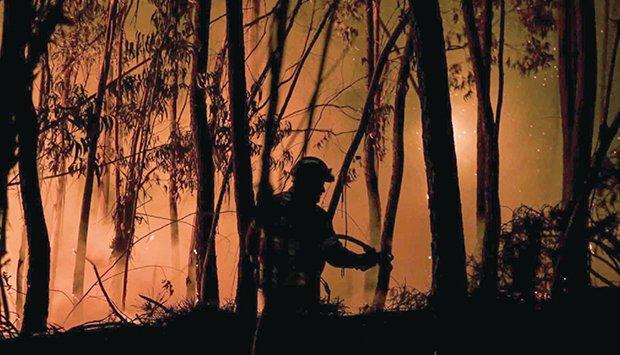
Africa-Press – Angola. Mainland Portugal registered four active fires friday, at 5:30 am, with Sabugal, in the district of Guarda, which concentrated more operatives and means, reported the Lusa agency, citing the Civil Protection website.
At that time, in Sabugal, there were 138 firefighters, supported by 39 vehicles, fighting the fire that broke out at 5:11 pm on Friday, according to the website of the National Authority for Emergency and Civil Protection (ANEPC).
The fire was considered an “important occurrence” by the ANEPC, since it already has “lasting more than three hours” and “more than 15 means of protection and assistance are involved”.
In the resolution phase, the ANEPC website indicated, at the same time, two fires, with 22 operational and seven vehicles, while in conclusion 17 fires, involving 465 operational and 138 land assets.
The Portuguese Institute of the Sea and the Atmosphere (IPMA) placed, on Friday, more than 50 municipalities in the districts of Braga, Vila Real, Bragança, Guarda, Viseu, Coimbra and Castelo Branco in maximum danger of rural fire.
The IPMA also placed several municipalities in Viana do Castelo, Braga, Porto, Aveiro, Vila Real, Bragança, Viseu, Coimbra, Leiria, Castelo Branco, Guarda, Santarém, Portalegre, Lisbon, Beja and Faro in very high and high danger. of rural fire.
The danger of rural fires will remain high in some regions of the continent at least until Tuesday, indicated the Institute.
The fire hazard, determined by the IPMA, has five levels, ranging from reduced to maximum, and the calculations are obtained from the air temperature, relative humidity, wind speed and amount of precipitation in the last 24 hours.
Injured firefighters remain hospitalized
Two firefighters, who suffered injuries as a result of fighting the forest fires, are still hospitalized, the Portuguese Fire Brigade League (LBP) revealed on Friday.
In a balance sheet, the LBP indicated that it continues “to monitor the evolution of the clinical situation of about three dozen firefighters injured in the fight against forest fires”.
Of these, nine “returned to work”, 16 “continue to convalesce at home in different stages of recovery” and two remain “hospitalized”.
The LBP cited the names of the firefighters who remain hospitalized: Gonçalo Coelho and Carla Rodrigues.
“To the two, in particular, and in general, to all the other firefighters who were injured, LBP sends a strong hug of solidarity and the wish for a speedy recovery”.
Sabugal deserves greater attention
Yesterday, four fires were raging in rural areas, with the one in Casteleira, Sabugal, the one that deserves more attention, a source from the National Emergency and Civil Protection Authority (ANEPC) told the Lusa agency.
The fire in the municipality of Sabugal, district of Guarda, broke out on Friday (5:11 pm) and is being fought by 155 operatives, using 39 vehicles and the support of four air assets.
“The fire is reaching the means”, said the source, adding that the flames are raging more intensely in some areas of difficult access, where air assets are active. There are no housing or infrastructure at risk, according to the same source. The ANEPC website reports a total of 221 fires in mainland Portugal, 187 of which are ongoing, three under resolution and 31 in conclusion.
Fighting the flames involves 1,357 operational personnel, 425 vehicles and six air assets.
Casteleira fire fought by 191 operatives
The fire that started on Friday, in Casteleiro, Sabugal, district of Guarda, continued to be, at noon yesterday, considered the most important by the Civil Protection, involving 191 operatives, 51 vehicles on the ground and two helicopters.
The information published on the website of the National Emergency and Civil Protection Authority (ANEPC) at 12:00 pm indicates that the fire was still “ongoing”.
In total, there are 29 rural fires, which mobilize 794 operational personnel, 224 vehicles on the ground and eight aerial assets to fight the flames.
Two of these fires are in progress, seven under resolution and 20 under completion, according to the terminology adopted by ANEPC.
In Vila Real, eight occurrences are reported, with 369 operational, 109 vehicles and two aerial vehicles.
RESEARCHER ALERT
Measures to stop erosion must be taken “before the first rains”
Erosion caused by fires can cause rapid flooding and contamination of water bodies, so mitigating measures must be taken before the first rains, warns Ana Rita Lopes, researcher at University of Aveiro (UA).
The researcher from the Center for Environmental and Sea Studies, from the UA Department of Environment and Planning, was part of the team that prepared the erosion risk map for Mainland Portugal – a tool to identify priority areas for mitigating the impacts of fires on erosion soil – known in March.
Half a year later, and with more than 100 thousand hectares burned in Portugal since the beginning of the year, Ana Lopes warns that “the timely implementation, ideally before the first rains after the fire season, of erosion mitigation measures, is crucial to the conservation of forest soils and the reduction of their negative impacts”.
For the researcher, the application of mitigation measures “must consider the particularities of the affected places, mainly the slope, type of soil, and the environmental and population environment”.
These measures have as their main objective the stabilization of the soil, either by reducing the impact of raindrops or by reducing the speed of their flow along the slopes.
According to the researcher, the measures can be “quite different” depending on the location, such as the application of a protective padding of organic residues (‘mulching’), trunk barriers at different altitudes and sowing, together with “appropriate phytosanitary and soil mobilization point of view”.
As for the impacts of the fires, Ana Lopes says that they are diverse and interconnected: “locally, the first thing we see is the destruction of the vegetation that intercepts and protects the soil from the direct impact of raindrops”.
“To the disappearance of the vegetation cover are added the temperatures generated during the fire, which promote the alteration of the biophysical properties of the soil, namely the reduction of the stability of the soil aggregates and reduction of porosity, and promotes conditions of repellency of the soil to water, among others. All this makes it difficult for water to infiltrate”, he explains.
The water that does not infiltrate drains and when it drains it takes with it ash, sediment, nutrients and organic matter.
“These negative local impacts can be reflected in the surroundings, for example in the possibility of: contamination of water bodies downstream, rapid floods, with sediment dragging with destructive capacity for goods and infrastructure, reduction of carbon storage capacity , loss of fertility and reduction of forest productivity”, he adds.
To allow “a quick diagnosis of areas at greatest risk and efficient action immediately”, the team delivered to the Institute for the Conservation of Nature and Forests (ICNF) a soil erosion risk map “for the vegetated areas most prone to the occurrence of of fires in mainland Portugal (eucalyptus, pine and scrub)”.
This map was reviewed and validated with local data collected at 10 study sites under post-fire conditions, which were monitored by investigators over 12 years.
“We believe that this map can be a very useful tool for stakeholders, from forest managers to policy makers, in the decision-making process after the fire in mainland Portugal, as it allows to fill some of the gaps identified in this context (areas intervention, with a greater risk of soil erosion), and to define in time the most appropriate emergency stabilization measures, with a possible reduction of economic and environmental damage”, he explained.
According to the document, in conditions of high fire severity, the Central-North area of the country shows a very high risk of soil erosion after the fire.
The Center-North region of the country is also “one of the areas with the highest recurrence of fires and, at the same time, it provides important ecosystem services for the country, including services related to the quantity and quality of water for human consumption, underlining the importance of rural fire management that integrates post-fire prevention, combat and restoration”.
The provisional data, until the 23rd of this month, obtained based on the Forest Fire Information Management System (SGIF), show that 103,332 hectares burned, 51% of forest stands, 39% of bushes and 10% of agricultural area. .
PORTUGUESE MINISTER FOR TERRITORIAL COHESION
“Calamity in Serra da Estrela does not affect other territories”
The Portuguese minister for Territorial Cohesion told Lusa on Friday that the declaration of calamity in Serra da Estrela does not affect support for other territories in the country affected by the fires, which can access the same measures.
“For anyone who knows the Serra da Estrela Natural Park and who went there after the fires, it becomes obvious why it had to be declared a state of calamity”, said Ana Abrunhosa, stressing that this does not prevent other territories from benefit from the same measures.
According to the official, who was speaking to Lusa on the sidelines of the presentation of a technological center dedicated to renewable energies, in Portimão (Faro), despite the fact that no calamity situation was declared in other areas of the country affected by fires, this does not mean that they have not the same supports.
“This does not prevent, as I have already said, that municipalities that, in 2022, had 4,500 hectares burned or 10% of their territory burned do not have access to the same measures”, he underlined, adding that the survey is already being carried out.
Among the support measures for areas affected by forest fires, there is the restoration of productive potential, support for soil stabilization, repopulation of trees and animal species, support for economic activity and replacement of public equipment affected by the fire, he listed.
According to Ana Abrunhosa, the declaration of calamity in Serra da Estrela is justified by the characteristics of the park and the whole of that territory, in addition to the size and impact of the fire, since 50% of the municipality of Manteigas and more than 20% of the municipality of Guarda burned.
In addition to the fact that, according to the Minister of Territorial Cohesion, a quarter of the territory of that natural park burned – where in some areas there are risks to biodiversity – it is a park that has been declared a World Heritage Site by UNESCO.
“Because of its extension, the impact of the fire on the territory, the characteristics in terms of biodiversity, in terms of the heritage of humanity that this natural park represents, led us to declare a state of calamity for a year”, summarized Ana Abrunhosa.
The minister also said that she considers that any citizen “understands well” why a disaster was declared for the Serra da Estrela Natural Park (PNSE), “without harming” other places that also suffered from fires in terms of the measures to be adopted. The Government approved, on Thursday, the declaration of a disaster situation for one year for the PNSE, affected since July by fires, as requested by the mayors of the affected territories.
At the press conference that followed the meeting of the Council of Ministers, the Minister of the Presidency, Mariana Vieira da Silva, also announced that the survey of the damages caused by these fires will be carried out within 15 days, in a process that will extend to the other municipalities in the country where “more than 4,500 hectares or 10% of their area” have burned in 2022.
On Monday, the Government met with the mayors of the Chambers covered by the PNSE – Manteigas, Celorico da Beira, Covilhã, Guarda, Gouveia and Seia – and also with the president of Belmonte – also present because he was hit by the flames – with the objective of assessing the damage caused and “establishing the necessary support measures”.
The Institute for the Conservation of Nature and Forests (ICNF) considered the Serra da Estrela fire to be the most extensive so far recorded since the one in Pedrógão Grande, in 2017.
The fire started on 6 August in Garrocho (Covilhã) and lasted 11 days in Estrela, extending to the municipalities of Manteigas, Gouveia, Guarda, Celorico da Beira and Belmonte.
For More News And Analysis About Angola Follow Africa-Press