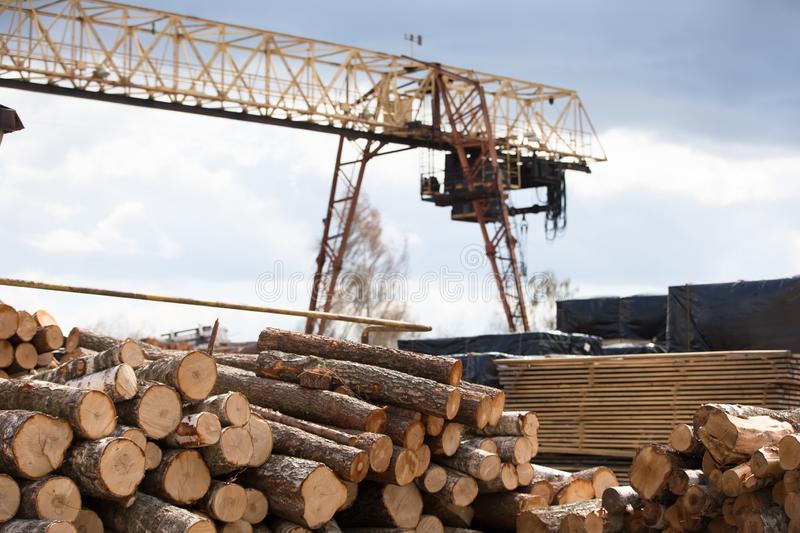
Africa-Press – Angola. The stoppage of the private wood processing industry of the company Macro Services, in the municipality of Ucuma, province of Huambo, has so far caused the unemployment of more than 200 young people.
Many of the young people who worked there were left to their own devices, while others chose to do some activity that could organize their lives, especially the cultivation of fields for food production. There are also those who have opted for easy profit, turning to delinquency, according to the young Mateus António.
He who worked at the factory, in the Sawing Section, said that life after the company was closed is no longer the same, since the monthly income obtained at the lumber mill supplied part of all the needs and helped the children to acquire school supplies, as well as in food.
José Armando, another former worker, came from the commune of Cacoma and over time worked in the maintenance area of the factory. He had the opportunity to build his house and since he was laid off he has dedicated himself to family farming, as he was able to buy a farm on the outskirts of the municipality, with the income from the times of the lumber company. Today, only good memories remain, but a strong desire to return to the heyday. Vasco Panzo, the head of the private company Macro Service, which has a license for logging in the Mundundo forest perimeter, in the commune with the same name, municipality of Ucuma, said that the more than 200 workers were dismissed because the company was closed. He assured that the industry, at the time, worked in three shifts,
The factory’s main activity was parquet, where the joints were made to look like a wooden floor, as well as the use of straw, in the manufacture of plywood and battens. It also produced wooden truck bases, laminates and other services, whose customers came from different countries, especially a buyer from the United States of America, who always bought most of the product.
Wood exploration
The work of logging, by the company Macro Services, in the forestry perimeter of Mundundo, began in 2009, whose activity also consisted of repopulating with different species of trees in the areas already exploited.
The company, during the period it operated in Mundundo, worked close to 553 hectares of land with the planting of trees of different species, from 2010 to 2015, considered to be the first phase of replanting. The second started in March of this year, where about 47 hectares were planted.
Vasco Panzo guaranteed that as soon as the rains start to fall in the region, another 27 hectares of Patula pine trees will be planted, coming from Zimbabwe and that, at the moment, they are in the phase of clearing the land to place new plants, which are be kept in the nurseries located at the company’s shipyards.
Despite not having concrete data on how many hectares of wood have already been exploited in the Mundundo forest, Vasco Panzo said that the company lacks a GPS to map the space affected by the cuts, in order to make a real calculation of the repopulation needs. In spite of everything, the company still guarantees employment at the shipyard to around 198 national workers, who make it possible to replant trees in the thousands of hectares that remain to be worked on.
The wood exploited in the Mundundo forest, much of it was transformed into the industry of the company located in the village of Ucuma, and in recent times it is simply for local consumption.
Reproduction of seeds
The seeds of the pine plants come from Zimbabwe and the multiplication is being done locally, in the nurseries of Mundundo, with a capacity of close to 100 thousand seedlings of plants.
“As soon as the seeds arrive, they are thrown into black plastic bags and it takes about a month to germinate and it is enough to reach a height of 15 centimeters, they can be planted in the field, but with strong prevention measures against arson in the dry season. The plant ceases to be a concern after seven years, after reaching more than 6 meters, in which the apex of the tree cannot suffer from the high temperatures of the flames”, he said.
Black plastic bags from nurseries are purchased from factories in Luanda and, for the plant to develop faster, it is necessary to use 12/24/12 fertilizers, which in a certain amount is mixed with a certain amount of soil and only then placed in the bag, together with the plant, to make the plantation healthier.
The manager also said that for the pine tree to be fully created, to take advantage of the wood, it takes more than 25 years, while the eucalyptus can take just over 15 years.
“In the past, our goal was to repopulate an average of 100 hectares per rainy season, a dream that is gradually not being realized because of the difficulties linked to the lack of financing, banks and partners are not opening their doors”.
At the moment, the company does not have any agronomists accompanying the plantations, but the knowledge acquired by workers over the years, through Zimbabwean technicians, is being used and continues to have an effect.
Fires
Vasco Panzo made it known that the phenomenon of fires is one of the main enemies that keeps the management of the company that exploits sleep from sleeping, as trees are planted at a certain time, in the same way as arson in dry weather chase the same.
The official defends the existence of a law that penalizes those people who make anarchic fires, not only because it destroys the environment, but also affects many farms and farms of the people, as well as economic objectives.
The first planting of 553 hectares of trees in the first phase in the Mundundo forest, the company lost more than 100 hectares swallowed by arson and had to be replanted again.
“The fire is even started by malicious people, although there are open roads to delimit the access to the fire, however, in the previous dry season, luckily there was no burning, because a strong awareness campaign was carried out in the neighboring communities, about of the damage caused by the fires”.
According to Vasco Panzo, clandestine cutting of trees on the perimeter takes place from time to time, mainly at night, and these activities have been frustrated several times.
For More News And Analysis About Angola Follow Africa-Press