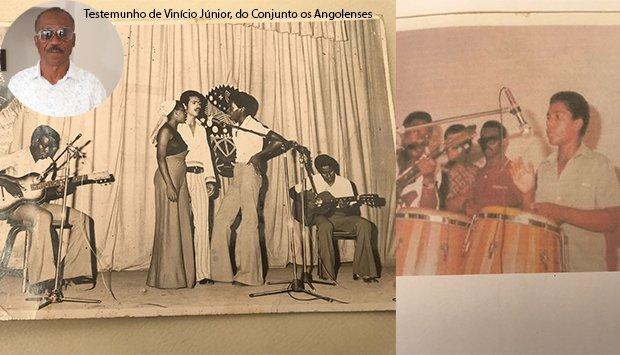
Africa-Press – Angola. Emerging from the student associations that in 1974 manifested themselves by changing the content of the subjects of Geography and History, Os Angolenses are certainly one of the formations of the political intervention music movement that contributed a lot to the mobilization for the cause of Angola’s independence.
Who listens to songs like “Africa from the Maghreb to Zimbabwe”, “Continuation of our struggle”, “Obscurantism and misery”, “Joy for the chosen path”, “Internationalist”, “Mua Ngola Mua Tu Vualela”, “Down with Apartheid” and “Ufolo Uetu”, promptly comes into contact with the strength of the messages of Os Angolenses, this group of students from Escola Industrial Oliveira Salazar (after the independence of Complexo Escolar Karl Marx-Makarenko and currently Instituto Médio Industrial de Luanda – IMIL).
The members of Os Angolenses, unlike other formations and many singers of that phase, invested in academic training and had music as a hobby. And through music, they played an important role in the fight against colonialism. Once Independence was achieved, other responsibilities began to emerge and the stages were moved away. Today, few of the former members of the musical formation are recognized as musicians.
Intervention music worker
To talk about Os Angolenses, Jornal de Angola went to meet Vinício Júnior, now retired after having served as a senior staff member in the Energy sector, where he was involved in several electrification projects in public companies and in the relevant Ministry. The artist described how it all started, when, in 1972, he played the guitar with Nelson Costa, a colleague at the Industrial School, where they would show off in their spare time, as well as at Marçal. Then he joined other friends from the neighborhood, namely Mário Domingos, Zé Manel (Rosa Roque’s brother) and Joãozinho. Before the 25th of April 1974, this group of friends was invited to perform at the finalist party at the Industrial School and, for the first time, they publicly presented themes of Angolan origin, where Pop music was the norm. vinicius junior and friends took to the school’s gymnasium what they heard at Marçal and at the JUVA – Juventude Unida da Vila Alice dances.
Emergence of Os Angolenses
Vinício Júnior talks about how it all started. “We appeared as Os Angolenses, in July 1974, three months after the 25th of April. There were several activities, lectures and student demonstrations to change the content of the History and Geography disciplines. changing the programmatic content, which was our main requirement. It made no sense to be in Angola and know little about our Geography and History. For the first time, there was a big political act at the school and that was when Armindo Ferreira and Nelson Costa took the stage, accompanied by Gigi, Zezé and Carmen, the chorus girls. We were all from the Industrial School, where we performed”.
Still according to our source, invitations followed to perform at the Comercial (currently 1o de Maio) and Colégio Feminino (currently Nzinga Mbandi) schools. Vinício Júnior added that, at the same time, “outside the student universe, political acts were encouraged in the sense of passing on the message to people about what the struggle was and how to achieve independence, and the music of political intervention in these acts”.
He recognized that, in a first phase, they had no partisan inclination, which can be confirmed in themes such as “I want to be someone”, “To be free”, “We shouldn’t have the graves full of flowers because someone died”, and others, which presented in almost daily public events in schools, where people gathered.
Vinício reveals a peculiarity: they passed the lyrics of the songs in stencil and the staff copied them. They did that, for example, with the song “Hoji-ya-Henda”. “And then Armindo, who was a teacher at the time, also started to create intervention songs. It is at this stage that we started to talk about the MPLA in the songs”.
Relationship with the MPLA
As young students and activists for the Independence cause, the members of Os Angolenses mobilized many people. “We participated in the inauguration of the first OMA house, in Marçal, and accompanied Carlos Lamartine and other artists. That’s when the group started to have a lot of followers”, said Vinício Júnior.
It was in that context that a young man challenged them, asking them if they had a repertoire to play at the Benfica de Luanda end-of-year party. This is how, on December 31, 1974, they performed at Eixo Viário, in the company of Águias Reais. Vinício remembers the moment like this: “We opened the party, which we considered to have been a victory, because we presented a repertoire of revolutionary songs in a mostly Portuguese environment, where we appealed not to mistreat the Angolans”.
Still on the subject of the group’s activities, according to Vinício Júnior, “Tchito was accompanied many times, Robertinho himself was part of the caravan that went to Ndalatando. Dina Santos was also accompanied by the group. There was also Bartolomeu de Carvalho or simply Fula, vocalist of the group that only sang in Kimbundu. Beto da Sassassa was also part of the group, as a saxophonist who partnered with Franco. Godinho, a great trumpeter, and several other good musicians, gave the his best for the group to grow a lot”.
The recordings of themes
“When Armindo sang ‘Ufolo uetu’, at Cidadela, it had a great impact. We recorded many songs on Rádio and not all of them are on the Poeira no Quintal album. The first one we recorded was ‘Quem chora Lumumba’. We also have ‘África do Maghreb to Zimbabwe’, but our big hit was ‘Down with Apartheid’, which seems to have been found in the archives of Rádio Nacional de Angola. When Commander Nelito Soares was murdered in Vila Alice, we made a theme for the Cuban people, with the arrival of the internationalists. When the Cuban youth secretary was here, we sang and he cried. Jimmy, who was a political commissioner, sang ‘Africa from the Maghreb to Zimbabwe’. He was very creative and always came up with new songs. He had still the song ‘Slavery and misery never’”; we have ‘Mua Ngola Mua Tu Valela’”…
“Almost” Forgotten
Vinício Júnior clarifies the almost omission of the group in the history of Angolan music. “The members of Os Angolenses, despite being young, did not have an official connection with the JMPLA, like Kissanguela, or with the Army like FAPLA-Povo. to the youth and the military, and, perhaps, this is the reason. But we continued and it must be noted that we had greater longevity, for example, than Kissanguela, who only played for two years. We went until the mid- 80s. another, some people attribute some of our themes to other actors”.
Vinício Júnior lamented the lack of official recognition by the MPLA and praised the homage paid to the group Os Angolenses by Rádio Nacional de Angola, within the scope of the Caldo do Poeira project, in June 2007, at the Kilamba Recreational and Cultural Centre. Speaking of that moment, the artist states: “The reunion was very difficult because we hadn’t played for a long time. It was interesting because many people -, service colleagues and neighbors -, who didn’t know about this side of us, were amazed”.
The guitarist and founder of Os Angolenses values RNA’s initiative and leaves a message: “It’s the only tribute that Os Angolenses know. THANK YOU. I don’t go much for material values. I know of elements from other groups to whom the State has been giving something, but never to us”.
Despite this, Vinício prefers to look on the positive side: “One of the great joys for us was, days before Independence, the television showed a show by Os Angolenses. This for me was the greatest achievement, at the time. And then, hours after before the proclamation of Independence, the theme of Armindo was played, which speaks of the bells that would ring on the day of our Independence”.
We fulfill our role
The guitarist from the revolution has the following opinion about what he and his companions have done for the benefit of the country: “I usually say that music is not an impeding factor for anything and we don’t even say what we are and what we were. people can play different roles and we liked what we did. We created the group and we had a role which was to help people to trace the paths of Angola’s Independence. It was at a time when we all had to make our contribution. And when we saw that we fulfilled our role we continued our lives. Then we played in halls like Marítimo da Ilha, Bela Vista, Desportivo União do São Paulo and we did professional tours. We also started to work with other people to change the content of the songs. Celino sang themes in Spanish, we became a group like any other”.
“Me and She”
Years after they were honored by RNA, Vinício, excited, began to produce some songs and thus gathered enough material to record the album “Eu e Ela”, with instrumental themes. to Marito dos Kiezos”, he clarified, adding that from time to time he appears to play in relaxed environments with friends. “Some colleagues ask me to take music more to heart, but I think I don’t have that much courage for the stage anymore. What I ask guitarists is to create more and not be repetitive. create new things”.
Who is Vinicio Junior?
VinícioJúnior was born on August 18, 1956, in Rua da Chapada, in Marçal, and grew up between Marçal and the Indigenous Quarter. Son of a famous radio technician from Marçal, responsible for arranging instruments and equipment for musical groups, he “attacked” guitars very early on. At the age of seven he was already playing by ear. There was a strong cultural movement, with children’s competitions in the Indigenous Quarter, where he played with oil can guitars.And he recalls friends like Pai Adão, Maiuca, Nandó and Noé. And older ones like Tonito Fortunato, Manuel Faria, Taborda Guedes, Sabú Guimarães, Vum-Vum, Cirineu Bastos, Morgado and Lila Burity.
At this stage of his musical construction Vinício highlights, in Marçal, Gouveia, a little referenced but very important character in Escola do Semba, a percussion group that on Sundays held matinees with the kids sitting on benches. With him were Kadiako and Mota. There he comes into contact with our instruments, listening to songs in Kimbundu.
Close to his house, the Quinteto Angolano do Dominique performed, then Dimba Angola, Luanda Show, Bossa 70, Mini Bossa and Os Giendas, this group that Adolfo Duia was part of.
His father offered him a guitar and he improved his playing with Nelson, another founder of Os Angolenses who already mastered the notes and gave tips to his friend, who already soloed well. At JUVA, a club in Vila Alice, he heard someone soloing a song by Duia for the first time, and later manages to do his first Angolan music solo, “Mariana”, by Mestre Duia.
As a child, Vinício Júnior had the perception that things were not going well because, from time to time, he saw adults being arrested in the environment where he lived. He recognizes the existence of older nationalists like Gabriel Leitão, Ciro Cordeiro da Mata and others.
For More News And Analysis About Angola Follow Africa-Press