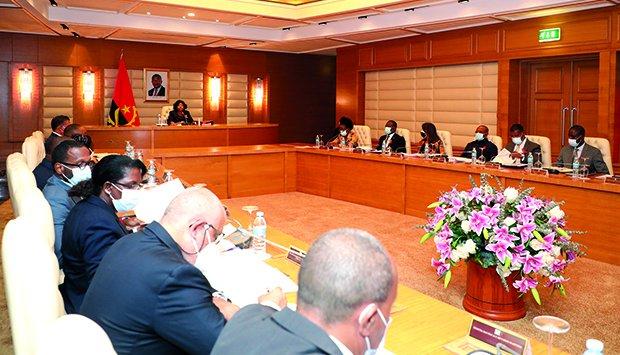
Africa-Press – Angola. The Vice-President of the Republic, Esperança da Costa, assured, Friday, in Luanda, that the legal, administrative, technical and financial conditions have been created for the launch of projects that will guarantee universal access to drinking water for the populations of Angola .
Speaking at the 7th Ordinary Session of the National Water Council (CNA), Esperança da Costa said that given the importance that water resources assume in everyone’s lives, it is urgent to articulate the different sectors involved in issues of planning, management and use of these resources, with with a view to meeting the needs of the population, especially those in rural areas.
The five-year period 2023-2027, stressed the Vice-President of the Republic, requires a set of tasks aimed at the sustainable use of water resources, which are increasingly valuable and indispensable for the development of the productive sectors and the well-being of all.
Esperança da Costa said that it is necessary and essential to pay increased attention to the riverside populations, whose lives depend on the quality of the river’s water, natural resources and ecosystem services that offer complete stability.
The CNA, together with the other sectors and organisations, said the Vice-President of the Republic, must continue to work for an increasingly equitable use of water resources within rural communities, as well as the continuity in making efforts to mitigate the drought. in southern Angola.
According to the also coordinator of the CNA, the documents considered and approved will certainly have to provide the conditions for launching the work that will allow the populations to have universal access to drinking water.
The holding of the 7th Ordinary Session of the National Water Council, the first chaired by Esperança da Costa, is a permanent institutional platform and technical consultation for the holder of the Executive Power, which requires adequate consultation with the different sectors.
“Aware of the financial limitations that the country faces, we are confident that, through the council, we will all work to find the best solutions in order to mitigate the numerous problems that limit access to water and the search for water security, within the framework of the changes climate,” he stressed.
Water Management
The National Water Council, quoted the Vice-President of the Republic, must be strengthened in its position, within the framework of water management, taking into account that Angola presents a complex hydrographic map, rich and also vulnerable, both in the context of climate change, as well as in terms of geopolitical factors.
According to the CNA coordinator, events of “water stress”, such as the severe drought in the south of the country, should deserve all the attention, emphasizing that the structuring projects to combat drought implemented in the province of Cunene are giving satisfactory results in the affected populations .
The construction of the water transfer system from the Cunene River to the Cuvelai Hydrographic Basin, the construction of the dams on the Calucuve and Ndúe rivers, as well as the respective channels, the realization of the Cafu Project is today an example of what recommended in situations of extreme drought.
In the 7th Ordinary Session of the National Water Council, reiterated the Vice-President of the Republic, an assessment was made, in essence, of the 2017-2022 period and also perspective for the organization and functioning of the CNA, paying special attention to the guidelines of this specialized body for the next five years.
Fighting drought in the South
A total of 475 million cubic meters of water is the storage capacity with the regularization of the Calueque Dam, in the hydroelectric development of the middle Cunene which will benefit the populations affected by the drought in the province of Cunene, according to the final communiqué of the 7 1st Ordinary Session of the National Water Council (CNA).
Led by the Vice-President of the Republic, Esperança da Costa, the 7th Ordinary Session of the CNA aimed to analyze the balance of activities for the period 2017-2022 and outline perspectives for the five-year period 2022-2027.
The meeting focused on issues related to the organization and functioning of the CNA with the approval of the regulations of the Executive Committee and the regulations of the Permanent Secretariat, appreciation and concomitant approval of the budget for the financial year of 2023.
With regard to activities aimed at combating the severe drought in the south of the country, members were informed of the ongoing works on the right bank of the Cunene River, where the Cova do Leão dam is being rehabilitated, of the land on the Caculuvar River, as well as the Cahama – Otchinjau Integrated System project and the Chitado Water Supply System.
With regard to the ongoing structural solutions in the province of Namibe, aimed at combating the effects, the construction of the Bentiaba, Bero, Carunjamba, Giraúl, Inamangando and Curoca dams, at a time when the public tender for the recovery and desilting of 43 stone masonry dams in the municipalities of Bibala (21 dams), Camucuio (16), Moçâmedes and Virei (six dams).
Consideration was also given to the proposal for guidelines for the preparation of the CNA Action Plan, as a guidance instrument that embodies a set of activities, visions and short, medium and long term perspectives, in matters of a strategic nature in the field of waters in terms of the sector. It was also considered that the action plan itself should be multisectoral, complemented by actions in other sectors.
The CNA’s action plan is supported by nine structuring axes, of which points such as the development of instruments for planning and management of water resources, harmonization and compatibility of legislation with an impact on water resources between the different sectors, review and updating of the 1969 agreement on the use of resources in the Cunene river basin between Angola and Namibia.
Other axes, underlines the communiqué of the meeting, are related to the regularization of concessions for the use of water resources of great socioeconomic and environmental impact, as well as the promotion and development of public-private partnerships in the field of management of watersheds and conflict prevention of use of water resources between local communities and other users.
During the 7th Ordinary Session, the CNA was informed about the structural solutions to combat the effects of drought aligned with the action plan for the Energy and Water sector, in the period 2018-2022 and the measures and actions of the National Water Plan (PNA) , whose axes include strengthening the water supply to municipal and communal headquarters.
CNA members were given a summary of the main issues that dominate the body’s mandate, with emphasis on the Program to Combat the Effects of the Drought in Southern Angola (PCESSA), of the “Cunene 8” project, with the aim of supply drinking water to the municipal offices of Cahama and Curoca.
The Council also analysed, the organization and operation of the Shared River Basin Commissions of which Angola is a part, with emphasis on the Permanent Joint Technical Commission for the Cunene River Basin and the strategic and shared management of the tri-national basin, namely Angola , Namibia and Botswana.
The CNA was created by Presidential Decree No. 76/17, of April 20th. It is a permanent advisory body of the holder of the Executive Power, coordinating and articulating the different ministerial departments, directly and indirectly linked to the planning, management and use of water resources.
For More News And Analysis About Angola Follow Africa-Press