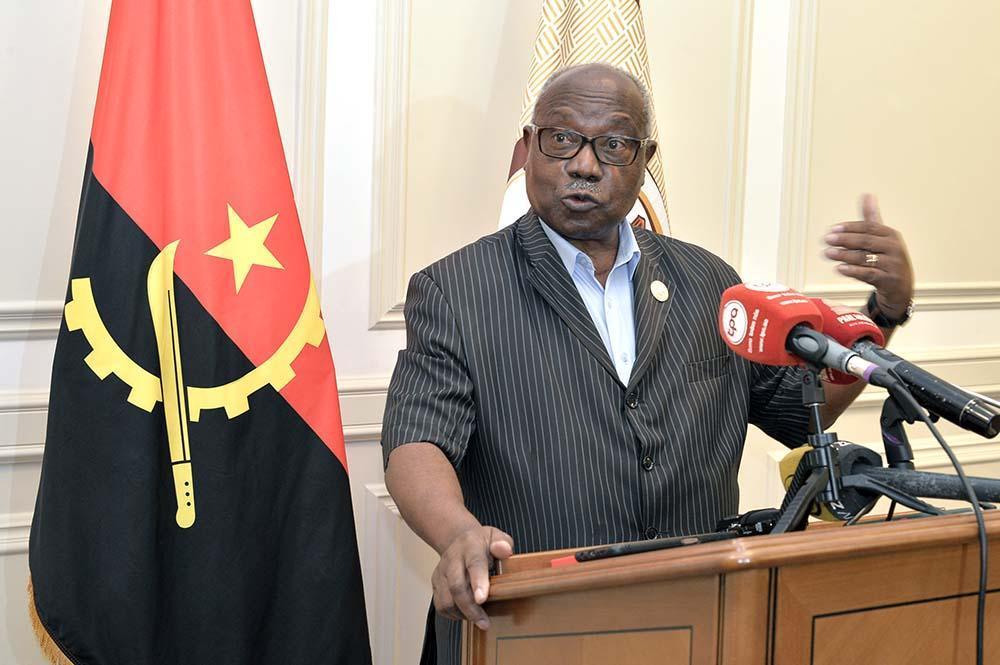
Africa-Press – Angola. The politician and academic, Lucas Ngonda, presented his book, “Political and Social Problems of Independent Angola,” this Tuesday in Luanda.
With this work, the author presents contributions to the national debate, bringing together his interventions in conferences, lectures, colloquia, and articles published in national and international newspapers from 1993 to 2020.
The book, prefaced by the author himself, covers various themes, distributed across 385 pages, and has a print run of 1,000 copies, published by Mayamba Editora.
In the preface, among other information, it reads that “The name Angola, given to the current country, gained prominence since the creation of the Kingdom of Ngola in 1530, a kingdom led at the time by Ngola Kiluanje Kia Samba.”According to some historians such as Alfredo Albuquerque Felner (1872-1937), Giovani António Cavazzi da Monteccucolo (1621-1678), Luiz Gonzaga, and others, he was a dignified sovereign of the Kingdom of Kongo, who governed the lands from Barra do Kwanza to Ambriz and penetrated inland as far as Cassanje.
In statements to the press, the author, a specialist in the field of sociology, highlighted the importance of understanding Angola’s historical past to understand current challenges, emphasizing that many of the difficulties faced today result from the way the territory and borders were defined during the colonial period.
According to him, the borders of current African nations, including Angola, were established by the European occupiers who delimited territories and gave them names without considering local historical and cultural realities.
“The occupier defined the space and gave it a name,” he stated, adding that Angola, as a political entity, did not exist before Portuguese colonization.
According to the academic, the name Angola arose due to the Portuguese presence on the African coast, motivated by commercial interests.
Political science expert Helder Maradona, analyzing the work from this perspective, focused on the preface, specifically the passage where the author discusses the so-called “poisoned independence,” an expression that, according to him, particularly caught his attention.
“I think that, later in the work, the author will delve deeper into this concept, explaining what he means by a poisoned independence. I found this point extremely important,” he asserted.
Finally, international relations analyst Osvaldo Mboco, who analyzed the book from an international perspective, highlighted Lucas Ngonda as an intellectual who not only writes about history but, in many cases, lived it and was a protagonist in it.
“In this work, the author questions, dismantles, and compels us to confront the history of Angola with lucidity, courage, and responsibility. The work results from the compilation of several interventions in conferences, lectures, and colloquia,” he noted.
He emphasized that the writer leads to a reflection on Angola in the periods before and after independence.
“He addresses the process of Portuguese colonization, the occupation of the territory, and the profound marks that this process left,” he argues.
Lucas Ngonda was born on April 7, 1940, in Sanza Pombo (Uíje).Having emigrated to France, he attended the Institute of Economic Studies at the University of Paris (Sorbonne).
For More News And Analysis About Angola Follow Africa-Press