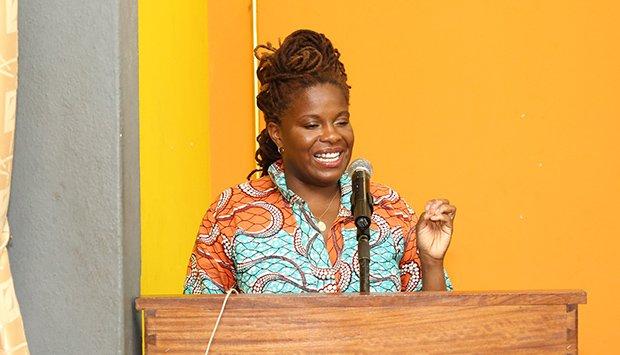
Africa-Press – Angola. Rachel Ghansah, African-American writer and journalist, shared experiences in conversation with Angolan writers last Tuesday, in the auditorium of the Union of Angolan Writers (UEA), in an initiative of the Embassy of the United States of America
The writer and journalist Rachel Ghansah spoke about her creative process, which was strongly marked by racial issues, the diaspora, education and others. She showed to be knowledgeable about the country, talking about Kiezos, films and other non-mediatized references. She thanked the Angolans for their hospitality and highlighted some similarities with African Americans.
In the first part of her communication, Rachel Ghansah spoke about her childhood in Indiana and Philadelphia, the strong presence of her mother, a teacher, and her Ghanaian father, her experience in journalistic editorials and her commitment to essays as a literary genre. She spoke of the feeling of having written the profile of Dylan Roof, a white man who murdered nine people inside the Emanuel AME Church in Charleston.
The report won him the Pulitzer Prize. According to Rachel, it was a mixture of introspection and a look at the historical and social aspects behind these racially inclined murders. She also shared the experience of being a black woman in a society where social construction and social structure allows similar acts to emerge. The power of education and literature was another focus, as well as the attitude of changing African narratives in the press. The danger of translating literary works and studying African authors in universities also deserved Rachel Ghansah’s attention.
With an interactive and provocative audience, the visitor closed the communication to the sound of “Kialumingo” by Urbano de Castro and, in English, said: “I like old songs even in America (I love the old songs, even in America)” .
Research the history of the African people
The American Embassy’s Culture and Education Press Secretary, Cynthia Day, explained Rachel Ghansah’s presence as follows: “it was not an initial invitation from us, in fact it was she herself who wanted to travel to Angola and we had the opportunity to meet her and thus an opportunity arose, which could never have happened so soon. We are very proud that Rachel is among us. This is just part of her working visit, which is to investigate and research the history of African people in America”.
As for the exchange, he assured that it will continue, considering that “this was a step in a long history”. ”, he underlined.
“It was interesting, because we had the opportunity to hear the various points of view of Angolan writers essentially related to the subjects addressed by the writer and also the relationship between the two countries”, he concluded.
“Interesting Experience”
Gociante Patissa, a member of the Angolan Writers’ Union linked to the exchange area, said that the meeting was “an interesting experience”. cultural diplomacy. Our house is always open and internationalization is an old ambition that has already been experienced through anthologies but literature is, above all, around human relationships and social relationships”, he underlined.
The Angolan author insisted on the idea that the exchange with the African-American writer is the beginning of a relationship in which both parties can cooperate with equity, so that it is not just one side receiving the culture of the other reality. “It was interesting, not just for UEA members, but for the student community as well.
He considered that it was also an input for the improvement of the English language, which is an international language.
For João Fernando, recently admitted to the oldest post-independence association, the exchange “was a good experience”. of UEA members. In his opinion, there should also be an interpreter who could translate the communication from English into Portuguese.
Historian and art critic Adriano Mixinge, also a member of the UEA, supports the idea that it was an “interesting experience”, stressing that “there was a great interaction between Angolan and African-American writers”. “She came here on the one hand to exercise her language and on the other to share how black Americans approach issues of race, diaspora, violations against women, topics not always discussed by us”,
He highlighted the appreciation of African languages by Rachel Kaadzi Ghansah, who he considered someone “very affable”. “She came to Angola to do a work on the Kingdom of Ndongo. She could see that she read our press a lot, to the point that she knew our names. She is very open to the world and talked openly. It was good, because only with the exchange of ideas can we learn a little from each other. She said that she really likes Kiezos’ music, we did a preview and saw that she knows Angolan cinema well: Sarah Maldoror, António Ole. It was a surprise to me the way she sees us and the way I saw her on social media,” she concluded.
Israel Campos, an Angolan journalist based in the UK, also said that it was “an interesting event”. “It’s always nice to look at ourselves through the eyes of others. I think outsiders always have different perspectives and she, of course, as an African American has a strong connection to Africa – her father is from Ghana – and she feels at home in Angola,” he said.
He highlighted the fact that the American journalist feels good in Angola and considers Angolans a welcoming people. “For us it is a good sign and it really gives us a different perspective. Sometimes, as people who live in the country, we have a particular vision also based on day-to-day problems, so it is always important and positive to have the opportunity to listen to other people, other visions, other perspectives on what we are and our way of life”, he underlined.
He said that as an African in the diaspora, he has a problematic relationship with the way people, especially in the West, look at African peoples. “There is this very great tendency to generalize, that is, to treat Africa as if it were a country and not a continent, and this, in my view, ends up dehumanizing the very individualities of the peoples a little, because each people has its own its own particularity, its modus vivendi. Only in Angola is there cultural diversity”, he said.
He considered it important to find or look at ways that could, in fact, change this narrative that the West has built and built for many years about Africa and Africans. “I think that literature and journalism play fundamental roles in the deconstruction of this vision. Literature, through stories that can actually show this Angolanity and Africa in the most varied aspects, always guided by the question of individuality, because the person must be treated and seen as such and not as an African people”, he highlighted.
Brief Profile
Born in 1981, Rachel Kaadzi Ghansah is an African-American journalist and writer, considered one of her country’s most brilliant essayists. She has worked on essays for profiles of African-American Hip Hop stars like Kendric Lamarr and Missy Elliot, artist Jean-Michel Basquiat and writer Toni Morrison. In 2017, with the profile of the white supremacist and assassin Dylan Roof, she won the Pulitzer Prize in the Writing category and with the same piece she won the National Magazine Award. She was a finalist for the National Magazine Award in 2014, for her profile of comedian Dave Chappelle.
For More News And Analysis About Angola Follow Africa-Press