By Adérito Ferreira
Africa-Press – Angola. Angolan diplomacy celebrates, this Monday, an indelible milestone in its history, given that it was, on February 12, 1976, that the then People’s Republic of Angola was admitted, “de jure”, into the Organization of African Unity (OAU), now the African Union (AU).
The admission took place three months after the great achievement of the Angolan people, the achievement of National Independence, constituting a decisive step in the field of International Law.
The proclamation of independence, by President António Agostinho Neto, on November 11, 1975, represented the culmination of an arduous and long struggle for national liberation, which began on February 4, 1961.
When proclaiming independence, António Agostinho Neto announced the country’s adherence, as a free and independent African State, to the principles of the Charter of African Unity, to which the OAU agreed by welcoming it as its new Member State.
The official declaration of the debut of the new State, delivered at the headquarters of the continental organization, by its first Minister of Foreign Affairs, José Eduardo dos Santos, highlighted that Angola had arrived at the OAU thanks to the determination, sacrifice, resistance and struggle of the people against Portuguese colonialism.
The country’s commitment to African ideals also began to be translated into the colors of the new National Flag, namely red, signifying the blood shed by Angolans in the anti-colonial and national liberation struggle, and black, representing the African continent.
The same commitment is expressed in the lyrics of the National Anthem, in verses such as “Let us raise our liberated voices”, “For the glory of the African peoples”, “Let us march Angolan combatants”, “Solidarity with the oppressed peoples”.
After 48 years since joining the OAU, Angola maintains its loyalty to the principles and strategic objectives of the African Union, successor to the Organization of African Unity, seriously engaging in the organization’s Institutional and Financial Reforms process.
Among the 55 Member States, Angola is in the top six of AU contributors.
Regarding the latter, there have been several expressions of recognition, especially from the African Union Commission (AUC), about the “strategic importance” of Angola for the Peace and Security of the continent.
One of the most emblematic testimonies is the holding (every two years) of the Pan-African Forum for the Culture of Peace – Luanda Biennial, an event organized in partnership with the AU and UNESCO.
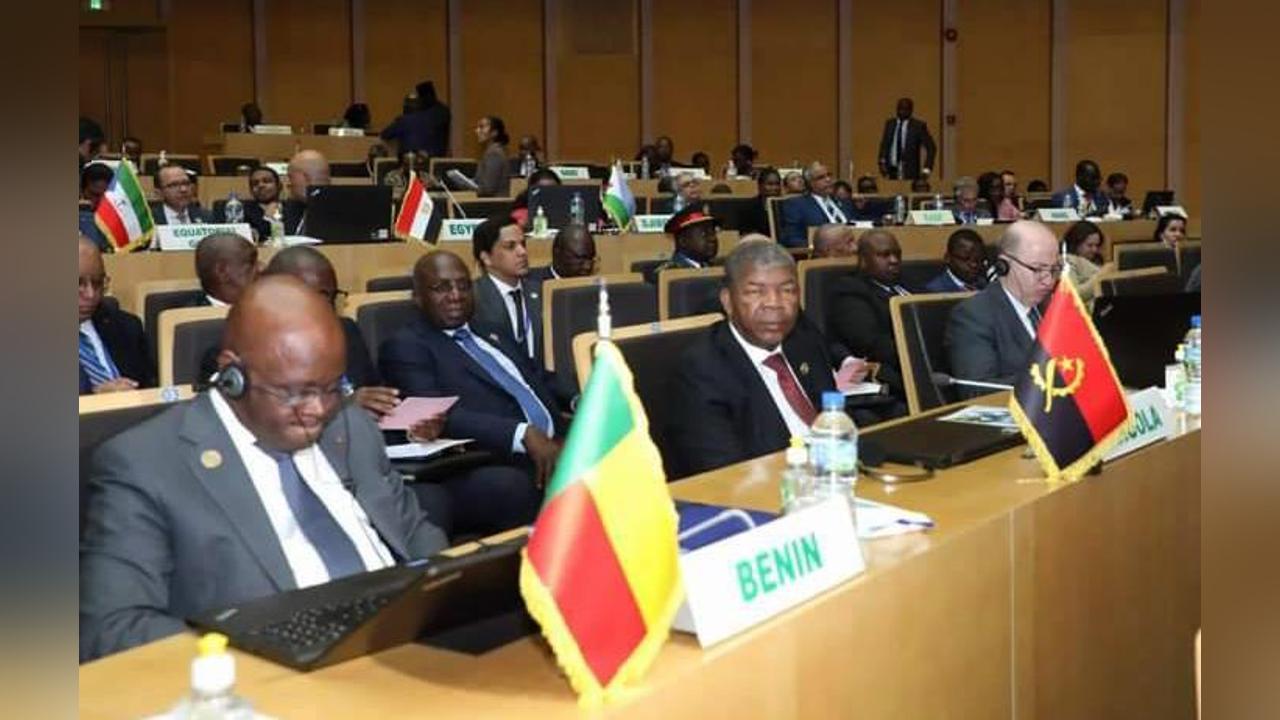
At this juncture, the country applied for a new election for the Peace and Security Council (CPS), a vote taking place during the 44th Executive Council, which will precede the 37th Ordinary Session of the Conference of Heads of State and Government (Summit ), scheduled for February 17th to 18th, in Addis Ababa (Ethiopia).
This will be the fourth presence at the CPS, after the 2007-2010, 2012-2014 and 2018-2020 mandates.
It is a permanent decision-making body for the prevention, management and resolution of conflicts, composed of 15 members.
However, the Conference of Heads of State and Government is the supreme body of the AU.
But this also includes the Executive Council, the Pan-African Parliament, the Court of Justice, the Commission (which includes the CPS), the Permanent Representatives Committee (to which the Angolan ambassador to Ethiopia belongs), in addition to other structures.
The position of Angola’s permanent representative to the AU has already been held by ambassadors Luís José de Almeida (1989-1993), Toko Diakenga Serão (1993-1998), Miguel Gaspar Fernandes (1999-2004), Manuel Domingos Augusto (2005-2010 ), Archangel Maria do Nascimento (2011-2018), Francisco José da Cruz (2018-2023) and currently by Miguel César Domingos Bembe.
Angolans in AU structures
Among the various presences of Angolans in the pan-African organization, the current Minister of Foreign Affairs, Téte António, previously served as representative of the African Union at the United Nations and diplomatic advisor to the president of the African Union Commission.
He was also a political observer for the AU at the United Nations Mission for the Organization of a Referendum in Western Sahara (MINURSO), from 1997 to 1999.
Since 2016, academic Sebastião da Silva Isata has chaired the AU International Law Commission, after serving as special representative of the African Union in Guinea-Bissau, Burundi and the Great Lakes Region.
Josefa Leonel Correia Sacko, current commissioner for Agriculture, Rural Development, Blue Economy and Sustainable Environment (since 2017), and Lieutenant General António Lamas Benedito Xavier, chief of staff of the African Force in State of Alert also stand out.
Meanwhile, Maria Teresa Manuela is a member of the African Commission on Human and Peoples’ Rights, special rapporteur on Prisons, Conditions of Detention and Policing in Africa and a member of the Committee Against Torture in Africa, while Pascoal António Joaquim is a member of the African Union Advisory Council on Corruption.
More recently, on November 8, 2023, Wilson de Almeida Adão, also an academic, was chosen as president of the Committee on the Rights and Welfare of the Child of the African Union (AU).
The list of Angolan entities in the organization also includes Matias Bertino Matondo, former special representative of the AU president for the Central African Republic; Luís Muxito, former military advisor to the president of the AU Commission, António Lamas Benedito Xavier, former chief of staff of the African Force in State of Alert and Paulo de Carvalho, former vice-president of the Council of the Pan-African University.
The Angolan authorities are committed to increasing the country’s influence within the AU, as a new Quota System was approved by the 38th Ordinary Executive Council, and, as part of ongoing reforms, the reserved places were increased from 39 to 74 to Angolan officials serving in the AU Commission.
Paradoxically, the country is one of the six largest contributors to the AU Statutory Budget, alongside South Africa, Algeria, Egypt, Morocco and Nigeria, but has a meager representation rate of around 7% in AU structures. organization, contrary to its statutes.
Unhappy with the situation, the President of the Republic, João Lourenço, highlighted, in his 2020 Address to the Nation, the strategic importance of inserting national staff into international and regional organizations, in the context of foreign policy and the defense of Angola’s interests in international arena.
Historic
The Organization of African Unity (OAU), founded on May 25, 1963, had as its main objectives to free the continent from the traces of colonization, promote unity and solidarity among African States, coordinate and intensify development cooperation, safeguard the sovereignty and territorial integrity of Member States and facilitate international cooperation.
The purpose of the OAU Charter is to promote the unity and solidarity of African States, cooperation between them and the international community, in favor of improving the lives of the people of Africa, defending sovereignty and independence, eradicating colonialism, human rights advocacy, among other issues.
However, in order to face problems aggravated by the phenomenon of globalization, by changes in the historical-political context of the Member States and with the aim of adapting the continent to the global economic panorama, and better resolving the social, economic and political problems of the countries, The African Union (AU) was created on July 11, 2000, replacing the OAU.
After the project was launched in 1999, in Sirte (Libya), by the Libyan leader Muammar Gaddafi, in July 2000, in Lomé, capital of Togo, the Constitutive Act of the AU was adopted, in July 2001, in Lusaka (Zambia). ), and the replacement program for the OAU by the AU was established.
In 2002, at the Durban Summit (South Africa), the inaugural session of the institution’s Conference of Heads of State and Government took place.
ANGOP journalist
For More News And Analysis About Angola Follow Africa-Press