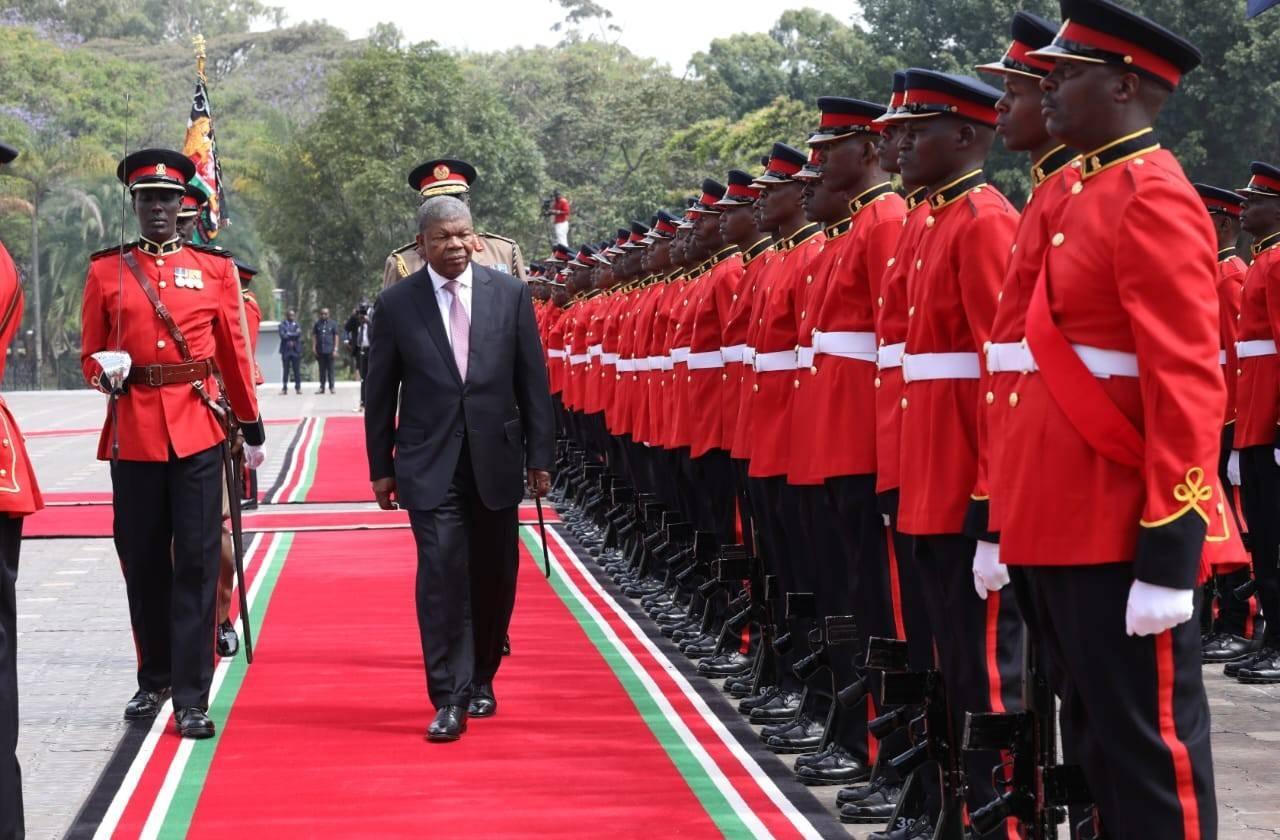
Africa-Press – Angola. The Angolan President, João Lourenço, paid homage to Jomo Kenyatta, founder of the Kenyan nation, with the laying of a wreath, this Saturday, in Nairobi, Kenya, at the mausoleum erected in his memory.
Accompanied by the First Lady of the Republic, Ana Dias Lourenço, the Head of State, who is on a two-day official visit to Kenya, paid homage in front of the Africanist’s tomb, located at the entrance to the Kenyan parliament.
First President of independent Kenya, Jomo Kenyatta governed the country from 1964 to 1978.
Journalist and politician, Jomo Kenyatta was an anti-colonial activist and politician, who governed Kenya as Prime Minister from 1963 to 1964 and as President from 1964 until his death in 1978.
He was the first indigenous Head of Government and played a significant role in transforming Kenya from a colony of the British Empire into an independent country.
Ideologically an African nationalist and conservative, he led the Kenya African National Union (KANU) party from 1961 until his death.
Kenyatta, the son of Kikuyu farmers in Kiambu, British East Africa, was educated at a missionary school and worked in various jobs before becoming politically engaged through the Kikuyu Central Association.
In 1929, he traveled to London to lobby to regain land from the Kikuyu tribe.
During the 1930s, he studied at the Moscow East Workers’ Communist University, University College London and the London School of Economics.
In 1938, he published an anthropological study of Kikuyu life before working as a farm hand in Sussex during the Second World War.
Influenced by his friend George Padmore, he embraced anti-colonialist and Pan-African ideals, co-organizing the 1945 Pan-African Congress in Manchester.
He returned to Kenya in 1946 and became a school director. In 1947, he was elected president of the Kenya African Union, through which he lobbied for independence from British colonial rule, attracting widespread indigenous support.
In 1952, he was among six prisoners accused of planning the Mau Mau anti-colonial revolt. Despite declaring his innocence – a view shared by later historians – he was convicted. He remained imprisoned in Lokitaung until 1959 and was then exiled to Lodwar until 1961.
After his release, Kenyatta became president of KANU and led the party to victory in the 1963 general election. As Prime Minister, he oversaw the transition of the colony of Kenya to an independent Republic, of which he became President in 1964.
In 1975, Jomo Kenyatta brought together the leaders of Angola’s liberation movements at the same table, in Nakuru, Kenya, to align a common vision on the struggle for independence.
For More News And Analysis About Angola Follow Africa-Press