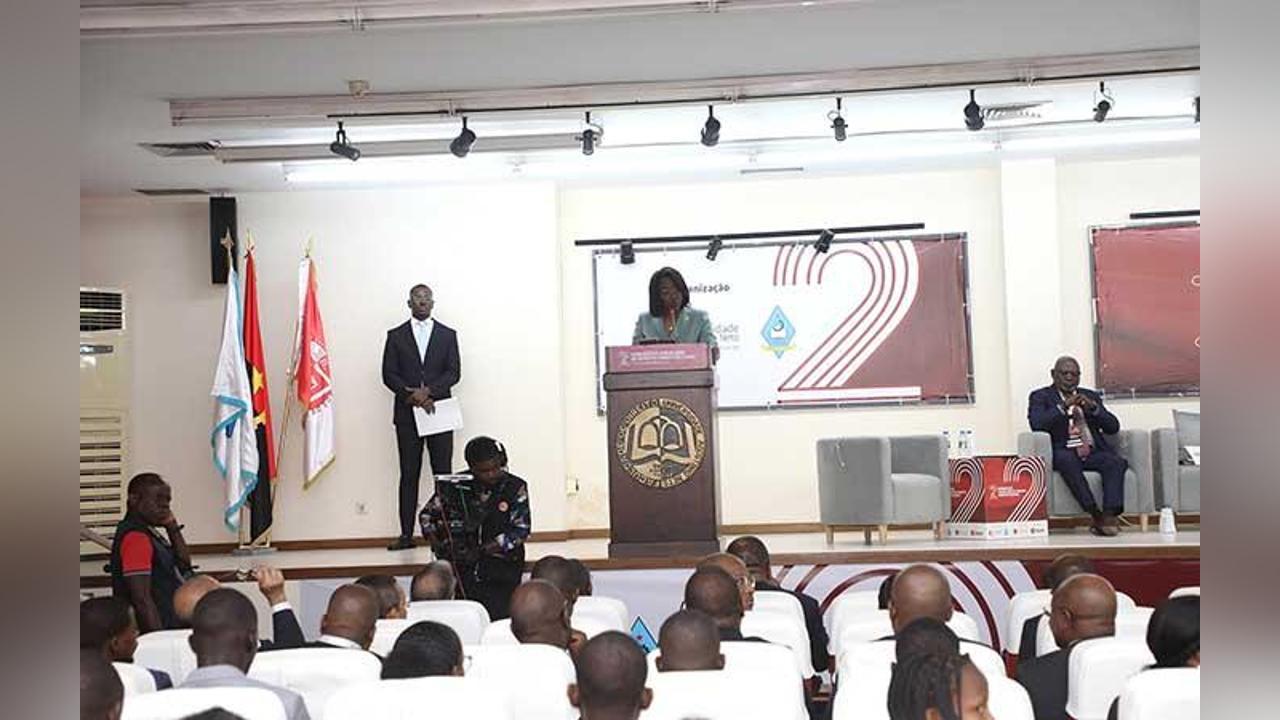
Africa-Press – Angola. The Judge Counselor of the Constitutional Court, Laurinda Prazeres Monteiro Cardoso, considered, this Tuesday, in Luanda, the Constitution of the Republic of Angola as the foundational basis of the Angolan State and the compass that guides the community.
The judge stressed that the Constitution, whether formal or material, is not reduced to a normative body regulating public powers, but is also the guiding thread and the foundation on which all State decisions must be based.
“In the preamble of the CRA it can be read that the Constitution is the First and Fundamental Law of the State and of Angolan society, which is part of the long struggle of the Angolan people to build a democratic State of law and a fair society in Angola”, he emphasized .
He added that it is always good for academics to come together to create and encourage spaces for reflection and debate on Angolan constitutionalism, contributing to the study of Angolan reality but without losing sight of the new perspectives of Constitutional Law.
When speaking at the 2nd Angolan Congress on Constitutional Law, the judge said that participants will have the opportunity and privilege to listen and learn from interventions guided by scientific principles.
“I, however, without neglecting scientific methods, would like to propose that we reflect on how a Congress of this nature can help to deconstruct the technical vision of the problems of Constitutional Law and the Constitution itself (……)”, he stressed.
This, he continued, to give it a dimension of everyday social life and, thus, bring it closer to the common citizen, taking into account that the vision and approach of the CRA, in its social dimension, presupposes accepting, above all, that it is a cultural creation.
“That the norms and values that underlie these result not only from the legacy of generations of scholars of the Science of Law and Constitutional Law in particular, but from social phenomena that are (or should be) properly contextualized in time and space “, he highlighted.
According to Laurinda Prazeres Monteiro Cardoso, in the field of research and discussion in social sciences, especially in an academic environment like this, there is usually an emphasis on questions of method.
For this reason, it understands that this concern cannot obscure other equally essential issues, such as the application of results to the service of society, hoping that the good ideas discussed go beyond theory and can be transformed into intentional action.
“Furthermore, by default or merit, when these distinguished academics join a congress, the practice of science becomes increasingly complex”, praised the Judge Counselor of the Constitutional Court, when opening the event.
As he explained, it is necessary, once again, to “deconstruct” the concepts, in order to avoid a type of collective skepticism, that is, society becoming convinced of the complexity of the approaches, but not becoming enlightened.
“It has been widely publicized and accepted that the Constitution is embodied in our social contract. Therefore, in this forum, it seems legitimate to ask ourselves what it is, and why it is considered the Fundamental Law of the State?”, he advised.
Likewise, he asked congressmen to ask themselves what and how they should do so that the values contained in constitutional principles and norms are known to the people in general?
Along the same path, and noting that the Law must be understood by everyone, he asked how such values can encompass all social strata and not just jurists, researchers, constitutionalists, legislators and law students?
“Still in accordance with the preambular provisions of our Magna Law, the Constitution is committed to the fundamental values and principles of Independence, Sovereignty and Unity of the democratic State of law, of pluralism of expression (….), he reinforced.
Laurinda Cardoso said that the idea of Constitutionality stems from the principle of Supremacy of the Constitution, that is, the CRA is the “Lex Mater” (supreme law).
For this magistrate, laws and other acts of the State, Public Administration and Local Power, including the Judiciary, must comply with the Constitution, on which their validity depends.
“In fact, it is also one of the foundations of the existence of constitutional jurisdiction, that is, the set of legal and institutional mechanisms, available for the judicial investigation of the constitutionality of laws and other acts of the State, a competence exercised, in the last instance, by the Constitutional Court” – he highlighted.
For all this, he recommended, the need to find, all together, the most assertive mechanisms so that, from a very early age, children and young people can grow up knowing the Magna Carta, and, consequently, learn about their rights is reinforced. and fundamental duties.
“That is, to grow up with a refined legal, political, civic and patriotic culture. In fact, it is essential to publicize the CRA more and better, so that the most basic rights of each and everyone are respected”, he explained.
He also added that, as the Constitution is an instrument of the people and for the people, the ideal is for discussions to be focused on ontological, axiological or methodological aspects, hoping for results that seek solutions to social, political or legal phenomena.
“If this is the case, we will be, on the one hand, contributing to strengthening the feeling of social cohesion, and, on the other hand, integrating those who feel left out of the knowledge and importance of the Constitution in the life of the country”, he concluded Laurinda Cardoso.
The first day of this 2nd Angolan Congress on Constitutional Law, which ends on Thursday, was attended, among other entities, by the president of the National Assembly, Carolina Cerqueira, assistants from the executive branch and judicial magistrates and the Public Ministry.
It is taking place at the Faculty of Law under the motto “Angolan Constitutional Law and the challenges of social transformations”, and is also attended by deputies, civil servants, students and members of civil society.
For More News And Analysis About Angola Follow Africa-Press