Africa-Press – Angola. The promised is due and here we are with yours, mine and all of us, PAIS NOVO, 5 years of transformation, the program that is doing a retrospective of the main moments, the main tasks, the main achievements and , above all, the great challenges that marked the first term of a President and a Government committed to the country and its people, committed to improving the living conditions of all Angolans.
Recently, we were presented with excellent information: life expectancy in Angola has increased again. We live longer in our country.
In the previous text, we talked about the Economic Environment that prevailed in the country until shortly after the Executive led by President João Lourenço took office.
We said that the Economic Environment, in general, was somewhat tense, quite pressured, for several reasons:
First, due to the global economic and financial crisis of 2014, with negative effects on almost all sectors of life in countries around the world;
Second, the global health crisis, caused by Covid-19, from the end of 2019 and which until today still continues to condition the normal course of activity in several sectors;
But, other problems and deficiencies, controllable and uncontrollable, also affected the Economic Environment in our country.
We are talking, for example, about the obsolete or maladjusted state, in time and in the context, of some legislation and laws, above all, in the economic, social and administrative domain. The variation in the sale price of a barrel of oil in the international market.
These deficiencies and other distortions contributed greatly to the economic environment being in a tense state, pressured, to the point of conditioning the DIVERSIFICATION OF THE ECONOMY, as one of the gigantic challenges of the country.
It was and is necessary courage, daring, short, medium and long term vision. But, above all, the work of the Executive, President João Lourenço and the millions of Angolans, from all professions and activities, who believed that with the new Economic Environment it was and is possible to diversify the economy.
It was with this desire and certainty focused on results that the Angolan EXECUTIVE launched, and is still in progress, the Sustainable, Diversified and Inclusive Economic Development Plan.
But…, what did or does this development plan contemplate? Surely you will be asking this question..
Geological-mining projects operate across the country
Let’s see:
This implementation plan, during the period 2018-2022, covers 24 action programs.
Attention: some of these programs have already been covered here in the NEW COUNTRY. Certainly many of us remember.
Even so, we are going to mention some programs included in this Sustainable, Diversified and Inclusive Economic Development Plan.
The Public Finance Modernization Program is one of them;
The Production Support Program, Import Substitution and Export Diversification (PRODESI) is another. And there are others more.
The implementation of this plan, in the period 2018 until the first quarter of 2022, absorbed 580 billion kwanzas, representing a degree of execution of 63.49 percent, and with results achieved visible to the naked eye…
Today, we are not going to talk about all the programs included in the Sustainable, Diversified and Inclusive Economic Development Plan.
For today, the subject is the Reforms of the Natural Resources Sector, a reform that has been necessary for some time, whose implementation is governed by two programs:
– The Program for the Development and Modernization of Geological-Mining Activities and the Program for the Development and Consolidation of the Oil and Gas Sector.
The Ministry of Mineral Resources, Oil and Gas coordinates the Program for the Development and Modernization of Geological-Mining Activities, with the execution of actions and projects being carried out by various bodies such as the Geological Institute of Angola, ENDIAMA, SODIAM and the Provincial Directorates.
This Action Programme, as part of the results-based governance strategy, focuses on the promotion of mineral resources, always within the logic of environmentally sustainable use of resources, in addition to creating local employment.
The exploitation of resources must support a set of lines that lead to the exploitation of diamonds, gold, iron, materials and products of mining origin for civil construction, agriculture and industry.
With the program for the Development and Modernization of Geological and Mining Activities until the first three months of this year, close to 57 billion kwanzas were invested, which represents a level of execution of 140 percent. It would be good, whenever we talk about money invested, to indicate what has been achieved. The same can be done in texts above.
For many, many years, when one spoke about the geological-mining sector, one immediately thought of diamonds and, rarely, of ornamental rocks.
Today, the country has increased production of precious stones and metals such as gold. We have a nascent industry in the country for the production of ornamental stone derivatives, such as granite, marble, among others.
This sector is now seriously supporting agriculture, with support being given to limestone producers.
In the period 2018 – 2021, an average of 21 thousand cubic meters of limestone were produced per year, a very useful raw material for soil fertilization.
The geological-mining sector increased support to producers of mineral resources for civil construction. As?
From 2018 to 2022, the annual production of silica sand increased to around 14,000 cubic meters. Equivalent to how many trucks? This raw material is important for the manufacture of glass. The increase in the production of silica sand is due to the fact that more factories in the field of tableware, both sanitary and hotel, enter the market, in addition to the beverage factories, which demand more glass bottles.
This performance was also due to the resumption of production at the Vidrul Factory, which was paralyzed from 2020 until the third quarter of 2021.
With the launch of the program for the Development and Modernization of Geological-Mining Activities, many raw materials that did not seem to exist in the country began to reappear and be reborn. This is the case with clay. Does it do what?
The production target for this raw material was 162 cubic meters, but by 2021, clay production reached 354 thousand cubic meters.
With the increase in clay production, building materials factories and ceramics industries grew in number and diversification of products, ranging from tiles to bricks, through kitchen products. Can we cite some examples???
The good performance of the indicator for this raw material is also a result of the greater demand for the product by the cement industry, as well as the promotion of new operators, permanent monitoring of activities and supervision of production.
We have already said it: the implementation of this Program for the Development and Modernization of Geological-Mining Activities cost the State, until the first quarter of this year, close to 57 billion kwanzas. Indicate some of the results of this investment?
The relaunch of these products and raw materials that little or nothing was said about them is called sustainable economic diversification and inclusion.
Oil Increases Production
In the oil and gas sector, the bet includes and is underway an ambitious program aimed at mitigating the decline in crude oil and gas production, relaunching and increasing competitiveness in this sector.
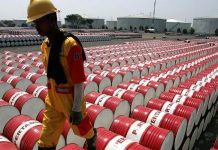
From 2018 to 2022, the average daily production of crude oil reached 1.237 million barrels of oil/day.
Contributing to this indicator were activities and projects that consist of continuing to implement measures aimed at reducing unplanned stops and reducing production losses, as well as the entry into production of new fields: N’singa in Block 0, Ochingufu , Agogo, Southeast and North Ca-baça, Vandumbo, Cuica and East Pole in Block 15/06, Platina in Block 18;
Since oil is the main guarantor of the State Budget, but today, with a reduced presence as a result of the promotion of other sectors of the economy, the strategy for this sector, given the decline in production that was registered, the Government approved a new strategy that consists of the Attribution of Oil Concessions for the Period 2019 – 2025, which provides for the bidding of another 50 blocks until 2025.
Other strategies for the sector were approved, such as the promotion of the development of marginal fields and new opportunities.
The average production of liquefied natural gas is also another bet. Before, millions and millions of dollars were burned in the open, also endangering the environment. Today, all petroleum derivatives are useful.
In accumulated terms, in the period 2018 – 2021, an average of 105 thousand and 859 thousand barrels/day of liquefied natural gas were produced, corresponding to a degree of execution of 143.44 percent of the target established for the five-year period 2018- 2022
As part of the program for the development and consolidation of the oil and gas sector, new refineries should be created: in Lobito, Cabinda and Soyo. The one in Luanda benefited from investments and, at the moment, increased the levels of production of crude oil derivatives between 2018-2021, an average of 2 million and 13 thousand tons were produced, corresponding to a degree of execution of 68.13 per cent. percent of the target established for the 2018-2022 five-year period.
In fact, the program for the development and consolidation of the oil and gas sector allowed giving new impetus to all areas of this sector.
Improved the distribution network of fuels and lubricants throughout the territory, by increasing storage capacity.
In cumulative terms, in the period 2018-2021, the storage capacity of fuels and lubricants on land stood at 675 thousand and 968 thousand cubic meters, corresponding to a degree and execution of 111.63 percent.
Added to these advances is the fact that from 2018 to 2022, it increased to 981 operational filling stations across the country.
The reforms that the Natural Resources Sector are benefiting from, especially the mining and oil sectors, clearly and unequivocally demonstrate that the country is moving forward with its commitment to its children, its staff and its professionals.
The Angolanization of this sector, that of Natural Resources, is proof of that.
Thank you President!
Thank you Angola.
And…don’t forget: ON THE TEAM THAT WINS…, DO NOT MOVE!
We repeat: ON THE TEAM THAT WINS…, DO NOT MOVE!
Thanks.
For More News And Analysis About Angola Follow Africa-Press