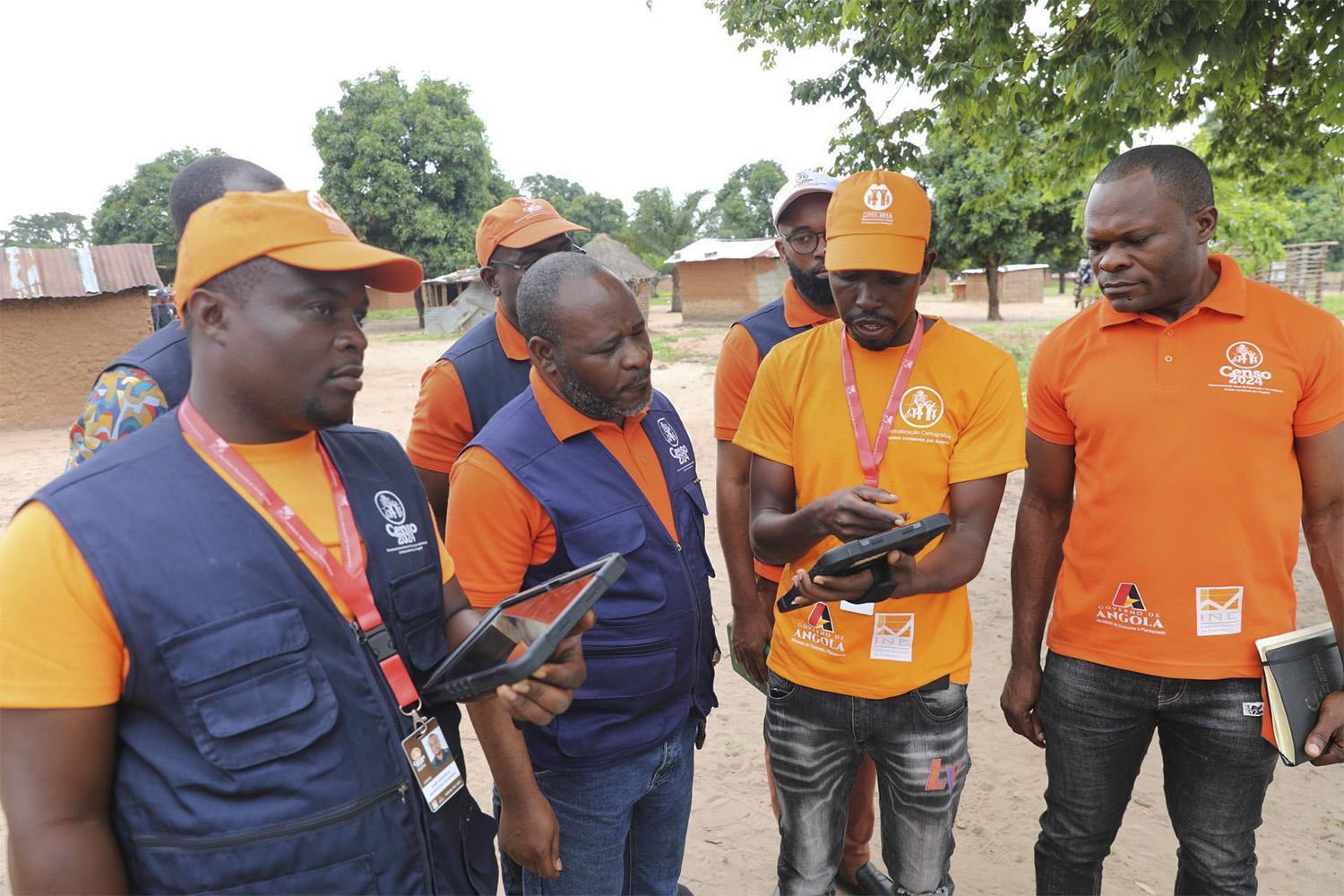
Africa-Press – Angola. The National Institute of Statistics (INE) began this Monday, in the commune of Sombo, municipality of Saurimo (Lunda Sul), a process of raising awareness among traditional, religious and administrative authorities about the process of cartographic updating, within the scope of carrying out the 2nd General Population Census 2024.
Speaking to the press, the director general of the National Statistics Institute (INE), José dos Santos Calengi, said that this process of raising awareness and updating cartography will extend across the four municipalities that make up the province.
He highlighted that the idea is to raise awareness among this segment at the level of neighborhoods, sectors and communes, as they are the entities that know the true limits of the different administrative districts of the province in general.
“The basic communication of this process must be shared with the responsible entities, as they will ultimately be the spokespeople, from the point of view of mobilizing communities”, he added.
He also highlighted that one of the main objectives of this process is to define and redefine the geographic limits of existing neighborhoods and the number of dwellings in the district.
He made it known that the collection of information will be done digitally, from households, and will be done via tablets that contain the data application.
The Population and Housing Census takes place throughout the country and covers national citizens, resident or temporarily absent foreigners and accommodation units.
The commune of Sombo, 170 kilometers from the capital (Saurimo), has an estimated population of more than three thousand 613 inhabitants, distributed across 14 villages.
According to data from the General Population and Housing Census, carried out in 2014, Angola at this time had a population of 28.4 million inhabitants and a fertility rate of 6.2 children per woman. The rate is higher in rural areas, reaching 8.2 children.
The second general population and housing census will allow us to know precisely the number of inhabitants in the country, how many men, women, children and elderly people, where they live and how they live.
With this information, the country will be able to better plan the distribution of essential services to all Angolans.
For More News And Analysis About Angola Follow Africa-Press