Africa-Press – Angola. Several exhibitors participated, from the 7th to the 9th of September, in the 14th edition of the ITEL Technological Innovation Fair, with projects linked to different areas, from Health, Education and Leisure
A calm and peaceful atmosphere was what was recorded in the morning on the first day of the Technological Innovation Fair of the Telecommunications Institute (ITEL), in Luanda, where 40 projects by final year students from that institution were exhibited. Through the initiative, which takes place every year, students presented to the public and the business class the skills and knowledge acquired during the four years of training.
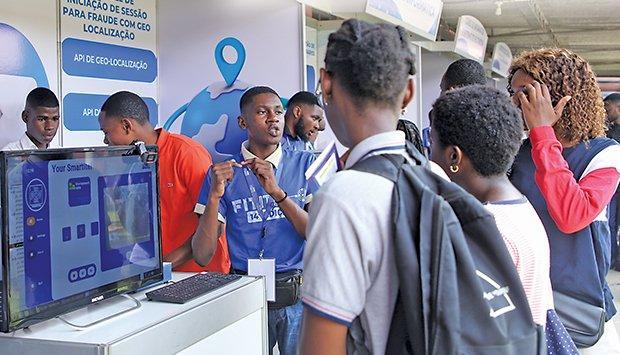
Upon entering the courtyard there were several profiled booths, where each student displayed their creations.
The environment, which at first seemed calm and easy to navigate through the corridors, suddenly began to become agitated and crowded with the arrival of visitors, mainly students, who colored the place white with their coats, causing the movement to become increasingly busy. increasingly difficult.
Having just arrived, the students went to the booths that caught their attention, curious to know how each project on display works.
“I was delighted with all the projects I found, especially with those systems linked to the health sector”, said Maria Joaquina, one of the visitors.
Paying attention to the inventors’ explanation, it was possible to notice on each student’s faces the admiration for everything they saw. “There are guys here”, commented among themselves a group of students who were strolling through the fair.
The activity also included a moment of debate to reflect on Technological Innovation in the Service of Road Safety.
Mitigating road accidents
On the occasion, the director for Telecommunications, Information Technologies and Social Communication, Matias Borges, encouraged young ITEL students to find ways to mitigate road accidents together.
Given the number of accidents that tends to grow, he stressed, ICT are tools that are helping and can generate solutions to this problem. “Today, at national level, the CISP has an integrated center that has helped with the various problems that have arisen on the roads, as they facilitate interaction between victims of accidents and the police”, he highlighted.
The head of the Telecommunications and Information Technologies department, Tomás Cucolo, who spoke about Technological Innovation in the Service of Road Safety, said that the National Police has made efforts and made large investments in technological equipment to curb the number of accidents on the country’s roads. The use of new technologies, he highlighted, will, in a certain way, help in monitoring road traffic.
In terms of technological equipment, he said, the country has some, but they are still not satisfactory. “We are investing in fixed and mobile radars, which aim to reduce the accident rate, because, from the moment the driver identifies a radar, they tend to reduce their speed”, he highlighted.
Tomás Cucolo said that, in the first half of 2023, the country recorded 7,283 road accidents, with 1,458 deaths and 8,926 injuries.
With these data, he highlighted, road education must start from the ground up, in order to combat the rate of occurrences. “If we invest in education from the ground up, in the future we will have a country with fewer road accidents”, he said.
The deputy commander for Fire Management, in the province of Luanda, Bravo Mendes, called on the young ITEL finalists to look at technological challenges, with the creation of equipment or systems for direct interaction between the citizen and the Fire Department.
After the debate on Technological Innovation at the service of Road Safety, a cultural moment followed. Minutes later, the fair became lively again, with a guided tour from booth to booth, given by the deputy governor of the province of Luanda for the Economic sector, Gilson dos Santos Carmelino, and other entities who were amazed by the projects and praised the initiative of each exhibitor.
Projects linked to different areas
Several exhibitors participated, from the 7th to the 9th of September, in the 14th edition of the ITEL Technological Innovation Fair, with projects linked to different areas, from Health, Education and Leisure.
Alfredo Augusto, 19 years old, ITEL final year student in the 2022/2023 academic year, resident in the municipality of Cacuaco, presented a system for monitoring vehicle overtaking, developed with the aim of helping to minimize road accidents.
Enthusiastic about the work itself, he explained that the application allows the driver to detect the approach of objects around him, causing the driver, still at a distance, to find mechanisms to avoid and avoid colliding with the obstacle.
The application, he highlighted, was designed to be connected to the car’s dashboard, where the driver can see the obstacle from the car’s screen. “The roads in the country have a deficit in terms of luminosity and often the vehicles themselves do not have lights. With this application it will be possible to detect, from a real distance, the obstacle and thus prevent constant accidents on the highways”, he explained.
Alfredo Augusto said that the creation of the project came about on his own initiative, but he had the help of one of the teachers.
The purpose, he said, is to materialize the system in a real car in the coming years, which is only possible if there are sponsors who help implement and experiment in a vehicle.
Online system
Also not left out was Filipe Matias, 20 years old. Together with a colleague, both finalists in the Electronics and Telecommunications course, they presented an online system to detect fire incidents.
Filipe Matias said that he used technology and sensors to detect fires early, as the system issues alerts in real time. The idea, he added, is for the project to be implemented in homes, industrial facilities and buildings.
Dressed in a blue shirt, like the other exhibitors, jeans and white sneakers, he explained that the application is linked to a communication system and that, through a central website, it is possible to send an alert to the Fire Department and the owner informing about the occurrence.
Although the project is online, he stressed that the client does not need to be connected to the Internet to detect signs of fire on their property. Filipe Matias highlighted that they created the application with the aim of preventing constant losses from material damage and, mainly, helping the Civil Protection and Fire Service to save lives.
“Since the only way for the Fire Department to become aware that there is a fire is through a call, we decided to create another method to facilitate direct communication between victims and the Civil Protection and Fire Service”, he highlighted.
Electronic wheelchair
On the other side, a circle of students looked intently at a small electronic wheelchair, which moved from one side to the other using a command.
Ivo Ngonga, with the controller in his hands, patiently explained how it works. In addition to making mobility easier for people with disabilities, it also helps to detect obstacles.
The idea, he said, came about after noticing the countless difficulties that people with disabilities face in their daily lives in getting around, as most depend on a family member or someone close to them to push them.
“The living proof is my older brother. I see the effort he makes to move around. So I started thinking about how I could make his life easier and that of others who find themselves in the same situation. It was then that the idea of creating this control came up remote”, he stressed.
Ivo Ngonga, 25 years old, lives in Cazenga, said he entered ITEL due to the influence of his father, who encouraged him to take the Electrotechnics and Telecommunications course. “I always said that it was good to study at this school but I never talked about how hard I had to apply myself. It wasn’t easy. I had to sleep a lot to revise. Today I can say that it was worth it, because all success requires sacrifice”, he highlighted .
In the coming years, he intends to continue developing the project and implement a system that can also reproduce voice, to help quadriplegics, who have disabilities in their lower and upper limbs. “The objective of participating in the fair is to attract investors who are interested in the project”, he said.
Rescuing culture
Said Mucondo, 19 years old, graduated from the IT and Multimedia System course, created an operating system called “Rescuing culture”. A 2D mobile application with the function of teaching or remembering historical dates, names of national heroes and above all Angolan ethnolinguistic groups.
The application, he stressed, works like a super interactive book, which is installed on the cell phone and can be used by individuals of all ages and countries who want to learn more about the country’s culture.
“People are increasingly tied to their phones and are losing the habit of reading. Looking at this aspect, the idea of creating this application came up so that people, through their own devices, can learn the history of our people”, explained.
The project teaches in three ways: in text, for those who like to read, in audio and video classes; since with images people tend to learn more easily.
Still in the field of education, as a way of helping with the quality of education in the country, Yonara Bola, 19 years old, and Raquel, also finalists in the IT and Multimedia System course, created a game dedicated to children with special needs(with Down syndrome, deafness, muteness and autism).
Yonara Bola explained that the game aims to help develop their cognitive abilities through a collection of games that, in a fun and interactive way, stimulate children’s attention and concentration.
“The game is made up of three categories. Each of them contains mini games adapted for each of the diseases. Which will help children with or without disabilities to know how to communicate with a child with special needs”, he explained.
The next step, he said, is to continue developing the project, updating it in light of constant technological updates and subsequently implementing it in schools, in order to minimize the deficit in the quality of special education that the country still faces.
Medical treatment systems
Cristiana Cangudo, 19 years old, an average Electronics and Telecommunications technician, together with a colleague, presented a medical assistance system for respiratory diseases and hypertension, which was their final course project.
While explaining, Cristiana Cangudo also demonstrated how the system works. “With the help of an interactive model it is possible to measure the level of oxygen in the blood, heart rate and systolic and diastolic pressure,” she said.
After the measurement, he continued, all data is sent to a web application, which in turn interprets the data and informs when the measured levels are normal or abnormal.
In cases where they are considered abnormal, he said, the application can map the user’s location and direct them to the nearest hospital. “When the levels are abnormal, making it impossible for the individual to move, a record is made with the number of a close family member so that, if the ambulance is delayed, the family member receives a notification in order to help the victim”, he said. .
According to the mentors, the inspiration to create the system came from several research studies, which revealed that 30 percent of the Angolan population is considered hypertensive. And according to the World Health Organization, 25 percent of the world’s population has a respiratory disease.
“We decided to use the knowledge acquired to try to help the population, initially in Angola and, who knows, in the future on a global level”, said Cristiana Cangudo, who dreamed of being a scientist as a child.
Hospital pre-diagnosis system
Looking at one of the diseases that have ravaged the country, malaria, Sara Safuliela and Abel Cutarica decided to develop a game that helps raise awareness among the population in order to retain more knowledge about the disease.
Abel Cutarica explained that the game allows people, including professionals and students in the field, to become familiar with health terms and procedures. The system is a complete, interactive and dynamic educational tool, with the aim of helping professionals and students in the Health area.
The game, he added, has two levels, the first consisting of questions and answers related to malaria and the second comprising 3D and 2D animation.
“In 3D animation we can see a conversation between the healthcare professional and the patient. Through this dialogue it is possible to make a diagnosis and find out what the user actually has. While in 2D animation there is a demonstration of how it is done the process of applying an injection, the thick drop test and, subsequently, seeing the result, issuing a prescription and recommendations”, he said.
Uíge Technological Training Center
Among the stallholders were also representatives of the Technological Training Center of the province of Uíge, the only province invited to participate in the fair, with projects linked to tourism and culture, education and multimedia.
Felipe Ferreira, one of the representatives, highlighted that in the education sector, a health laboratory was created that contains virtual equipment that allows the teacher, while teaching, to carry out demonstrations.
Regarding the multimedia project, the first Angolan cartoon series that portrays domestic violence is being created.
The Uíge Technological Training Center has existed for two years and has already trained around 80 technicians.
Reduce flooding in hospitals
Student Fábio Teixeira and his colleagues developed a hospital pre-diagnosis system, with the aim of reducing floods recorded in hospitals.
The system allows patients to make a medical diagnosis, anywhere, by having a device and app on their phone.
” The device is made up of several heart rate, blood oxidation and temperature sensors. After vital data are analyzed, through a questionnaire, the patient must fill out a form on the web, as if they were talking to the doctor, will fill in the symptoms, medical history, all the patient’s clinical information will go into the form and then this data is processed and a diagnosis is generated”, he clarified.
If the diagnosis is serious, he continued, the patient is sent directly to the nearest hospital. When you arrive at the hospital, your name will already be registered in the database as a critically ill patient and you will be treated immediately, ruling out the possibility of waiting in line.
If the diagnosis result is mild, he explained, the system can provide full support to that patient, with medical recommendations, instructions on what they should do, what medications to take and all other information necessary for the patient to feel better. .
To do this, he said, we had to contact specialists in some clinics and hospitals. “We were selected at Clínica Sagrada Esperança, where we worked in partnership with the electromedicine team, in order to acquire technical and ethical information about Medicine”, he concluded.
Customer control
One of the projects that caught the attention of visitors is Mototaxi Customer Control, developed by final year students of the IT and Telecommunications course.
Jacinto Nzinga, one of the mentors, explained that the project was developed with the aim of preventing accidents and motorcycle thefts, as well as obtaining information on daily income. From a device connected to the motorcycle, he added, we can control all activity from the phone. In this case, the owner can see how many passengers were transported, the money collected, the location of the motorcycle and the route the motorcycle is taking, all in real time. In case of theft, the owner can also lock and unlock the motorcycle.
“An important detail is that the motorcycle only works if the driver has a helmet on his head, otherwise the motorcycle will not start. We did some studies on the motorcycle and implemented this system so that it has this functionality”, he highlighted.
Accident Prevention System
Another project designed by students to improve road safety is the “Accident Prevention System”, developed by final year IT students.
Daniela Caixinda explained that the initiative was created to mitigate the number of accidents caused by drowsy drivers.
“There was a need to create a project that aims to solve this same problem, which is the accident prevention system using hazard detection lenses. When the driver is driving, using the lenses, when falling asleep, an alert is given to the driver. driver. If he doesn’t wake up, the car will slowly stop as if it were parking. And if he wakes up, he continues his journey normally.”
jornaldeangol
For More News And Analysis About Angola Follow Africa-Press