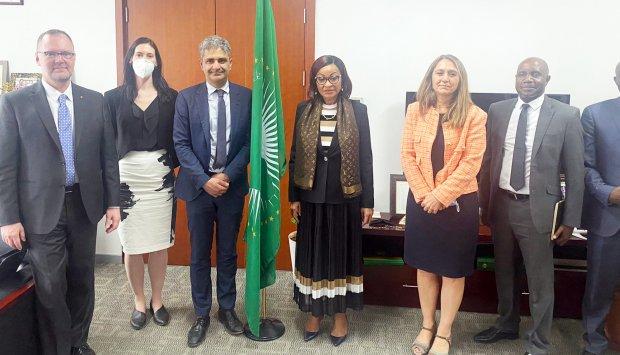
Africa-Press – Angola. The continent’s main challenge for the next 40 years is to achieve the vision of Africa’s Agenda 2063: “to build an integrated, prosperous and peaceful Africa, driven by its own citizens who represent a dynamic force in the international arena”, he assured this Thursday. fair in Addis Ababa, the African Union (AU) Commissioner Josefa Sacko.
During the meeting held at the African Union headquarters, in the Ethiopian capital, with the director general for Pan-African affairs of the Canadian government Tarik Khan, the African Union diplomat expressed concern about the negative impact that the Covid-19 pandemic, considering”devastating, exposing existing cracks and vulnerabilities and reversing progress on Agenda 2063 and sustainable development goals in particular, has shown just how vulnerable our food, health and economic systems are.”
He informed that the African Union Commission is also committed to the implementation of the Sharm el-Sheikh commitments on water and sanitation, and its success in accelerating the objectives in this African strand on water security, quality monitoring network and implementation of policy guidelines on sanitation, which will facilitate their effort to bring about an end to open defecation on the continent.
“We should also look to develop a successor framework for Africa Water Vision 2025, so given Canada’s experience in water and sanitation and surveillance on the continent, we look forward to exploring partnerships in this area.”
In this regard, he informed that the AU is working towards the United Nations conference on water to be held in 2023, because it considers that without water, sustainable food systems, industrialization or health and sanitation baselines cannot be expected.
In this way, he explained that the AU needs to strengthen its human resources and technical capacity in water issues, therefore, he requested Canada’s support for the materialization of this commitment in the AU countries, since the Canadian experience is recognized in the addressing water and sanitation issues.
With regard to the blue economy program, he made it known, which offers several entry points for collaboration, including with AUDA-NEPAD, which could be explored, for the strengthening of this activity on the continent.
In this way, the diplomat added, it is necessary to strengthen the blue food systems, infrastructure, ocean science and trade and innovation, but also to look at freshwater resources.
In the chapter on disaster risk reduction, it recognizes that while progress has been made in reducing risk and building resilience, with the AU multi-hazard early warning system coming into operation and the early action room for Providing warnings of impending disasters in Africa, member states still face monumental challenges in managing the increasing risks of climate-aggravated disasters.
“There is an urgent need to address these challenges through agile multi-hazard early warning systems, robust disaster risk governance, strengthening risk finance for resilience and Urban Resilience,” he warned.
Collaboration
For his part, Canadian diplomat Tarik Khan was receptive to collaborating with the AU, as it is a valid partner in the global strategy integrated in common principles.
“It is in our interest to finance projects for the development and materialization of the Agenda 2063 strategy. Furthermore, there is an urgent need to build the technical capacity of the actors to work effectively on these issues”, he highlighted.
For More News And Analysis About Angola Follow Africa-Press