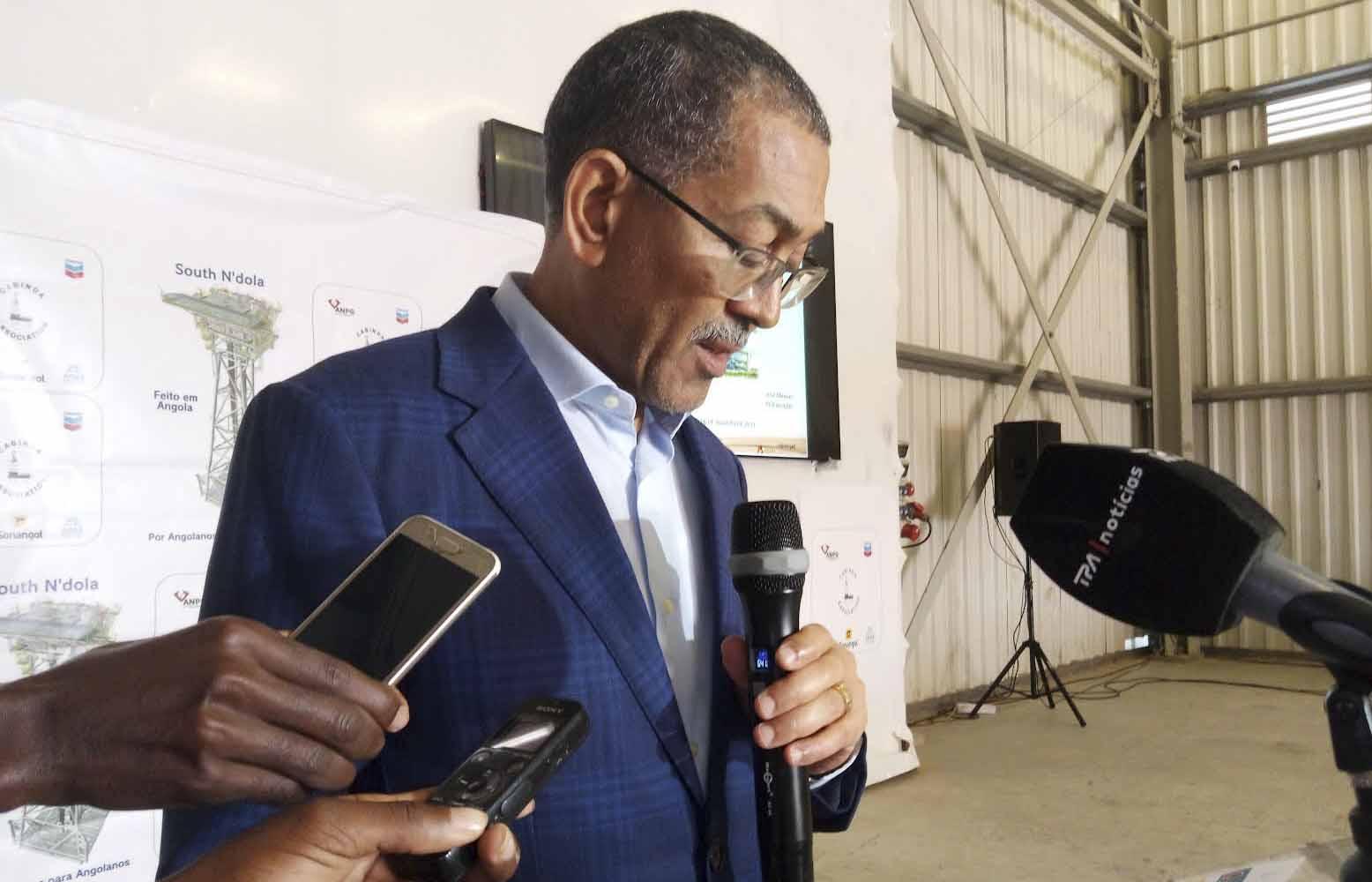
Africa-Press – Angola. The Minister of Mineral Resources, Oil and Gas, Diamantino de Azevedo, defended, this Wednesday, in Porto Amboim, the need to deepen geological studies on the existence of mineral resources in the province of Cuanza Sul.
“There is an urgent need to carry out in-depth studies, so that we can talk about the possibility of economically extracting certain minerals, for example iron, whose content must be more than 50 percent”, he concluded at a meeting with members of the Cuanza Sul government on the local potentialities.
He also specified barite, used in the oil industry, stressing that there is no need to import this mineral, as it exists in the country.
The minister pointed out that Planageo gave some geophysical anomalies, which exposed on geological charts, are tools for companies to work and decide in which areas they intend to make concessions, a job that can take between five and 15 years.
“From here, there is an urgent need for legislation that is attractive to investors, for the exploitation of mineral and oil resources, as there is a high risk from prospecting, research and exploitation”, he stressed.
Mineral resources, oil and gas in Cuanza Sul
President of the Board of Directors of the Geological Institute of Angola, José Manuel, who spoke about “the geological and mining potential of the province of Cuanza Sul”, underlined that, within the scope of the National Geological Plan (Planageo), the province has 12 geological maps with multiple occurrences.
“Within Planageo, we looked for the existence of occurrences of some minerals that need a more painstaking work that can reach the deposit or mines”, he said, adding that it was verified the existence of some ferrous, manganese, limestone, gypsum, copper, cobalt, barite, nickel, precious stones, gold, silver and zinc, quartz, medicinal water, lead and barium.
The PCA of the National Mineral Resources Agency, Jacinto Rocha, who spoke about concessions and grants in the province of Cuanza Sul, said that 20 titles have already been issued, nine of which are for prospecting and 11 for exploration of diamonds, non-ferrous metals and basic metals, medicinal water, limestone, gypsum, quartz and others.
The administrator of Endiama, Laureano Receado, said that there are three concessions in prospecting and one in production, with three square kilometers, which deserve a more in-depth study.
“ There is preliminary information about these concessions. 128 diamonds have already been recovered at the time of prospecting and there are around 31,000 carats”, he pointed out, adding that this information still needs more work to assess whether it will be viable.
He highlighted that the district of Quibala has great potential.
For his part, the director of the Petroleum Derivatives Regulatory Institute, Luís Fernandes, pointed out that municipal administrations are authorized to grant licenses for fuel supply pumps of up to 200 cubic metres, sales of gas and lighting oil.
Luís Fernandes informed that in Cuanza Sul there is the Porto Amboim Ocean Terminal (TOPA), with a storage capacity of 36 thousand and 22 cubic meters of diesel, gasoline and kerosene, while in the field of gas it has a capacity of 224 metric tons supported by 53 distribution networks.
Until the second quarter of this year, 40 fueling stations were in operation, out of the 53 existing networks in Cuanza Sul.
On behalf of Sonangol, its administrator Edson Pongolola, who spoke about “Sonangol’s activity in Cuanza Sul”, stressed that the company has works in two blocks in Cuanza Sul, but with the aim of increasing production activity and consequently the operated quota of the 10 percent for 2027.
“Seismic activity is ongoing until the end of the year and the preparation of the geology teams for the drilling of wells planned for next year”, he stressed.
Cuanza Sul, according to the source, consumed six thousand 54 metric tons of fuel in the second quarter, a reduction of 30 percent compared to the first quarter, while gas consumption amounted to 26 metric tons per day.
For Cuanza Sul, Sonangol placed 48 thousand metric tons of diesel, gasoline, kerosene and others, until July.
For More News And Analysis About Angola Follow Africa-Press