Africa-Press – Angola. The Minister of Justice and Human Rights said this Monday, in Luanda, that the Local Human Rights Committees are the main tool of the National Strategy for the promotion, defense and protection of citizens, at a time when it is being fulfilled. by 80 percent.
Francisco Queiroz underlined, by the way, that Human Rights were elevated to the category of National Security matter, with a seat in the assessments of the National Security Council, chaired by the President of the Republic.
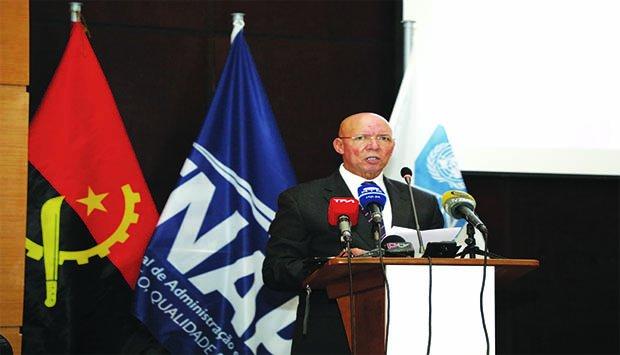
Minister Francisco Queiroz spoke on the matter during the 2nd National Conference of Local Human Rights Committees, which allow the implementation of the Executive’s actions in this matter, within the framework of the National Strategy.
He made it known, in this regard, that in order to reach the desired age, it is essential that the Local Human Rights Committees are equipped with the necessary knowledge in order to better serve the cause, because their training is the main axis of action of the Executive towards these instruments for the implementation of Human Rights policies.
The minister informed that, currently, the country has 160 Municipal Committees, with just four missing to cover the 164 municipalities. As far as the communes are concerned, 40 institutions have already been established, designated as Communal Committees, having ensured that the network will be extended to the entire national territory. “The human rights management system in the country aims to give national actors greater protagonism, promotion, defense and supervision of Human Rights, thus rescuing national sovereignty over the human component”, explained Francisco Queiroz.The Local Rights Committees Human Rights, he stressed, are the privileged space for debate and concentration on the promotion and defense of human rights, being, therefore, autonomous structures, in the intersectoral context, integrated by public entities, representatives of civil society, religious authorities, traditional authorities and other stakeholders. The Human Rights Committees act at the provincial, municipal and communal levels.
Francisco Queiroz added that the Local Human Rights Committees are the decisive factor in this strategy, on which the guarantee of the fundamental rights and freedoms of citizens, throughout the national territory, depends. In this order, your local work represents “Majority” achievement.
The national director of Human Rights, Yanic Bernardo, clarified that the “MajorAdade”, in human rights, is the main challenge of the National Strategy for Human Rights ENDH. “The implementation of this principle, of high political and social scope, is the main axis of the ENDH, constituting the most innovative aspect of the aforementioned Strategy”, he underlined, having mentioned that it is the anchor principle that motivated and determined its formulation and proposal of approval.
The principle of Greater Age in Human Rights makes the Strategy an instrument of national sovereignty and of the promotion, defense and protection of Human Rights. Yanic Bernardo defined the basic principles of “Majority” as the culture of equality, non-discrimination, communication and dissemination of human rights, civil and political rights, rights of assembly and demonstration, economic, social and cultural rights, as well as access the Justice.
For the short term, according to the national director of the DH, the aim of the “Majoridade” is to consolidate the culture of peace and strengthen democracy, citizenship and civil society. “This involves investing in strengthening the foundations of democracy, political inclusion and participatory social dialogue, strengthening civil society and its organizations, ensuring the dissemination of ethical and patriotic values and behavior”, he pointed out.
Country Increases Actions Against Human Trafficking
Angola currently occupies second place in the ranking of the United States of America on the fight against Trafficking in Human Beings (TSH) and Victim Protection, announced yesterday, the Secretary of State for Human Rights, Ana Celeste Januário.
Speaking on the matter, during a lecture on “Challenges in the implementation of the National Action Plan to Combat Trafficking in Human Beings”, Ana Celestel Januário said that the country was recommended to increase the proactive involvement of the Interministerial Commission linked to efforts to combat THB.
In this way, he said, the country will join the regional instrument (SADC) for data collection, development of standards at the national level for the collection, synthesis and analysis of data related to the application of the Law to combat THB and the protection of victims. .
Ana Celeste Januário noted that this includes launching a national public awareness campaign to combat THB, increasing efforts to provide shelter, counseling and medical care to victims, developing referral mechanisms and standardized protocols.
The Secretary of State indicated that efforts to combat Trafficking in Human Beings will also continue, guaranteeing the protection of victims, through the implementation of standardized procedures for the identification of victims, as well as launching cases of Trafficking of People in the Regional Database.
He explained that the involvement of the Interministerial Commission has increased considerably, promoting activities such as seminars (a total of 30 activities), workshops, debates, lectures on THB with the participation of 3640 people. “Angola joined the Database in 2017, having launched cases that can be consulted online”, stated Ana Celeste, stating that, in this way, several awareness campaigns were launched using different methods, highlighting the adhesion to the “Blue Heart “, in progress since 2018.
Ana Celestes informed that Angola was recommended to condemn traffickers, increase efforts to investigate and prosecute trafficking crimes, amend article 1 78 of the penal code to Eliminate all forms of internal sex trafficking and investigate human trafficking in the sector. of construction and pastoralism. She added that from 2015 to date, 31 cases have been tried, 137 investigated and 278 traffickers investigated, 46 convicted. Luanda has the highest number of cases, followed by the provinces of Cunene, Zaire, Lunda-Norte and Cabinda.
The Interministerial Commission against Trafficking in Human Beings (TSH) was created by Presidential Decree no. of traffic.
The aforementioned Commission is coordinated by the Minister of Justice and Human Rights and comprises the Ministries of Social Action, Family and Women Promotion, Foreign Affairs, Interior, Public Administration, Labor and Social Security and Youth and Sports.
For More News And Analysis About Angola Follow Africa-Press