Africa-Press – Angola. The Executive approved, this Tuesday, in Luanda, at the 5th Ordinary Meeting of the Economic Commission of the Council of Ministers, a set of measures aimed at restoring the purchasing power of pensioners, setting the maximum amount of old-age retirement pensions at 607,874. 00, the minimum at 48,272.00, while those for survivors, disability and old-age allowances at 30,894.00.
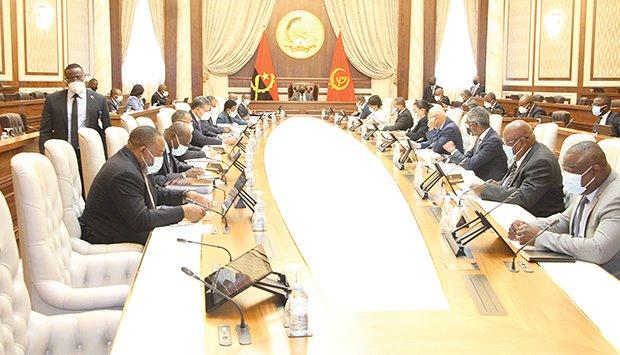
The Economic Commission of the Council of Ministers refers, in the press release, that, at the meeting, led by the President of the Republic, João Lourenço, at the Presidential Palace, in Cidade Alta, a Memorandum was considered, which succinctly presents the correction to effect on pensions, as well as a methodological proposal and the main assumptions adopted for the proposal to update pensions.
Thus, as expressed in the diploma, the updating of the amounts of social benefits, within the scope of Compulsory Social Protection, determines the minimum and maximum amounts, with the aim of guaranteeing the certainty and security of the insured and pensioners, as well as facilitating the interaction between the Management Entity of Mandatory Social Protection, policyholders and taxpayers.
In effect, old-age retirement pensions with a value greater than the minimum amount and less than the maximum amount foreseen, the survivor’s pension and those for disability and old-age abandonment are subject to an increase of 10 percent.
The members of the Economic Commission also approved the balance report on the execution of the National Development Plan (PDN 2018-2022) for the first quarter of this year, with a degree of execution of the goals, in the first quarter of this year, numbered at 45 .92 percent. In cumulative terms (until the first quarter of 2022), the tasks were carried out in the order of 69.53 percent.
Kwenda, PIIM And Actions To Combat Poverty
The report also highlights that the execution of the Integrated Plan for Intervention in Municipalities (PIIM), in the first quarter of this year, registered improvements in the fulfillment of the precedent conditions of the projects, culminating in an increase in the number of projects in conditions to be implemented, which passed to 2013, at the end of the first quarter of this year, compared to 77 in 2019, 1494, 1494 in 2020 and 1983 in 2021, representing an increase of 15 percent in relation to the 1749 initially programmed.
In the area of the Program for Local Development and Combating Poverty, the report highlights the reintegration of 75,716 citizens in income-generating activities (of which 12,369 ex-military), with direct visibility in the municipalities and a positive impact on the communities, as well as the distribution of 320 tractors, which benefited 277 cooperatives.
As part of the Kwenda programme, the report highlights the registration of 631,836 families in the first quarter of this year to benefit from direct cash transfers, of which 320,000 households have already benefited from disbursements, totaling 12,401,760. 640 Kwanzas. Regarding staff training, the report highlights the return to the country of 940 masters, of which 85 in the first quarter of this year, and 183 doctors, who benefited from external scholarships.
National Production
Regarding the promotion of national production, until the first quarter of this year, 656 companies and 409 cooperatives had benefited from credit (approved credit), making a total of 1065 approved projects, distributed across the agriculture, commerce and distribution, manufacturing, livestock and , aquaculture, marine and inland fisheries.
The Economic Commission of the Council of Ministers approved a Memorandum that proposes the restructuring of the “Made in Angola” service, which presents a pragmatic approach on the need to implement a set of actions that guarantee the reactivation of this service, which aims to mobilize companies to the purpose of economic growth, seeking to improve the competitiveness of national goods and services and contribute to the sustained balance of the trade balance.
On the same occasion, the Regulation for Adhesion to the aforementioned service was also approved .
The Economic Commission of the Council of Ministers also approved a Memorandum on the implications of the military conflict between Russia and Ukraine on the Angolan economy. This memorandum states that the conflict, on the one hand, has a positive impact on the country’s economy, due to the increase in oil revenue, caused by the rise in the price of oil in international markets and in Angolan markets since the beginning of the conflict.
On the other hand, the document points out the negative implications of the conflict on the economy, due to the risk of increasing the price of imports of essential goods for widespread consumption (food and raw materials), and the risk of reduced inflows of foreign direct investment, particularly in the diamond sector, where Russia is one of the main investors.
The Economic Commission therefore approved a set of policy measures in the fields of management of international reserves, the financial system, technological infrastructure and cyber security, agriculture, infrastructure to support agricultural production, mineral resources and diplomacy.
At yesterday’s meeting, the balance of execution of the National Treasury’s financial programming for the first quarter of this year was approved, a document that presents the results of the execution of revenue for the period in question, as well as the execution of expenditure, with and without of treasury.
The members of the Economic Commission took note of the balance of payments report and international investment position for 2021, and the report and accounts of the National Bank of Angola for the financial year of the same year.
Combating Money Laundering
The Economic Commission approved, in the field of preventing and combating money laundering and terrorist financing, a proposal for measures that aim, among other objectives, to ensure the strengthening of good governance and transparency in trade relations; combat the growth of illicit trafficking in narcotics and psychotropic substances, as well as transnational organized crime, to prevent Angola from becoming a haven for criminals.
The proposal also provides for the promotion of transparency and improvement of the public procurement system; provide specific, clear and consistent mechanisms for consulting and sharing data, with a view to facilitating the tracking of illicit operations; improve Angola’s image and reputation internationally, as well as improve the business environment to attract private investment.
Minister estimates that the national economy could grow by 2.7 percent
The Minister of Economy and Planning announced the growth of the national economy, until the end of this year, in the order of 2.7 percent, driven by the “positive growth” of the Oil Sector at 2.1 percent and non-oil sector at 3, 2 percent.
Speaking to the press at the end of the meeting of the Economic Commission of the Council of Ministers, Mário Caetano João pointed to a performance in the fiscal accounts of 1.7 percent of GDP, as a result of the 42 percent increase in tax revenues in the first quarter of this year. year, which resulted in an acceleration of fiscal expenditure in this period by 22.2 percent.
In terms of foreign exchange, the official referred to the appreciation of the Kwanza at around 24.31 percent against the dollar, having positioned itself, until the end of the first quarter of this year, at 446.43 Kwanzas per dollar. As for the promotion of national production, Minister Mário Caetano João said that, from 2018 to the first quarter of this year, 1,065 projects were approved, of which 656 were from companies and 409 from cooperatives, for an approximate amount of 750 billion Kwanzas.
In terms of the informal economy reconversion program, it announced the formalization of 135 thousand informal operators by the end of the first quarter of this year. Mário Caetano João indicated that the preparation of a global report is in the pipeline, which will reflect the performance of the Executive over these five years. As for the proposal to restructure the “Made in Angola” service, the minister said that the novelty is the introduction of the KR code, to give consumers greater security, allowing them to obtain more information about the products. for a better management of the referred service, the Minister of Economy and Planning, Mário Caetano João, said that four essential assumptions were elected, namely the legal and administrative organization, simplification of the process of joining the service, communication and marketing and promotion of the internal market.
The minister underlined that for the annual use of the seal, each product will pay the equivalent of 50 thousand Kwanzas, having informed that with a single registration, in this amount, companies will be able to register three products, and each fourth product will pay only 50 percent of 50 thousand Kwanzas.
To mitigate the effects of the war between Russia and Ukraine, the minister spoke of the need for the productive sector to equip itself with agricultural instruments and fertilizers, with a view to promoting cereal production, in order to overcome the major challenges related to the of products from the countryside to the large commercial centers.
For More News And Analysis About Angola Follow Africa-Press