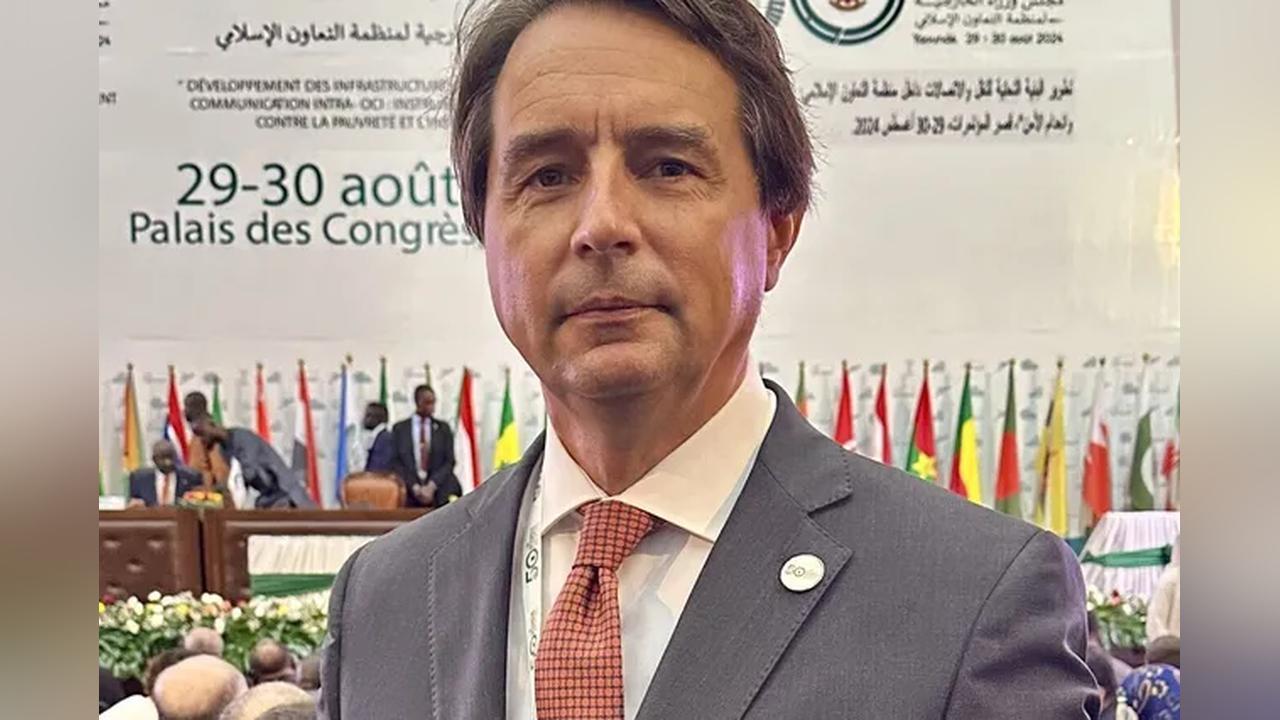
Africa-Press – Angola. Portugal’s new ambassador to Angola, Nuno Vaultier Mathias, declared this Thursday in Luanda his commitment to strengthening and continuing bilateral relations between the two countries.
In statements to the press after presenting his credentials to the Angolan Head of State, João Lourenço, the Portuguese diplomat said that he arrives in Luanda motivated by the objective of strengthening the historical and fraternal ties that unite Angola and Portugal.He emphasized that bilateral cooperation encompasses multiple domains and the immediate focus will be on implementing ongoing initiatives, while simultaneously identifying new sectors with development potential.
Nuno Mathias indicated that he intends to deepen this exploratory work in the coming months, highlighting the central role of the communities of both countries in strengthening bilateral relations.
He mentioned that he was accompanied by the consuls-general of Portugal in Luanda and Benguela as a symbolic gesture of appreciation for the Portuguese community residing in Angola and the consular work carried out in supporting Portuguese and Angolan citizens.
He stated that the Portuguese business presence and the strong interaction between the two communities contribute to an “intense and vibrant” rapprochement between the peoples.
When questioned about facilitating visas for Angolan citizens wishing to travel to Portugal, the ambassador clarified that a continuous effort has been made to improve consular services.
In this context, he highlighted the recent investment in the Consulate General in Benguela as a sign of Lisbon’s commitment to improving the service provided in Angolan territory.
Bilateral Relations
Angola and Portugal maintain a multidimensional cooperation considered one of the densest and most strategic in the Lusophone space, based on historical, linguistic, cultural and economic ties, as well as the sharing of the Portuguese language.
Diplomatic relations between the two countries date back to 1975 and have been strengthened by regular political consultations and coordination in multilateral forums, including the Community of Portuguese Language Countries (CPLP), where Luanda and Lisbon cooperate on regional and international issues.
Economically, Portugal is among Angola’s main partners, with a significant presence in the banking and financial sectors, civil construction and public works, energy and oil, telecommunications, trade and distribution, and the food industry. At the same time, Angolan investors have been consolidating their presence in the Portuguese market.
Cooperation also extends to education and training, with scholarship programs, academic exchange, and university and scientific partnerships. Portugal remains one of the main destinations for Angolan students, while technical training and academic recognition initiatives promote knowledge mobility.
In the area of health, the two countries maintain partnerships that include professional training, hospital cooperation, and technical assistance to the health system.Resident communities also play a central role in bilateral relations. A large Angolan community lives in Portugal, while Angola hosts a significant Portuguese community, contributing to the strengthening of human and economic ties.
Consular cooperation and the improvement of mobility services have been priorities to facilitate the movement of citizens.
The cultural dimension remains one of the pillars of the partnership, with initiatives promoting the Portuguese language, artistic exchange, cooperation in the audiovisual sector, and the organization of joint cultural events.
In the field of defense and security, cooperation includes military training, technical exchange, and collaboration in maritime and coastal security.
The bilateral partnership is considered strategic for the economic diversification of Angola, the internationalization of Portuguese companies, the strengthening of the Lusophone space, and the promotion of stability and cooperation in the South Atlantic.