Africa-Press – Angola. About 170 kilometers from Seoul, the capital of Korea, is Sangju, a city in North Gyeongsang Province. The region, with an estimated population of 103,950 inhabitants, covers an area of 1,254.69 square kilometers and has a humid continental climate.
It is in Sangju that another project was born to create a Smart Farm Innovation Valley, that is, the development of a Smart Farm, with an extension of 42.7 hectares.
This Smart Farm, the largest in the country, works as a kind of training school for young farmers. But it is not the first in Korea, since there are three other valleys, installed in Gimje, with 21.3 hectares, Goheung, with 33 hectares, and Miyang, with 22.1 hectares.
The Sangju Innovation Valley, visited on October 5, 2022, by South Korean President Yoo Suk-yeol, is being developed to create young people who can secure and lead the future of agriculture in the country, as highlighted by Ryu Gyo-jeong, head of the Intelligent Planning Team at the Department of Intelligent Agriculture.
During the visit to space, Ryu Gyo-jeong explained to a group of African journalists that the project, launched two years ago by the Ministry of Agriculture, Food and Rural Affairs, aims to improve the growth of Smart Farm in Korea, through the introduction of cutting-edge technology such as robots and other equipment.
The official also highlighted that the creation of Smart Farm is a service that aims to control the level of aging of farmers and prevent the effects of climate change and disasters on agriculture.
Taking into account that Korea has agriculture as one of the key sectors to maintain the development achieved by the country, he said that the country uses its great technological capacity to boost production in agricultural fields.
“The Korean Government encourages the creation of smart farms in order to improve productivity and reduce input costs, focusing mainly on the dissemination of smart farms based on government subsidies”, he said.
Therefore, the South Korean State has invested in the construction of this innovation valley, since 2021, a total of 166.2 billion won (Korean currency), the equivalent of 127.85 million dollars. However, the farm only started operating last year.
One of the most important areas of the farm is the Incubation Center for Business Startups for Young People, where the greenhouses are installed, in an area of 2.27 hectares.
As for education management, in which farmers have the right to training and space for the creation of Smart Farm, at this stage, the institution chooses only Korean citizens aged 18 to 39, with 30 percent of them being from Sangju.
Each year, the authorities select 52 young people, who are trained over a period of 20 months, the first two of which introduce the program, with approaches to business management and Smart Farm and crop physiology, handling crops by item, field trips, special lectures by specialists.
In the following six months, the selected youths go on to practical education, through the use of the practical greenhouse at the Incubation Center and the leading greenhouse at the Intelligent Farm, among other activities.
Finally, in the last training phase, consisting of 12 months, young people undergo management practice. Here, they experience agricultural handling on their own responsibility, with the provision of a practical greenhouse, as well as practical education continues throughout the farming period.
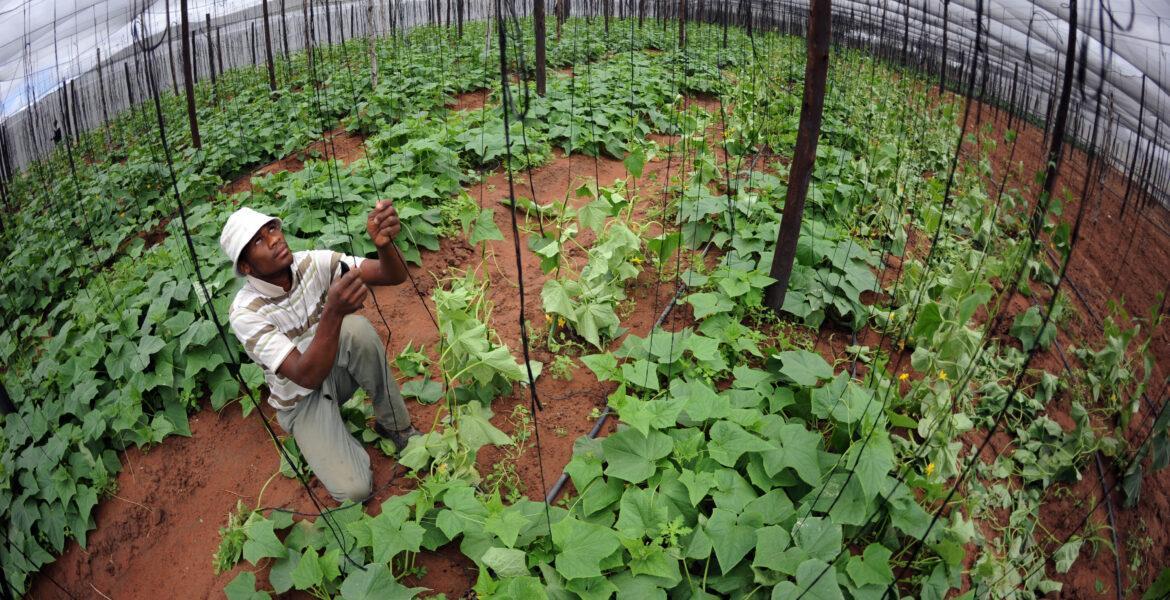
For example, rice remains one of Korea’s most important agricultural products. But the State wants to diversify production. In this sense, the young people from Fazenda Inteligente are committed to planting, using new technologies, cucumber, tomato, strawberry and melon.
At the moment, although the Smart Farm welcomes only nationals, its official assured that the country is exporting equipment and technology to other nations, as happened with the Netherlands.
Innovation Center Services
In addition to the Business Startups Incubation Center for Young People, the training space has a Youth Agricultural Village, Innovation Valley Support Center, Detention Lagoon, Demonstration Complex, Smart Farm (lease type) and Cultural Street.
During the period in which they are using these services, the young farmers learn to create entrepreneurial projects, so that they can later set up their farms and businesses in a three-hectare space in the future in three years.
Thus, teams of 12 people are selected, divided into four, and each of them is oriented to produce for three years. The annual operating cost is $2,150. This production is accompanied by 21 companies.
These companies operate through the Demonstration Complex. This is where these and research institutes are installed to test intelligent agricultural equipment and verify its safety. Along with them, Korea’s top-notch Smart Farm Data Center also operates in space.
The center welcomes farmers, with 28 residences for young people and trainers. At the moment, they are occupied by 76 people.
As for Rua Cultural, the person in charge explained that it is a space for culture, leisure and rest, used by residents of the center and by people close to the institution. It has greenhouse cafes, picnic parks, meeting places, among others.
By the end of next year, the Center for Agriculture and Innovation will have new services or compartments.
Advantages of using Smart Farm
The journalists visited various points of the Innovation Centre, where they found a different way of doing agriculture, taking into account the use of new technologies in production.
So Ryu Gyo-yeng was asked the difference between traditional farming and Smart Farm. The answer was quick: the latter is focused on optimizing production, to bring more efficiency and reduce waste.
The official referred to Big Data technology, explaining that it allows calculating the meteorological situation and the condition of the soil, with a view to receiving or not a certain type of plants.
Another great characteristic that differentiates the two types of agriculture, he pointed out, is that the more modern one is able to determine the temperature, and it is possible to create the environment for the planting of certain species, even in periods not considered appropriate.
If the greenhouse was seen with the amount of seeds and calculated by men, in intelligent or innovative agriculture, electronic devices perform this function.
“Advanced technologies make it possible to analyze planting, cultivation, harvesting and much more”, said Ryu Gyo-jeong, adding that these methods reduce resources and waste, as well as save farmers’ efforts and delay their aging.
Inside smart farming
When referring to the expression Smart Farm, the same as “intelligent agriculture” in Portuguese, it is a concept popularized in recent years, to account for the resource of technological/digital changes in agriculture.
Smart agriculture has emerged to increase agricultural efficiency, as it opens up the possibility of mechanized planting replacing traditional labor.
This adoption allows rural producers to increase productivity, optimize harvest time and reduce expenses with hiring more people to work in the field.
In smart agriculture, digital equipment also allows you to have information about the state of temperature/climate, the quality of the land/soil, the period of plant irrigation, control of possible pests and the prevention of threats or natural disasters.
For this reason, the person in charge of Vale de Inovação said that countries like Korea, which have awakened to its advantages, have adopted intelligent agriculture.
Big Data and production control
There are several most modern technologies taken to the agricultural production fields, in the Smart Farm. Among these is Big Data.
In addition to Big Data, farmers also use the Internet of Things (IoT), artificial intelligence, drones or autonomous vehicles, satellite images and automated systems, cloud computing, blockchain, sensors and GPS.
At the Sangju Smart Farm, young farmers use, among other things, Big Data technology, which helps other more modern operating mechanisms.
Big Data technology, explained the person in charge of the center, allows data to be controlled and sent continuously and in record time.
The system is an important strategy for collecting, organizing and interpreting information, taking into account speed, volume, veracity, variety and value.
Basically, Big Data is an intelligent system for storing and analyzing data, and one of its great advantages is the fact that it has the capacity to process any type of digital record from different sources.
For example, in field work, information related to geolocation, soil characteristics and historical water consumption and crop rotation are extremely important. And Big Data helps in this task, concluded Gyo-jeong.
jornaldeangola
For More News And Analysis About Angola Follow Africa-Press