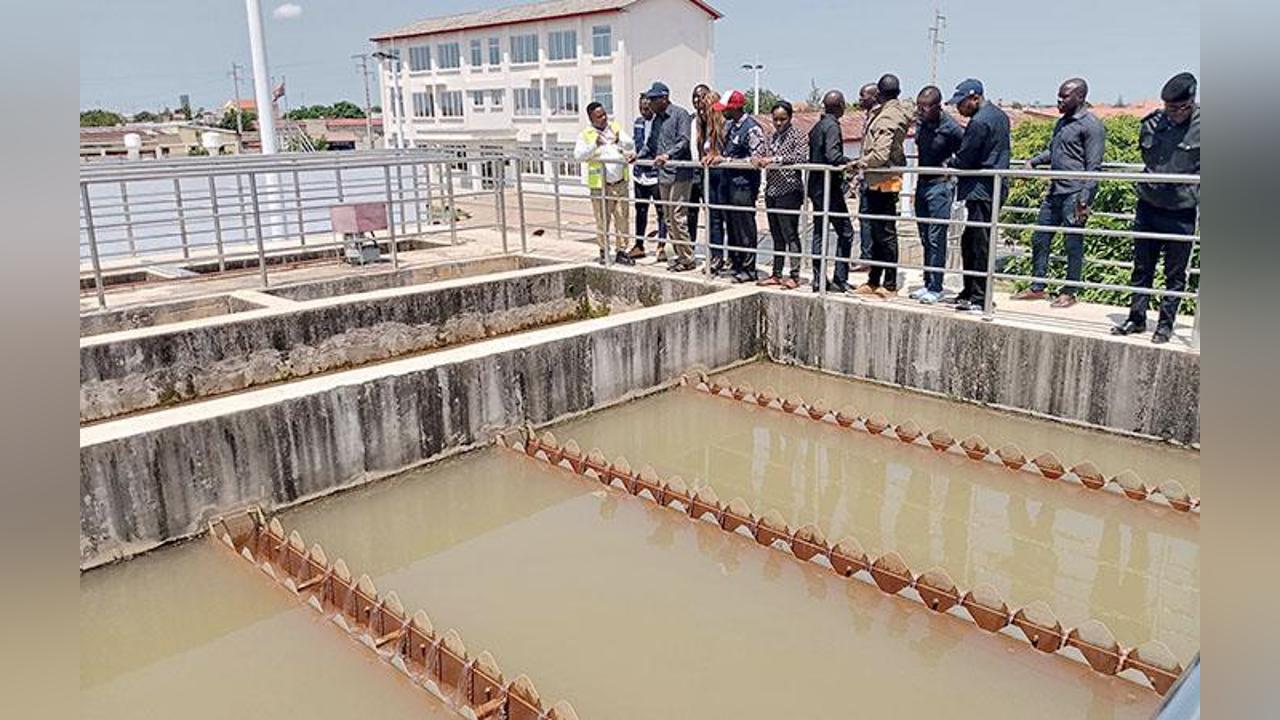
Africa-Press – Angola. A study on the socioeconomic situation of the main municipality in the province of Moxico, recently carried out by the Instituto Superior Politécnico Privado Walinga, indicates that only 16 percent of the population of the city of Luena has access to drinking water.
According to data released in a report by this higher education institution on the socioeconomic situation of the population of Luena, consulted, access to water is one of the “big” challenges facing residents of the city and periphery.
According to the results of the survey, carried out in 19 neighborhoods of the city, outskirts and towns, 84 percent of the people questioned stated that they are deprived of piped and drinking water for consumption.
The study indicates that 33 percent of the population consumes water from the tank, 30% from fountains, while 13% of the population consumes water from the well and 11% taken directly from the river.
The city of Luena has seven thousand and 400 household connections made as part of the implementation of the Development Project (PDISA I), which benefited eight neighborhoods in the urban center and outskirts.
The second phase of project implementation (PDISA II), currently underway, expected to end in 2024, with financial support from the World Bank (WB), plans to make 15 thousand new connections, increasing the water supply rate to Luena, passing 70 percent.
Regarding electricity, the study shows that the majority of the population in this district has access to electricity, with a coverage rate of around 54 percent, with the majority having access to the public network.
In this quadrant, in addition to the Chiumbue thermal and hydro plants, which produce more than 20 Megawatts, within a year, the city of Luena will see an increase in energy distribution capacity, with the entry into operation of a Solar Energy Park with power of 26,906 megawatts, construction of which is above 70 percent.
Regarding electricity, the study shows that the majority of the population in this district has access to electricity, with a coverage rate of around 54 percent, with the majority having access to the public network.
Poor sanitation
As for basic sanitation, the Walinga study describes that in terms of sanitation it is a concern, with 57 percent of respondents unaware of a garbage collection point in their respective neighborhoods.
In the absence of solid waste collection points, according to the study, most people deposit garbage in inappropriate places, with holes in backyards and ravines being the places chosen to deposit objects.
Still in the field of sanitation, 54% of the population uses dry latrines to meet their needs and only 10% use the bathroom inside and outside the house.
The Walinga Private Polytechnic Higher Institute was founded in 2017, with a range of eight degree courses.
This institution teaches courses in Economics, Sociology, Accounting and Finance, Nursing, Law, Human Resources Management, Psychology and Primary Education.
The province of Moxico has two more Private Higher Education Institutions, namely the Instituto Superior Politécnico do Moxico (ISPM), the only one offering public education, and the Instituto Superior Politécnico do Luena (ISPP).
Moxico has close to one million inhabitants, according to the projection of the National Statistics Institute (INE), during the 2014 Population Census, with higher education only concentrated in the city of Luena, the provincial headquarters.
The city of Luena concentrates half of the population of the province of Moxico, which currently has close to one million inhabitants, according to projections by the National Statistics Institute.
For More News And Analysis About Angola Follow Africa-Press