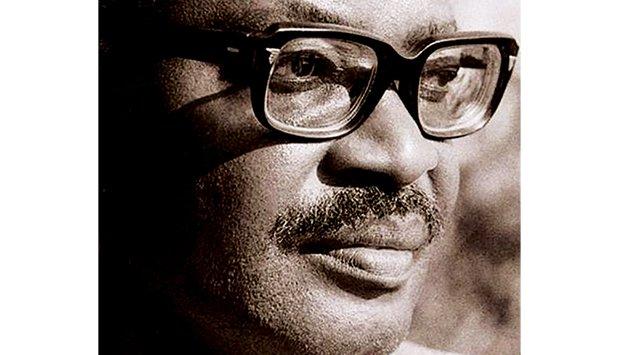
Africa-Press – Angola. The young Agostinho Neto, who wanted to study engineering, arrived in Portugal in 1947 and enrolled at the University where he studied Medicine.
Counting the time of training, prisons and exile, he would later recognize that he had spent a large part of his life away from his native land, further away in this one, where his personality formation took place. From Dembos to Luanda, passing through Malanje and Bié, he felt the pain of his people and the revolt against colonial oppression. Agostinho Neto was born, at five o’clock on September 17, 1922, in the village of Kaxicane, parish of S. José, municipality of Icolo e Bengo, in the district of Luanda, being the son of the evangelist pastor Agostinho Pedro Neto and the primary teacher Maria da Silva Neto. He accompanied his parents when they moved to Luanda, in 1930. Three years later, he finished his primary education, given to him by his parents, and was approved with distinction. In 1934, he enrolled, on 14 February, Leaving the small village, where his father celebrated worship on Sundays, Agostinho Neto then arrived in Luanda, aged eight, to continue his studies. “Arrived in Luanda in 1930, I continued primary school with my brothers. We lived in the American Evangelical Mission. My father had left teaching and was exclusively a pastor. After primary school, my brothers and I moved to the Liceu Salvador Correia (now Mutu-ya-Kevela Magisterium), where there were very few Africans at the time, advised by my father, we taught the ‘little ones’ in primary school”, says Agostinho Neto.
As a result, and despite always appearing on the Honor Roll, the brilliant student drags himself through high school for ten years for a course of seven. It’s just that his parents asked him to accompany his older brother, Pedro, step by step. Thus, if Pedro failed in a year, Agostinho Neto suspended his preparation and waited for him.
After finishing his studies in Luanda, he goes on to apply for a job in the municipal administration. He succeeds and becomes an assistant in the health services, having been sent to Malanje. And he has another remarkable experience, similar to the one he had in the Dembos, when he came into contact again with the “contractors”. “And it was there that I felt, truly, and strongly, the violence of the Portuguese reactionaries. The two years I spent in Malanje greatly contributed to my political training”, recalls Neto who, at that time, in addition to his political convictions for the revolt against the terrible living conditions and lack of freedom of his people, already demonstrates in his poems attachment to the values of their land.
It is in the region of Piri, Dembos, where he will live for six months with his parents, specifically in 1944, that the peasants inspired him with some poems that he would later destroy, considering them incipient. In 1946, he published an article in the newspaper O Farolim in which he called the attention of youth to the problems of the land and its people, criticizing the tendency towards «Eurotropism».
After Malanje, Agostinho Neto is transferred to Bié, but stays for a short time. And he could also see the harsh conditions of his countrymen. His father, who died in 1946, had advised him to save as much as possible to continue his studies at the University of Lisbon. But what you put together is not enough. It is through Bishop Ralph Dodge, a friend of his father’s, that he gets a scholarship to study medicine in Portugal, as a thank you for the work he had developed for the evangelical missionaries. Thus, the young Agostinho Neto, who wanted to study engineering, arrived in Portugal in 1947 and enrolled at the beginning at the University of Coimbra and then at Lisbon, where he studied medicine. Counting the time of training, imprisonment and exile, Neto would later recognize that he had spent a large part of his life outside Angola.
“Actually, I only spent a small part of my adult life in Angola. I was born there in 1922, left for Portugal at the age of 25, in 1947, returned to my native country in 1959, where I was arrested, sent back to Lisbon and only returned in 1975”, Neto tells journalist Augusta Conchiglia. The first arrest in 1957 left a deep impression on him. Neto was collecting signatures in favor of the Movement for Peace, as leader of the MUD Juvenil, and was caught by the infamous International Police and Defense of the State (PIDE), which guarantees him three years in prison. However, it was in Portugal, specifically at the Center for African Studies, where he became one of the most dynamic elements of the gathering that he animated with lectures and conferences. formation of the African Maritime Club, in Lisbon.One of Agostinho Neto’s biggest challenges was certainly in the field of culture.
Challenges in Culture and Education
It is evident, for example, in the speeches of the first President of Angola, the concern with national languages. In a speech by Agostinho Neto at the Angolan Writers Union, in 1979, in which he defended the teaching of languages in primary and secondary education. He referred to the need to “identify the problems of national culture”, but also to “point out solutions, present paths”. A year earlier, in 1978, the National Language Institute had already been created, which later became the National Language Institute. “There is a need to adopt a language policy that takes into account the coexistence of all languages. Hence the fact that the late President Agostinho Neto raised this problem”, defended the director general of the National Language Institute (ILN), recently, José Domingos Pedro: “If there are so many languages, why will there be exclusivity in just one language?” In a recent interview, the former deputy minister of Culture (2002 to 2008), an institution he joined in 1975, Virgílio Coelho goes far: “The ideas about National Languages are, without a doubt, one of the hallmarks of Agostinho Neto , which were erased by the positions of some figures implanted in the Civil Service and even in the MPLA-party and negatively and drastically alienated by the 2010 Constitution”, says the anthropologist. The Instituto de Línguas Nacionais was born thanks to Agostinho Neto and this could be one of its greatest hallmarks of governance during his very short term (November 1975 – September 1979). His death is a cruelty of nature that is difficult to erase, difficult to understand!… Historically, we will have to recover our memory and read again with our eyes to see what was publicly proposed by the guiding document of the 3rd Plenary Meeting of the Central Committee of the Popular Movement for the Liberation of Angola (MPLA), which took place in the auditorium of the National Museum of Natural History, in Luanda, from 23 to 29 October 1976”, he recalls. The Education sector, for example, with the lack of infrastructure and human resources, found itself struggling to manage the first post-independence years. Despite all the difficulties, the principle of free education is instituted. And the result was astonishing: from a total of 512,942 students in 1973, the country now has 1,026,291 children enrolled in the first four years of schooling. However, teaching has always been a concern of Agostinho Neto and his fellow nationalists. In a text of reflection on “the course of black literature”, in March 1951, Neto recalled that “black peoples are going through their period of confusion, for having suddenly abandoned their culture, completely modifying the system of life in one or two generations, to acquire a Europeanized culture structured on fragile foundations” and “the desire to rediscover their lost and forgotten culture is one of the most encouraging symptoms”. the then University of Luanda gained the status of a national university and was renamed the University of Angola, with the promulgation of decree nº 77-A/76, of 28 September. The President of the Republic and first Rector, António Agostinho Neto, wanted “national cadres with a new mentality, capable of functioning as architects of a new society aimed at the triumph of popular democracy”. Today, the first higher education institution in the country, which changed its name to Universidade Agostinho Neto, on the 24th of January 1985, maintains the challenge of training national cadres for the development of society; and, while doing so, it recognizes the fundamental role of its first Rector, by granting on the 25th of September 2018, at the Belas Conference Center, posthumously, the title Doctor Honoris Causa to its patron and first Rector, Dr. Antonio Agostinho Neto. The award of the title is due to the courage and nationalist and patriotic sense shown by António Agostinho Neto at a difficult time for the country and the commitment to training qualified staff to help in the process of reconstruction and development of the Nation.
For More News And Analysis About Angola Follow Africa-Press