Africa-Press – Angola. Frederico Henriques received from the hands of the municipal director of Lubango da Educação the diploma of merit for the 20 years dedicated to teaching reading and writing
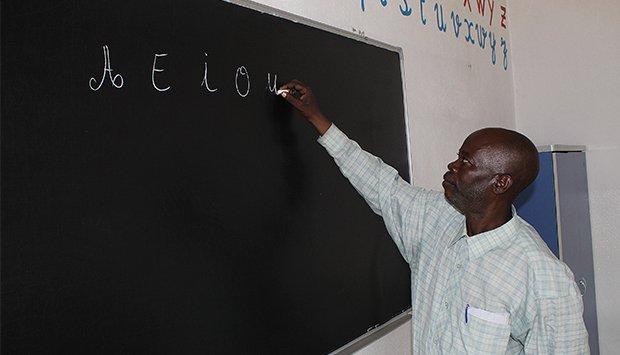
The shy smile on the face of literacy teacher Frederico Henriques Mica reveals an extreme state of mind marked by two feelings.
It’s worth the joy that springs up on the face of the eldest proud to have taught many people to learn to read, write and count.
The ex-military and nursing technician jumped for joy when he was called to receive his diploma of merit, in the provincial act of the 8th of September, World Literacy Day.
Mica, as he is known in the neighborhood “A Luta Continua”, Vulgo Sofrio, on the outskirts of Lubango, received the diploma of merit from the municipal director of Education, António Correia, for his dedication to the eradication of illiteracy in Huíla.
The tribute enthused Frederico Mica for 20 years dedicated to opening the minds of children, young people and adults in the struggle to learn the alphabet, form words and read them.
On this day, Mica made two exciting retrospectives of a career of commitment. Balancing the impact of her trajectory on other people’s lives, she rejoiced because she lost count of the number of literate citizens.
But the smile faded as he took stock of the impact of his work on his personal life. The unemployed nurse described that the reward of dedication time “did not change his social condition”.
“This year, I complete 20 years as a contracted literacy teacher. I was paid 10,000 kwanzas in subsidies per month. But since 2019, we haven’t received anything. We don’t know why?”, lamented that father of 11 children.
Frederico Henriques Mica is one of the many literacy teachers who have now become a volunteer, after a directive from the Minister of Education suspending their contracts. He considers himself a literacy teacher by virtue of the fact that he embraced the profession by “not entering the health sector”.
The nurse, whose face and dress reveal bitterness, explained that he embraced a literacy career after participating in an adult training course. “I would like to thank the Education Directorate that today gives me a certificate of merit. Thank you for the recognition”, he rejoiced.
Frederico Mica congratulated himself on having participated in the literacy training of 100,000 people, of the 170,203 enrollments since the institutionalization, in 2019, of the Youth and Adult Education Plan, according to data revealed by the director of the provincial Education Office, Paula Joaquim .
Crisis affects subsidies
The suspension of contracts and subsidy payments to literacy teachers is contained in a directive from the Ministry of Education, nº 2139, of April 7, 2020. until the debt situation is regularized.
The document pointed to the economic and financial crisis as an obstacle in the payment of subsidies to literacy teachers.
In the directive, the minister defined as a strategy to overcome the framework the survey and registration of literacy teachers with subsidies in arrears, determining the number and overall value.
He defended the mobilization of volunteer literacy teachers by municipalities, and the nominal list should be forwarded to the Ministry of Education for proper monitoring and logistical provisioning.
The order guides the mobilization of civil society, with emphasis on companies, churches, the Armed Forces, the National Police and students, to voluntarily participate as literacy teachers.
The constitution of provincial and municipal literacy commissions and the respective technical groups is also foreseen, in compliance with what guides Presidential Order nº 174/19, of 9 October, on the elaboration of local operational plans with a view to intensifying the Literacy for youth and adults.
Regularization of subsidies
Verónica Chitima, literacy teacher for 15 years, at Nossa Senhora de Fátima school number 200, in the Lalula neighborhood, received, this year, for the first time, a subsidy of 90 thousand Kwanzas.
Despite the lack of remuneration, the literacy teacher found motivation in her children to continue teaching young people and adults.
“I had never received anything. But this year I received this amount. We continue to work because when I am in front of the students I also think about my children”, said the literacy teacher, who has lost count of how many people have passed her.
Verónica Chitima called for the payment of the 2020 and 2021 subsidies and the regularization of the next ones, to motivate literacy teachers in the mission of getting people to learn to read and write.
Literacy teacher Leonardo Pinto, who has been at the Assembly of God Center for 18 years, also lamented the lack of subsidies. The father of 10 children found it impossible to survive on a subsidy of 10,000 Kwanzas paid many months late.
Leonardo Pinto called for a review of the remuneration policy for literacy teachers, as they are the protagonists in the challenge of eradicating illiteracy among citizens.
Expert talks about literacy challenges
One of the main challenges of literacy is to promote social transformation. This goes beyond learning to read and write, considered specialist Ventura Augusto, when he was giving a lecture at the provincial act alluding to the World Literacy Day, marked on the 8th of this month.
The Literacy specialist called for a deep analysis and adaptation of this year’s motto, “Transforming literacy learning spaces”, for the current context.
“Among the various challenges that are imposed are professionalization. Because there is no point in learning the ABC without teaching transforming skills and abilities”, he argued.
The specialist said that the actors in the process must think of solutions that provide spaces for learning writing, reading and skills.
“It is not enough for people to learn to read and write. It is necessary to create spaces for professionalization. If all centers have vocational courses, we will be able to mark safe steps for literacy to produce impactful results”, he considered.
Ventura Augusto said he believed in the possibility of creating integrated literacy and professional training centres, as long as “there is political will”. “Integration is possible, provided there is a combination of efforts and the involvement of other partners in this challenge”, he said.
The speaker stated that young people or adults with school delays need professional training to facilitate their integration into the market. “A person with professional training, even if he cannot read, even if he is employed, can find ways to create solutions for his survival. Because reading and writing is not synonymous with anything”, he explained.
The deputy governor of Huíla for the Political, Social and Economic Sector, Maria João Chipalavela, joined in the same vein, saying that “literacy is not a simple process of teaching and learning”.
Maria João Chipalavela agrees with the idea of transforming literacy centers into spaces for the transfer of essential skills and competences for a life of initiative and autonomy.
Date was established by the UN
Every year, on the 8th of September, is World Literacy Day. The date was created by the United Nations (UN) and the United Nations Educational, Scientific and Cultural Organization (UNESCO) in 1966.
This celebration was instituted with the aim of discussing issues and issues related to literacy around the world, promoting a broad debate on the importance of literacy, especially in countries that still have considerable illiteracy rates.
The literacy of children and adults can significantly change the course of a country, since the greater the individual’s access to everything that reading offers, whether through cultural, leisure or even through education itself, the greater are the the chances of conquering better opportunities in the job market and, consequently, a better quality of life and access to new paths.
Therefore, this date is very relevant, as it not only raises awareness of the importance of knowing how to read and write, but also discusses and proposes possible alternatives so that literacy is accessible to all.
In recent decades, several countries have made a commitment to combat illiteracy. Currently, literacy reaches about 85 percent of the world’s population, according to data from the United Nations.
In Angola, literacy was launched in 1976 by the first President of the Republic, António Agostinho Neto. At the time, the illiteracy rate of the economically active population was estimated at 85 percent.
Agostinho Neto was aware of the “heavy legacy” that colonialism had left, and which would only be erased after many years, so he launched the literacy challenge.
Since then, great work has been done to reduce the number of illiterate people. Several campaigns were carried out in factories, rural areas and literacy centers and classrooms. Today, the illiteracy rate among citizens over the age of 15 is 24 percent.
According to official data, the country currently has more than 5,000 volunteer literacy teachers, who serve a total of 152,591 citizens in literacy classrooms. Much remains to be done to end illiteracy. The objective is for every citizen to know how to read and write and to have access to other levels of education, in order to guarantee a better life.
Literacy is the basis of education, one of the priorities of the Angolan State. This process is directly related to the development of a country. The more illiterate people a country has, the lower the development index. And whoever said that “a developed country is a world that reads”, was not wrong.
Investing in education is investing in development, because the more educated an individual is, the greater the chances of conquering better opportunities in the job market and contributing to progress.
The fight against illiteracy is, therefore, a great challenge yet to be overcome, but this is not just a task for the State, but for the whole of society.
For More News And Analysis About Angola Follow Africa-Press