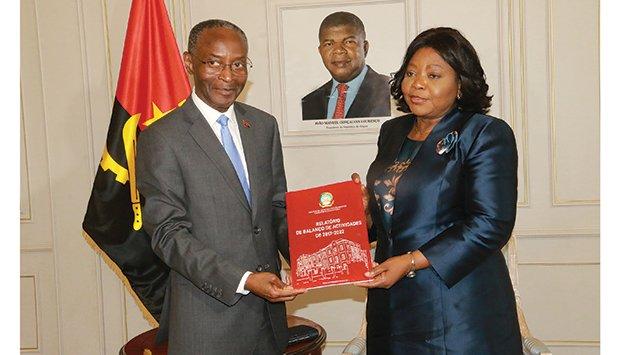
Africa-Press – Angola. The first woman to occupy the position of Vice-President of the Republic, auxiliary body of the Holder of the Executive Power, Esperança Maria Eduardo da Costa, has been working since Thursday (15) in the afternoon in Cidade Alta, after investiture in Praça da Costa. Republic, in Luanda.
Esperança Maria Eduardo da Costa, upon arrival, at the Office of Support Organs for the Vice-President of the Republic (OAVPR), was received by the outgoing Vice-President, Bornito de Sousa.
The two entities held a private meeting. In the end, the outgoing Vice-President, Bornito de Sousa, delivered the Balance Report on the Activities of the Support Bodies to the Vice-President of the Republic for 2017-2022 to the second figure in the State hierarchy, Esperança Maria Eduardo da Costa.
In addition to the delivery of the 2017-2022 OAVPR Activities Balance Report, the executive transition ceremony was also marked by the exchange of memories between them, in the various domains of social, academic and professional life.
The outgoing Vice-President presented some areas of work related to the OAVPR, with emphasis on the Gallery of Vice-Presidents of the Republic and the Project Room, also known as PMO – Project Management Office.
Esperança Maria Eduardo da Costa, second on the list headed by President João Lourenço, was elected Vice-President of the Republic for the 2022-2027 term by the MPLA party, declared the winner in the General Elections of 24 August, having obtained 51.17 percent of votes. With a PhD in Biology (Plant Ecology) and university professor, Esperança da Costa becomes the first woman in the gallery of Vice-Presidents of the Republic in the history of Angolan democracy.
Until the MPLA’s nomination to run as number two on the list for the national circle, Esperança da Costa held the position of Secretary of State for Fisheries at the Ministry of Agriculture and Fisheries.
Profile of the Vice President of the Republic
The new Vice-President of the Republic has a PhD in Phytoecology (Technical University of Lisbon, 1991-1997), a Master’s in Plant Productivity (Instituto Superior de Agronomia, Universidade Técnica de Lisboa – 1990-1992), a degree in Biology (Faculty of , Universidade Agostinho Neto – 1978-1985), in addition to having attended high school at Liceu D. Guiomar de Lencastre, Njinga Mbandi, in Luanda (1972-1978).
Since 2020 Secretary of State for Fisheries, Ministry of Agriculture and Fisheries. She was director of the Botany Center of Universidade Agostinho Neto (2010-2020), national director of the Expansion of Higher Education at the Ministry of Higher Education (2007-2010), vice-rector for the University Expansion of UAN (2002-2007), coordinated within the scope of its functions, the implementation of several higher education institutions in different provinces of the country and the establishment of five public universities.
Founder of the UAN Botany Center. Deputy Director of Scientific Affairs at UAN (1997-2002), national coordinator of the SADC Biodiversity Studies Network (SABONET), focal point for Southern Africa of the International Science Network (IFS), member of the BENEFIT Working Group, responsible for the training part of the cold stream of Benguela for Training, full professor at UAN.
She was, from 1986 to 1990, head of the Biology Department of the Faculty of Sciences, UAN, after having been between 1982 and 1986 monitor and head of the Herbariology Section of the Faculty of Sciences, UAN.
It is also worth mentioning in the “work sheet” of Esperança da Costa, from 2009 to 2012, that she was a consultant for Biodiversity at the United Nations Development Program, from 2008 to 2012 she was a consultant to the Minister of the Environment, between 1999 and 2012. 2005 consultant for the Ministry of Fisheries and Environment.
She also participated in relevant projects, namely coordinator of the master’s degree in Agronomy and Natural Resources at the Faculty of Agricultural Sciences, which operated in Huíla. Partnership UAN and Technical University, Lisbon. She participated in the coordination of the implementation of the Fisheries Academy, in Namibe, coordinator of the Creation of the Botany Center of the Faculty of Sciences.
On the other hand, she coordinated the Resettlement of the Faculty of Agrarian Sciences in Huambo, in addition to coordinating the Masters in Environmental Management and Governance at the Faculty of Sciences of the UAN – Partnership with the Faculty of Sciences of the University of Lisbon. She was also coordinator of the Escola Superior de Tecnologia do Namibe and the National Node of GBIF – International Platform for Biodiversity.
Member of the working group of the Benguela Cold Current Regional Commission. The curriculum also includes courses on Stock Analysis, Biomass of Fisheries Resources, Maspalomas, Spain; Management and Environmental Impact; SARIMA Course on Scientific Research, 2017.
It has some publications, with emphasis on Taxonomy of POACEAE in 2008; Endangered Plants in Angola in 2009; Medicinal Plants of Angola in 2013. He is President of the Executive Board of the Angolan Association of Biologists; member of the International Association on Environmental Impact, IAIA, United States; Member of the Lusitanian Association of Phytosociology, Lisbon; Adjunct Coordinator of the Installing Commission of the Order of Biologists.
The partisan biography stands out, among other functions, as the founder, in 2006, of the Specialty Committee of Ecologists and Environmentalists; coordinator of the Biodiversity Technical Group; CAP member number 2 Rangel.
Member of the MPLA Central Committee, member of the Monitoring Group of the Secretariat of the Political Bureau to the province of Huambo; coordinator of the OMA Monitoring Group for the province of Huambo; member of the MPLA Political Bureau; member of the Board of the Association for the Development of Communities of Angola (APDCA).
For More News And Analysis About Angola Follow Africa-Press